[pageLogInLogOut]

#Associations

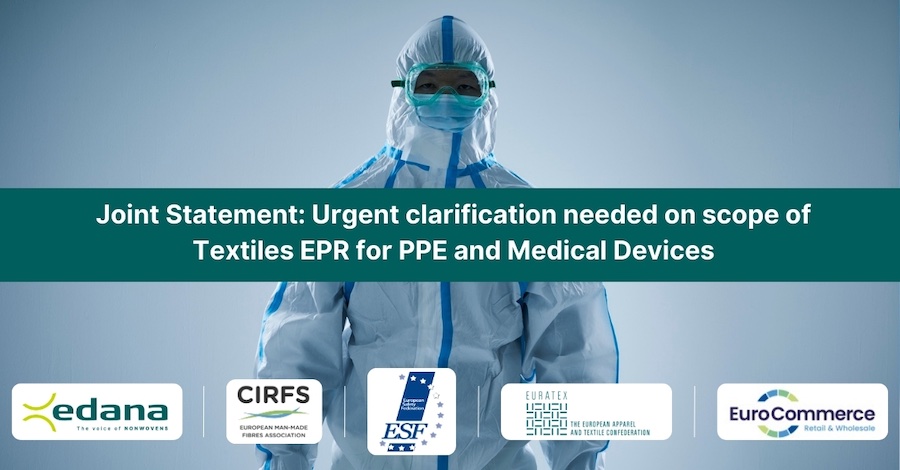
Joint Statement: Urgent clarification needed on scope of Textiles EPR for PPE and Medical Devices
© 2025 EDANA
EDANA, the voice of nonwovens, alongside fellow industry associations CIRFS (European Man-Made Fibres Association), EURATEX (The European Apparel and Textile Confederation), ESF (European Safety Federation), and EuroCommerce (Retail & Wholesale), has issued a joint statement raising critical concerns regarding the transposition of Directive (EU) 2025/1892, the targeted revision of the Waste Framework Directive.


As Member States begin implementing the Extended Producer Responsibility (EPR) for textiles, a lack of distinction within the Directive’s Annex IVc is causing confusion. Currently, the specified CN codes do not distinguish between standard apparel and essential Personal Protective Equipment (PPE) or Medical Devices (MD).

The joint statement highlights that PPE and Medical Devices are engineered to protect users from hazardous environments, including chemical, biological, and radiological risks. Consequently, these garments often become contaminated and are classified as hazardous waste, requiring incineration—often with energy recovery—rather than recycling, to ensure safety.

Including these products in standard textile EPR schemes poses significant risks:

  • Cross-Contamination: Mixing hazardous PPE waste with household textiles threatens human health and environmental safety.
  • Regulatory Conflict: Contaminated PPE disposal is already regulated under Articles 13, 17, 18, and 19 of the existing Waste Framework Directive.
  • Low Circularity Potential: PPE constitutes less than 1% of textile waste, with 80-90% treated as hazardous. The environmental benefit of recycling the remaining fraction is negligible compared to the transport required to aggregate sufficient volumes.

The statement also calls for guidance on safety shoes. Like other PPE, these items face contamination issues that limit recyclability. Furthermore, manufacturers cannot guarantee product warranties or conformity for reused safety footwear, and the fee scaling for heavy items (e.g., steel-toed boots) remains unclear.

Recital 28 of the Directive already suggests that products posing safety or hygiene risks should be excluded from the EPR. However, this is being overlooked in national implementations, such as in Spain and the Netherlands.

Therefore, the signatories urge the European Commission to issue clear guidance to Member States confirming that products complying with the PPE Regulation (2016/425) and the MD Regulation (2017/745) are outside the scope of the Textiles EPR.


More News from EDANA

#INDEX 2026

INDEX™26 Awards winners announced: Setting new benchmarks in nonwovens

The nonwovens industry has officially crowned its new winners. Today at the opening of INDEX™ 2026, five companies were honoured with the INDEX™ Awards, the industry’s highest accolade for technical excellence and forward-thinking design.

#Nonwovens

PET spunbond from China – EDANA welcomes imposition of provisional anti-dumping measures

On 13 May 2026, after eight months of investigation, the European Commission imposed provisional anti-dumping duties of 45.6-50.0% on imports of PET spunbond from China. EDANA welcomes this expression of the Commission’s clear determination to protect EU industries from the unfair trade practices of Chinese producers.

#INDEX 2026

INDEX™26: World’s leading nonwovens exhibition presents groundbreaking product launches, exclusive seminars and immersive experiences

From 19 to 22 May 2026, 620 exhibitors from 44 countries will gather in Geneva at Palexpo for INDEX™26. The exhibition aims to demonstrate how the future of technical materials will increasingly be shaped by collaborative supply chains and integrated innovation across the nonwovens industry. This year’s edition focuses not only on individual technological advances, but also on how cooperation throughout the value chain can enhance the performance, sustainability and value of nonwoven solutions.

#Nonwovens

2025 Nonwoven production in Greater Europe: European Nonwovens Industry remains strong amid challenging market conditions

EDANA, the international association serving the nonwovens and related industries, released today the European annual statistics for 2025, offering a comprehensive picture of the nonwovens industry in Greater Europe. This information shows an overview of the industry’s strength and resilience across the region. According to the figures collected and compiled by EDANA, overall nonwovens production in Europe declined by around 2.2% in 2025, reaching 2,919,000 tonnes.

More News on Associations

#Associations

Italian textile machinery sector faces weak start to 2026 despite domestic growth

In the first quarter of 2026, order intake for Italian textile machinery manufacturers recorded a decrease of 5% compared to the same period in 2025, reflecting a still challenging start to the year. The decline affected foreign markets (-7%), while the domestic market showed growth (+21%).

#Techtextil 2026

Young talents honoured – 60 years Walter Reiners Foundation

At the Techtextil trade fair in Frankfurt at the end of April, Peter D. Dornier, chairman of the VDMA’s Walter Reiners Foundation, presented awards to five successful young engineers. Promotion and sustainability awards were presented in the categories of bachelor’s/project theses and diploma/master’s theses. Academic theses are eligible for the sustainability awards if, for example, they develop solutions for resource-efficient products and technologies.

#Associations

BTMA backs global growth while investing in future UK leaders

As one of a number of new initiatives launched this year, the British Textile Machinery Association (BTMA) is launching the UK-India Textile Machinery Coalition. The UK-India Free Trade Agreement, signed in July 2025, has implications that extend across sourcing, competitiveness and long-term trade dynamics, believes BTMA CEO Jason Kent.

#Raw Materials

China projected to increase cotton production, yields, and imports in 2026/27

World cotton production in the 2026/27 season is projected at 25.9 million tonnes, exceeding global consumption of 25.2 million tonnes, according to the May 2026 issue of Cotton This Month. That means both production and consumption are expected to remain close to current season levels, while global cotton trade is projected to decline by 2.7% to approximately 9.6-9.7 million tonnes.

Latest News

#INDEX 2026

INDEX 2026: Reicofil introduces RF 5.10 upgrade boosting output by 10 percent

At INDEX 2026, Reifenhäuser Reicofil will present its latest developments for the nonwovens industry under the guiding themes “Grow Together”, “Expand Together” and “Transform Together”. On this occasion, the leading manufacturer of nonwoven machinery will be unveiling two brand-new technology advancements – RF 5.10 upgrade and RF Core – at the show.

#Recycled Fibers

Lindex and BASF partner to bring textile-­to­-textile recycled polyamide to lingerie sector

Lindex has partnered with BASF’s loopamid® to accelerate textile-­to-­textile recycling and advance the shift towards more circular material solutions in the fashion industry. Together they introduce loopamid to the lingerie sector.

#Dyeing, Drying, Finishing

Tradition and Innovation – Phoenox Textiles Ltd. relies on state-of-the-art carpet back-coating line from Brückner

For more than 70 years, Phoenox Textiles Ltd. has been synonymous with quality, reliability, and inno-vation in the textile industry. Founded in 1954 in Huddersfield (Yorkshire, UK), a region with a long tradition in textiles, this family-owned business has continued to evolve without losing sight of its roots. Today, in its fourth generation under the leadership of the Mosley family, Phoenox successfully combines decades of experience with a clear, forward-looking corporate strategy.

#ITM 2026

Uster FiberQ excels for recycled raw materials too

Uster FiberQ is a complete solution for raw material utilization, supporting spinners to achieve consistent quality and profitability every day, building further growth for the future. The Turkish company ORTA relies on FiberQ with recycled yarn for its denim production. Data-driven knowledge puts the producer in control of raw material utilization – ready to make the correct decisions for process efficiency, quality and productivity.

TOP