[pageLogInLogOut]

#Composites

JEC Composites Innovation Award 2025 for CO2-negative house walls in lightweight construction

At this year's JEC Composites Innovation Awards ceremony, the award in the "Construction & Civil Engineering" category went to the "DACCUSS" project, coordinated by the DITF. TechnoCarbon Technologies GbR, the inventor of Carbon Fiber Stone (CFS), received the JEC Award together with its development partners. The award is for the development of house walls made of Carbon Fiber Stone (CFS), a CO2 negative composite material.

Each year, the JEC Composites Innovation Awards recognize innovative and creative projects that demonstrate the full potential of composite materials. With the help of a development team from 12 companies and research institutions, TechnoCarbon Technologies GbR successfully submitted its innovative DACCUSS building element for house walls made of Carbon Fiber Stone.

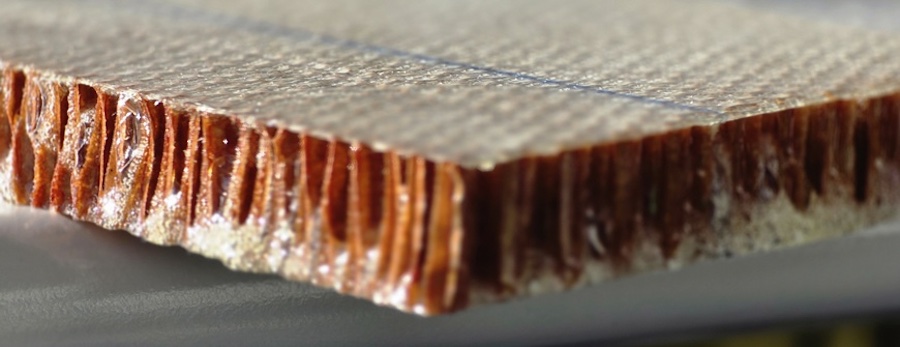
Carbon Fiber Stone is a building material made of natural rocks and bio-based carbon fibers. It serves as an environmentally friendly replacement for CO2-intensive concrete in the construction industry. While conventional concrete walls release large amounts of CO2 during production, the DACCUS building element binds 59 kg of CO2 per square meter and therefore has a negative carbon footprint. In addition, the panels weigh only one-third of equivalent reinforced concrete house walls.
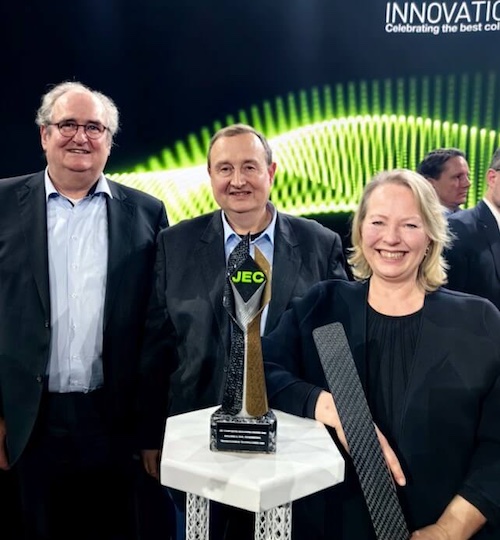
(from left) Kolja Kuse (TechnoCarbon), Dr. Erik Frank (DITF), Britta Waschl (e5)  Photo: © 2025  DACCUS-Team
(from left) Kolja Kuse (TechnoCarbon), Dr. Erik Frank (DITF), Britta Waschl (e5) Photo: © 2025 DACCUS-Team


Each DACCUS element consists of several high-strength natural stone slabs made from magmatic rock. Inside the construction are bio-based carbon fibers, which the DITF Denkendorf is working intensively to develop. They form the stiffening element that enables the high strength of the construction elements and, in turn, contribute to the negative CO2 balance. The layer between the natural rock slabs is filled with carbon-negative biochar granulate, which is responsible for the insulation of the building element. The mineral sawdust from the cut rock slabs can be used as a soil amendment and serves as a binder for free CO2 from the atmosphere. The strict focus on processes and materials that actively bind CO2 has made it possible to produce a building material with a negative CO2 balance.

Partners: Deutsche Institute für Textil- und Faserforschung Denkendorf (DITF), TechnoCarbon Technologies GbR, Universität Hamburg (UHH), Labor für Stahl- und Leichtmetallbau GmbH (LSL), AHP GmbH & Co. KG, Technische Universität München (TUM), GVU mbH, Silicon Kingdom Holding Ltd., Gallehr Sustainable Risk Management GmbH, Peer Technologies GmbH & Co. KG, GREIN srl, Convoris Group GmbH, RecyCoal GmbH, ITA, Institut für Textiltechnik der RWTH Aachen, LISD GmbH.
More News from Deutsche Institute für Textil- und Faserforschung Denkendorf

#Research & Development

More safety and comfort for protective clothing thanks to auxetic fabrics

When everyday materials are pulled, they stretch or elongate in the direction of the pull and become narrower in cross-section. We can also observe this property in two-dimensional textiles. Auxetic structures behave differently here. They have the striking property of not changing under tensile stress or even increasing their width or thickness. These properties are advantageous, for example, in protective textiles or textile filter media. The DITF are researching auxetic fabrics for various applications.

#Research & Development

Panty liners prevent bacterial vaginosis

Worldwide, almost one third of women of childbearing age suffer from bacterial vaginosis. This is when the sensitive microbiome of the vagina becomes unbalanced. Such a disorder of the vaginal flora can cause urogenital infections, abscesses on the ovaries or fallopian tubes or premature births. This significantly increases the risk of infertility in women and of contracting a sexually transmitted disease or HIV.

#Research & Development

DITF send a signal for climate protection

The German Institutes of Textile and Fiber Research Denkendorf (DITF) have successfully implemented extensive investments in photovoltaic systems at their site in Denkendorf. The systems installed on the roofs of the buildings and covered parking lots have a total installed capacity of 840 kilowatt peak (kWp). The DITF invested 1.6 million euros in this with the support of the state of Baden-Württemberg. The system was ceremonially put into operation on September 17, 2025.

#Research & Development

4.2 million Euros for research into textile recycling

Around the world, used textiles are still rarely recycled and pile up into huge mountains of waste. A recent study by the Boston Consulting Group (BCG) drew attention to this problem. However, the low recycling rate is also due to the fact that only a small percentage of used textiles are actually suitable for recycling into high-quality materials and for demanding applications. The German Institutes of Textile and Fiber Research Denkendorf (DITF) are addressing this problem with their research.

More News on Composites

Latest News

#Recycling / Circular Economy

Circulose restarts commercial-scale production at Ortviken plant in Sundsvall

Circulose today announced the restart of its commercial-scale production plant at Ortviken in Sundsvall, Sweden, marking a significant step in scaling next-generation materials for the global fashion industry. The company plans to resume production of CIRCULOSE®, a recycled pulp made entirely from discarded cotton textiles, in the fourth quarter of 2026.

#Textiles & Apparel / Garment

VIATT 2026 to debut German Pavilion, strengthening European participation alongside key Asian textile hubs

Vietnam’s textile and garment sector continues to be a major contributor to the country’s economic growth, with export revenues expected to reach USD 46 billion in 2025, a 5.6% increase from 2024 . From 26 – 28 February, the Vietnam International Trade Fair for Apparel, Textiles and Textile Technologies (VIATT) is set to contribute to economic growth opportunities by accelerating digital transformation and green transition across the entire textile value chain. The upcoming edition will respond to the rising demand for advanced technologies and sustainable materials with the introduction of the German Pavilion, alongside strong exhibitor participation from key Asian sectors, as well as several high-profile fringe events.

#Sustainability

Ying McGuire becomes new CEO of Cascale

Cascale today announced the appointment of Ying McGuire as Chief Executive Officer, effective June 1, 2026.

#Technical Textiles

Sustainable, lightweight, and sound absorbing: Polyester-based front trunk solution for BEVs

As car manufacturers look to further reduce their carbon footprint, Autoneum has developed an innovative front trunk solution for battery electric vehicles (BEVs), made entirely from polyester-based textile. The Ultra-Silent Frunk offers significant weight reduction, improved acoustic and thermal insulation, and uses up to 70 percent recycled material, supporting sustainable and efficient vehicle design. Autoneum, global technology leader in acoustic and thermal management for vehicles, has already received orders for the new frunk from three major OEMs in Asia and Europe to be built in three BEV models. Series production for two BEVs has been underway in China and Germany since last year.

TOP