[pageLogInLogOut]

#Natural Fibers

Decreasing production and the critical role of traceability

Cotton production estimates have decreased significantly since last month, dropping from 25.9 million tonnes to 25.5 million tonnes, while shifts in trade patterns and demands from retailers and brands are making cotton's origin increasingly important.

The decrease in production is largely coming from three countries: the United States (-400,000 tonnes), Pakistan (-100,000 tonnes), and Sudan (-50,000 tonnes). Water shortages and unusually dry weather are the issues for the US and Pakistan, while Sudan's crop damage is the result of pest infestations.

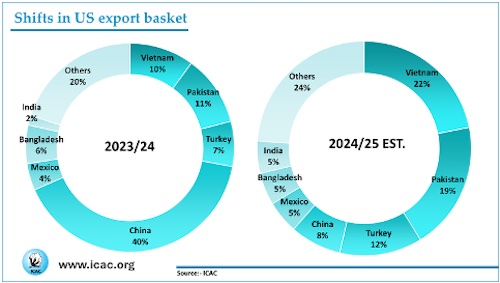
Although consumption and trade numbers are largely unchanged from last month, import and export partners are shifting. China accounted for 40% of US cotton exports in 2023/24, but that number has dropped to 8% as the US has increased its trade with Vietnam, Pakistan, Turkey, and India. Those changes — combined with a US executive order that allows products made from US raw materials to be exempted from import tariffs — mean textile manufacturers must provide traceability. Retailers and brands are increasingly demanding traceability as well.
© 2025 ICAC
© 2025 ICAC


There are two other notable developments since last month:

+ India’s levels of cotton lint imports increased by nearly 3.3 times in 2024/25 compared to the prior season.

+ Bangladesh and India are expected to increase their US imports.


ICAC data rectification process

The ICAC Secretariat is undertaking data rectification work, during which we will perform data adjustments for all our reported regions and countries. ICAC is the primary source for all of our statistical data. For this month, changes to cotton market variables have been made for Ethiopia from 2014/15 to the present, and the projected season. The data has been updated using information from the Ethiopian Cotton Organization, Ethiopia Revenue and Customs Service, and the Trade Data Monitor.

ICAC’s Statistical Data Portal

For the most current statistics, please refer to the ICAC’s Statistics Portal. It is updated with new data constantly, and that new information is immediately reflected in the Portal, making it a valuable resource all month long.

ICAC’s Price Projections

The Secretariat’s current price forecast for the 2025/26 season, based on current supply and demand estimates, ranges from 60 to 96 cents per pound, with a midpoint of 76 cents per pound. ICAC’s price projections are made by Ms Lorena Ruiz, ICAC Economist.
More News from International Cotton Advisory Committee (ICAC)

#Raw Materials

China projected to increase cotton production, yields, and imports in 2026/27

World cotton production in the 2026/27 season is projected at 25.9 million tonnes, exceeding global consumption of 25.2 million tonnes, according to the May 2026 issue of Cotton This Month. That means both production and consumption are expected to remain close to current season levels, while global cotton trade is projected to decline by 2.7% to approximately 9.6-9.7 million tonnes.

#Raw Materials

ICAC launches Carbon Credits Initiative to deliver new income streams to cotton farmers

The International Cotton Advisory Committee (ICAC) has announced a new initiative designed to unlock additional income streams for cotton farmers through participation in carbon credit markets, linking sustainable production practices directly to financial returns.

#Raw Materials

Global production expected to decline in 2026/27 as policy shifts and weak demand reshape trade

Early projections for the 2026/27 season indicate that global cotton lint production will decline by 4% to 24.9 million tonnes, while world consumption is expected to remain stable at approximately 25 million tonnes, according to the April 2026 issue of Cotton This Month.

#Raw Materials

The 83rd Plenary Meeting: Reports from the ICAC Secretariat

Every year, one of the most anticipated sessions at the International Cotton Advisory Committee's (ICAC) Plenary Meeting is the Reports from the Secretariat — and the 83rd edition in Bremen, Germany, did not disappoint.

More News on Natural Fibers

#Yarns

From advanced fibres to eco‑focused yarns: Yarn Expo Autumn 2026 set to welcome global industry to Shanghai

From 25 – 27 August, Yarn Expo Autumn 2026 will return to the National Exhibition and Convention Center (Shanghai) to reinforce its role as a key meeting point for the global yarn and fibre industry. With over 22,000 visitors, the previous edition gathered nearly 580 leading exhibitors from 16 countries and regions, showcasing advanced developments and creative applications that support innovative, sustainable textile design. The upcoming edition will not only present an extensive range of fibre and yarn products, but will also feature a comprehensive fringe programme, including industry forums and trend display areas, providing innovative upstream enterprises with a stage to introduce next‑generation materials and sustainable concepts.

#Research & Development

Regional hemp bast for lightweight construction profiles

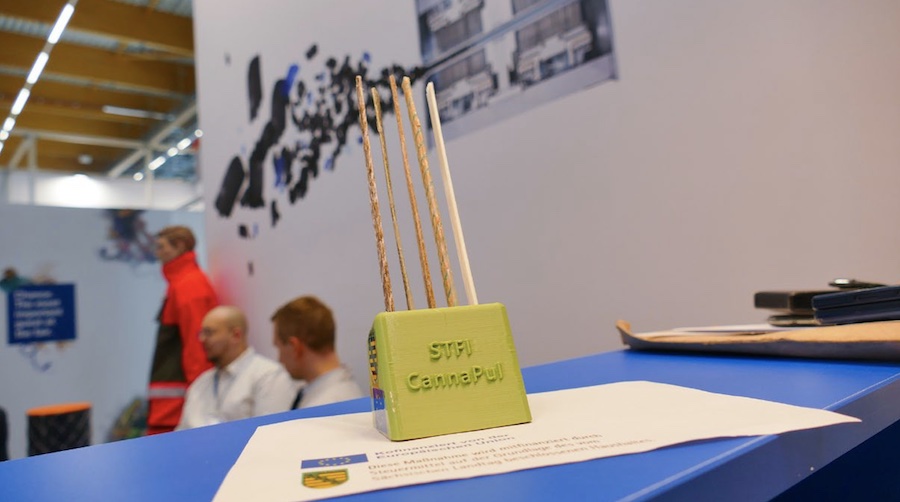
The cultivation of fibre hemp for the production of ropes and clothing has a long tradition in Saxony. Due to its excellent fibre properties, it is also suitable as a renewable raw material for reinforcement in fibre composites. At the STFI and IWU in Chemnitz, the CannaPul project is cur- rently investigating how a regional value chain for hemp-based lightweight construction profiles can be established. To this end, the technical processing of hemp fibres into continuous fibre strands and their embedding in a suitable bio-based matrix are being investigated.

#Raw Materials

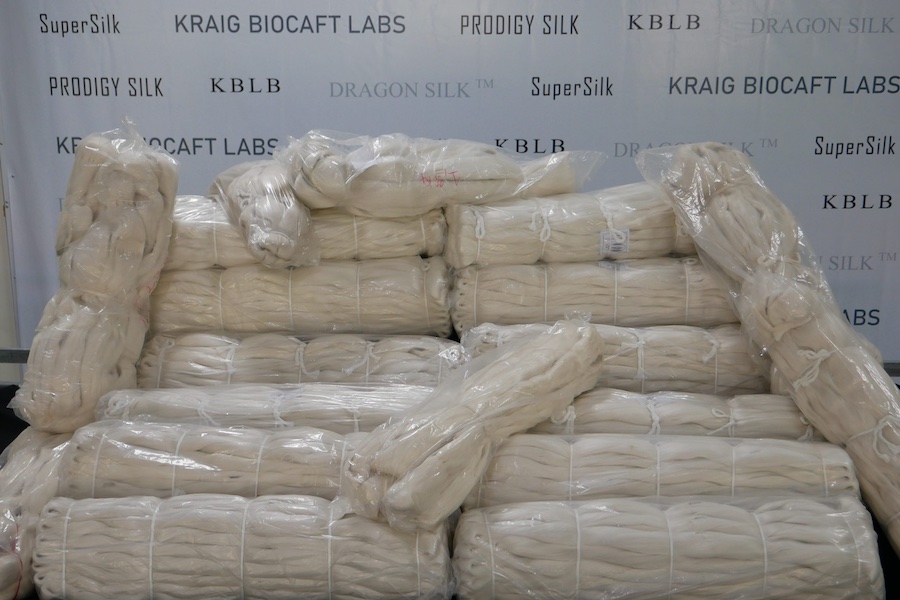
Kraig Biocraft Laboratories reports major progress converting record-setting spider silk cocoon production into reeled silk

Kraig Biocraft Laboratories, Inc. (OTCQB: KBLB) (“the Company”, “Kraig Labs”, or “Kraig’s”), a world leader in spider silk technology*, today announced significant progress in the processing of its recently produced recombinant spider silk cocoons into reeled silk.

#Raw Materials

Fiber traceability - A vehicle to ensure sustainability or injustice?

The Bremen Cotton Exchange is making a new paper available for download. In this paper, analyst Veronica Bates Kassatly and statistician Terry Townsend examine the justifications behind this approach and assess the consequences for textile and apparel sustainability claims and global legislation.

Latest News

#INDEX 2026

INDEX 2026: Reicofil introduces RF 5.10 upgrade boosting output by 10 percent

At INDEX 2026, Reifenhäuser Reicofil will present its latest developments for the nonwovens industry under the guiding themes “Grow Together”, “Expand Together” and “Transform Together”. On this occasion, the leading manufacturer of nonwoven machinery will be unveiling two brand-new technology advancements – RF 5.10 upgrade and RF Core – at the show.

#Recycled Fibers

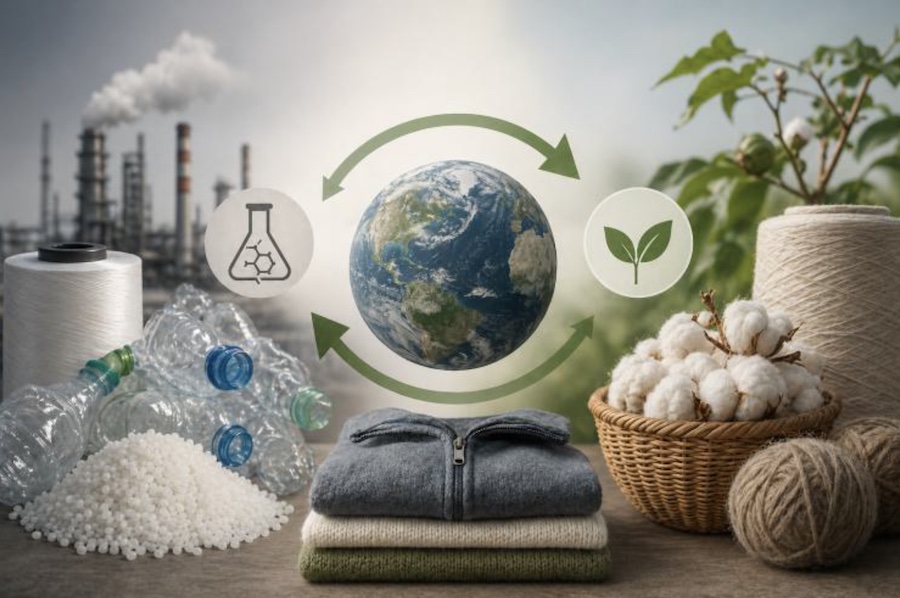
Lindex and BASF partner to bring textile-­to­-textile recycled polyamide to lingerie sector

Lindex has partnered with BASF’s loopamid® to accelerate textile-­to-­textile recycling and advance the shift towards more circular material solutions in the fashion industry. Together they introduce loopamid to the lingerie sector.

#Dyeing, Drying, Finishing

Tradition and Innovation – Phoenox Textiles Ltd. relies on state-of-the-art carpet back-coating line from Brückner

For more than 70 years, Phoenox Textiles Ltd. has been synonymous with quality, reliability, and inno-vation in the textile industry. Founded in 1954 in Huddersfield (Yorkshire, UK), a region with a long tradition in textiles, this family-owned business has continued to evolve without losing sight of its roots. Today, in its fourth generation under the leadership of the Mosley family, Phoenox successfully combines decades of experience with a clear, forward-looking corporate strategy.

#ITM 2026

Uster FiberQ excels for recycled raw materials too

Uster FiberQ is a complete solution for raw material utilization, supporting spinners to achieve consistent quality and profitability every day, building further growth for the future. The Turkish company ORTA relies on FiberQ with recycled yarn for its denim production. Data-driven knowledge puts the producer in control of raw material utilization – ready to make the correct decisions for process efficiency, quality and productivity.

TOP