[pageLogInLogOut]

#Raw Materials

Global cotton production projected to outpace consumption, but risks remain

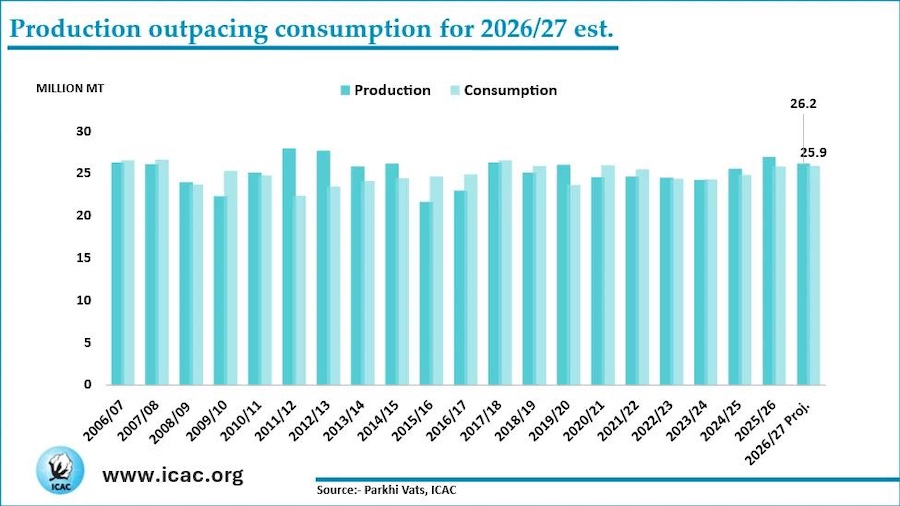
Global cotton production is projected to reach 26.2 million tonnes in the 2026/27 season, marginally outpacing estimated consumption of 25.9 million tonnes. However, early-season production risks — including weather volatility and pest pressures — could narrow that buffer as the crop progresses, according to the September 2026 issue of Cotton This Month, published by the International Cotton Advisory Committee (ICAC).


Historically, global production estimates decline by approximately 100,000 tonnes from initial projections as crop conditions clarify. Assuming normal seasonal developments, ICAC projects that 2026/27 production will likely ease toward 26.0-26.1 million tonnes, with steeper declines possible if major weather disruptions or pest outbreaks emerge.
© 2026 ICAC
© 2026 ICAC


Key Regional Highlights

China: Ongoing sales from state reserves, which began July 20 and have averaged roughly 8,000 tonnes per auction, are improving near-term domestic availability. However, eventual reserve replenishment — alongside potential weather risks in Xinjiang — could lead ICAC to revise China’s import demand upward later this season.

India: Upward revisions bring estimated 2025/26 production to 5.5 million tonnes (+9%) and consumption to nearly 5.9 million tonnes (+7%), driven by strong domestic mill demand and textile export growth. Long-term stability is being bolstered by the government’s five-year Cotton Mission and digital initiatives like the Kapas Kisan app (enrolling over 4.1 million farmers) and Kasturi Cotton Bharat's blockchain traceability framework.

Pakistan: Production remains constrained by climate variability, pest infestations, poor seed quality, and high input costs. Output is estimated at 1.15 million tonnes in 2025/26 (-4%) and projected to fall further to 1.10 million tonnes in 2026/27, expanding reliance on raw cotton imports.

United States: Planted area is revised upward to 3.3 million hectares (+5%), raising projected 2026/27 output to 2.9 million tonnes. Additionally, newly implemented US Section 301 tariffs (10% to 12.5%) are altering global trade flows; key manufacturing hubs like Vietnam may face a cost disadvantage, prompting buyers to reassess sourcing strategies.

Price Projections

The ICAC Secretariat forecasts the 2026/27 Cotlook A Index price to range between 62 and 99 cents per pound, with a midpoint of 78 cents per pound.

The author of Cotton This Month is Parkhi Vats, Principal Statistician & Data Architect at ICAC.

The next issue of Cotton This Month will be released on October 1, 2026. Real-time statistical updates are available continuously via the ICAC Data Portal.

ICAC Data Portal


More News from International Cotton Advisory Committee (ICAC)

#Raw Materials

Redesigned World Cotton Day website offers tools, ideas and inspiration

With World Cotton Day just one month away, the International Cotton Advisory Committee (ICAC) has launched a completely redesigned www.WorldCottonDay.com, creating a new global home for everyone who wants to learn about, celebrate, and support cotton.

#Raw Materials

ICAC’s 84th Plenary Meeting to be held March 24-26, 2027, in Alexandria, Egypt

Registration will soon be open for the International Cotton Advisory Committee’s 84th Plenary Meeting, to be held March 24-26, 2027, in Alexandria, Egypt. The local Organizing Committee in Egypt has chosen “Building a Resilient and Competitive Future for Cotton and Textiles” as the theme for the event, which will be held at the Rixos Montaza Alexandria Resort.

#Natural Fibers

Global garment trade nears USD 550 billion as competition intensifies

The global garment industry has undergone a dramatic transformation over the past two decades, with knit and woven garments together accounting for nearly 60% of world textile exports in 2025, according to the August 2026 issue of The Textiles Observer, a free publication from the International Cotton Advisory Committee (ICAC).

#Raw Materials

ICAC International Seminar in Taipei to explore strategic synergies across the textile supply chain

The International Cotton Advisory Committee (ICAC) — together with the Taiwan Textile Federation (TTF), under the guidance of the Ministry of Economic Affairs and the Ministry of Foreign Affairs of Taiwan — will bring international cotton and textile leaders together in Taipei on September 10 for the ICAC International Seminar 2026.

More News on Raw Materials

#Raw Materials

ALLIED expands down traceability with lot-level carbon footprint data

ALLIED Feather + Down has expanded its TrackMyDown traceability platform to include validated cradle-to-gate carbon footprint data linked to individual down lots. The initiative is designed to provide brands and consumers with more detailed environmental information on the materials used in finished products and could also support future data requirements associated with Digital Product Passports.

#Raw Materials

Cotton made in Africa puts farmer dialogue at the heart of agricultural training

A new manual created by the Aid by Trade Foundation and African People & Wildlife shows how Cotton made in Africa aims to transform cotton cultivation through dialogue rather than directives.

#Raw Materials

Cotton Brazil Dialogues 2026 concludes with 50 international participants immersed in Brazilian cotton production

The Cotton Brazil Dialogues concludes its 2026 edition after a series of technical visits to farms, cotton gins and reference centers, as well as workshops focused on Brazilian cotton production. A total of 50 participants from 14 countries took part in the field trips. The initiative is led by the Brazilian Association of Cotton Growers (Abrapa) and the National Association of Cotton Exporters (Anea), with support from the Brazilian Trade and Investment Promotion Agency (ApexBrasil).

#Raw Materials

Brazil sets new cotton export record and consolidates global leadership

Brazil ended the 2025/26 commercial year with a new record, consolidating its position as the world’s largest cotton exporter. Between August 2025 and July 2026, the country shipped 3,373,941 tonnes of the fiber, 19% more than in the previous cycle, and reached record revenue of US$5.3 billion. The result represents a milestone in Brazil’s expansion in the international market and reinforces the country’s role as a strategic supplier to the global textile industry.

Latest News

#Knitting & Hosiery

KARL MAYER invites the Global Textile Industry to celebrate its 90th anniversary at its German Headquarters in 2027

KARL MAYER is turning its anniversary year 2027 into a milestone for the textile sector. To mark its 90th anniversary, the industry leader is inviting customers, partners, and experts from around the world to a unique event series in September aimed at pushing boundaries, unlocking new opportunities, and jointly setting the course for a new era in textiles – just as KARL MAYER has done throughout its history. The company’s headquarters in Obertshausen, near Frankfurt, is the place to be.

#Associations

ITMF names three winners of the Sustainability & Innovation Award 2026

Three projects from the UK, Korea and China have been selected as winners of the ITMF Sustainability & Innovation Award 2026. The projects address textile-to-textile recycling, chemical recycling for automotive textiles and a regenerative approach combining silk production with ecological restoration.

#Recycling / Circular Economy

nova-Institute launches groundbreaking Advanced Recycling Database for strategic market insight

The new Advanced Recycling Database reduces complexity by providing industry stakeholders with up-to-date expert-reviewed intelligence on companies, technologies, plants, capacities, locations, products and partnerships across the global advanced recycling landscape.

#Yarns

Durak Maxibalance thread supports users’ movement and balance comfort

Durak Tekstil, a leading brand in its industry, has developed Durak Maxibalance, a new product engineered with bio-ceramic and FAR IR technology. Ushering in a new era for sportswear, activewear, and medical textiles, this technology offers features designed to support balance and movement comfort by reflecting the energy absorbed from the body back into it.

TOP