[pageLogInLogOut]

#Retail & Brands

PUMA’s materials strategy receives top marks in the Material Change Index by Textile Exchange

Sports company PUMA has received the highest recognition for its materials strategy in the Material Change Index compiled by global non-profit organization Textile Exchange.
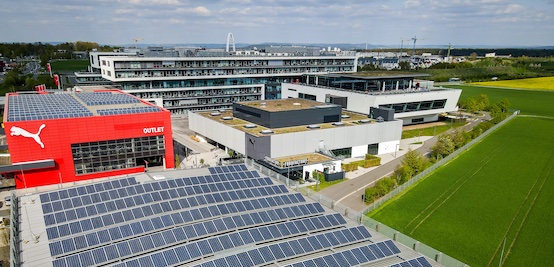
PUMA Headquarters Germany Herzogenaurach (Photo: Business Wire)


“We know how important our choice of product materials is, when we want to reduce our carbon footprint and lessen our environmental impact”

Out of hundreds of companies examined, PUMA was amongst 11 in 2024 to be ranked in the fourth and highest “Leading” tier. Companies with this distinction showed an integrated materials strategy aligned with global goals, disclosed climate goals and targets and made progress towards a circular use of materials, Textile Exchange said. This year’s result is one step up from PUMA’s inclusion in the second-highest “Scaling” tier in 2023.

“We know how important our choice of product materials is, when we want to reduce our carbon footprint and lessen our environmental impact,” said Anne Laure Descours, PUMA’s Chief Sourcing Officer. “We are very happy to be ranked as ‘Leading’ in this years’ index and we will take it as an opportunity to further strengthen our materials strategy.”

PUMA has a 2025 target of making 9 out of 10 products with materials that are classified as preferred fibres by Textile Exchange or which originate from certified sources. In 2023, this was already the case for 8 out of 10 products. In 2023, 99.7% of all leather was sourced from Leather Working Group-certified tanneries and 99.2% of all cotton was certified or recycled as was 99.4% of all paper and cardboard packaging.

Almost 65% of the polyester used for PUMA’s apparel and accessories in 2023 came from recycled materials and the company also started to scale up the use of recycled cotton. In 2024 PUMA announced that millions of football jerseys had been made with textile waste through its RE:FIBRE recycling initiative.

The Material Change Index is the largest peer-to-peer comparison initiative in the industry and aims to help track the sector’s progress in fibre and materials sourcing, strategy and the circular transition. The aim of the organization is to help the fashion industry achieve a 45% reduction in greenhouse gases from raw material production by 2030.


More News from PUMA

More News on Retail & Brands

#Recycling / Circular Economy

Recover™ secures multi-year recycled cotton agreement with H&M

Recover™ has signed a multi-year agreement with H&M to support the integration of its recycled cotton fiber, RCotton, for use in H&M’s products. Since early 2024, H&M and Recover™ have collaborated on product development, which now enables scaled commercial introduction of Recover™ mechanically recycled cotton into H&M’s collections.

#Sustainability

GORE-TEX® KIDSWEAR launches innovative membership scheme for kids’ jackets

With its revolutionary new membership model, GORE-TEX® Kidswear now offers families a simple, flexible and sustainable way of kitting out their children in top-quality jackets. It is aimed at the parents of children aged between five and ten and kicks off with a choice of functional winter jackets.

#Sustainability

H&M Foundation funds pioneering initiative to build the factories of the future

The H&M Foundation is committing SEK 53 million (approx. EUR 5 million) towards Future Forward Factories, a five-year initiative led by Fashion for Good, to address fashion’s most polluting stage: tier 2 textile processing.

#Natural Fibers

Better Cotton Initiative marks World Cotton Day with launch of innovative product label

The Better Cotton Initiative (BCI) has launched an innovative product label for the fashion and textile sectors which allows retailer and brand members to provide consumers with greater clarity about the origin and percentage of BCI Cotton in their products.

Latest News

#Recycling / Circular Economy

Circulose restarts commercial-scale production at Ortviken plant in Sundsvall

Circulose today announced the restart of its commercial-scale production plant at Ortviken in Sundsvall, Sweden, marking a significant step in scaling next-generation materials for the global fashion industry. The company plans to resume production of CIRCULOSE®, a recycled pulp made entirely from discarded cotton textiles, in the fourth quarter of 2026.

#Textiles & Apparel / Garment

VIATT 2026 to debut German Pavilion, strengthening European participation alongside key Asian textile hubs

Vietnam’s textile and garment sector continues to be a major contributor to the country’s economic growth, with export revenues expected to reach USD 46 billion in 2025, a 5.6% increase from 2024 . From 26 – 28 February, the Vietnam International Trade Fair for Apparel, Textiles and Textile Technologies (VIATT) is set to contribute to economic growth opportunities by accelerating digital transformation and green transition across the entire textile value chain. The upcoming edition will respond to the rising demand for advanced technologies and sustainable materials with the introduction of the German Pavilion, alongside strong exhibitor participation from key Asian sectors, as well as several high-profile fringe events.

#Sustainability

Ying McGuire becomes new CEO of Cascale

Cascale today announced the appointment of Ying McGuire as Chief Executive Officer, effective June 1, 2026.

#Technical Textiles

Sustainable, lightweight, and sound absorbing: Polyester-based front trunk solution for BEVs

As car manufacturers look to further reduce their carbon footprint, Autoneum has developed an innovative front trunk solution for battery electric vehicles (BEVs), made entirely from polyester-based textile. The Ultra-Silent Frunk offers significant weight reduction, improved acoustic and thermal insulation, and uses up to 70 percent recycled material, supporting sustainable and efficient vehicle design. Autoneum, global technology leader in acoustic and thermal management for vehicles, has already received orders for the new frunk from three major OEMs in Asia and Europe to be built in three BEV models. Series production for two BEVs has been underway in China and Germany since last year.

TOP