[pageLogInLogOut]

#Textile chemistry

How to defossilise the chemical industry: RCI’s new policy proposals for a renewable carbon future

A new report presents policy proposals to facilitate the transition from fossil carbon to renewable carbon from biomass, CO2 and recycling in Europe.

The European chemical industry, a cornerstone of manufacturing with significant economic impact and a key enabler for many other industries, is at a crossroads. The sector is facing an acute crisis due to global competition, rising energy costs and regulatory burdens. Once a leader in patents and production, Europe now trails behind China and the US, reflecting signs of declining competitiveness. The sector’s heavy reliance on fossil fuels for raw materials (over 90%) exacerbates its challenges, creating dependencies and limiting control over its carbon footprint at a time when Europe is grappling with the need for a green transition to ensure long-term prosperity and competitiveness. As a result, there are clear signs of ongoing deindustrialisation in the EU chemical industry. 

Amidst these challenges lies an opportunity: Defossilising Europe’s chemical sector by transitioning to renewable carbon sources such as biomass, carbon capture and utilisation (CCU) and recycling. This shift is not merely an environmental necessity, but a strategic move to enhance Europe’s industrial competitiveness and resilience in the global marketplace. However, progress is hampered by regulatory barriers, the slow expansion of renewable energy, insufficient demand for sustainable products and limited uptake of new technologies.

To address these barriers, the Renewable Carbon Initiative (RCI) has released a comprehensive report outlining ten policy proposals designed to accelerate the transition to renewable carbon in feedstocks and materials. Developed in collaboration with experts from nova-Institute and RCI members, these proposals aim to bridge the gap between innovation and large-scale implementation. 

A vision for defossilisation: Driving change through targeted policies

The defossilisation of Europe’s chemical industry requires not only a clear commitment to defossilisation but also an actionable policy framework that supports, guides and incentivises the transition to renewable carbon. At the heart of this vision is an overarching commitment to defossilisation – a high-level agreement that establishes the foundation on which all future European policies can build upon. To create concrete market demand for sustainable products from renewable carbon, mandatory targets for the use of renewable carbon in chemicals and materials should be implemented. This can either be achieved by novel regulation or adaptation of existing regulations such as the Packaging and Packaging Waste Regulation (PPWR), the End-of-Life of Vehicles Regulation (ELVR) or the Ecodesign for Sustainable Products Regulation (ESPR) – and an adaptation of the EU Emission Trading System (ETS) or an alternative European Carbon Utilisation Trading System (CUTS).

To make the transition to renewable carbon a reality, EU policy further needs to enable sustainable access to renewable carbon feedstocks while ensuring competitiveness at both global and sectoral levels. To achieve this, RCI’s policy proposals include concrete suggestions to facilitate access to more waste as a feedstock, secure local access to biomass from agriculture, forestry and carbon capture, lead the way on international trade of renewable carbon feedstocks, balance regulation between energy and material uses to maximise synergies and ramp up availability of affordable renewable energy e.g. by favourable conditions for alignment with defossilisation targets. 
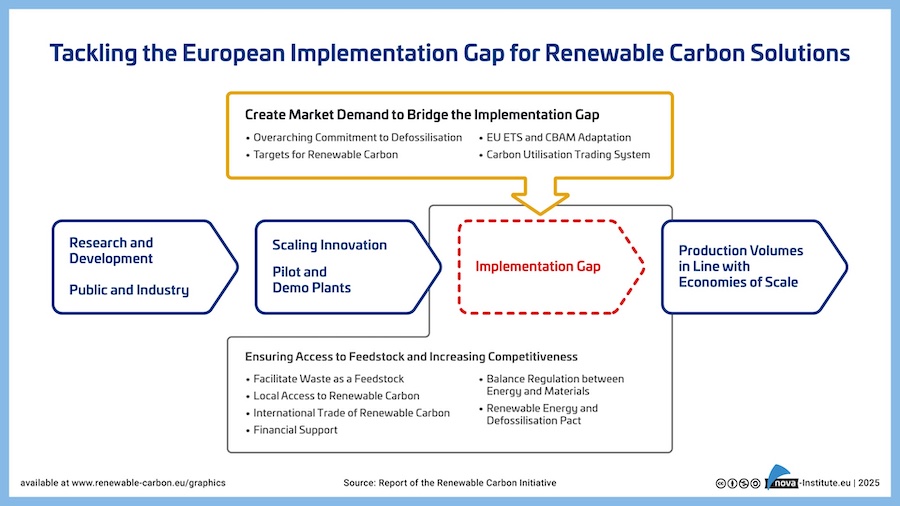
A new report by the Renewable Carbon Initiative outlines 10 concrete policy proposals to facilitate the transition of Europe’s chemical industry to renewable carbon. These proposals are aimed to support the target of a clean, but competitive chemical industry in Europe with increased resilience and lower fossil dependence. © nova-Institute


A new report by the Renewable Carbon Initiative outlines 10 concrete policy proposals to facilitate the transition of Europe’s chemical industry to renewable carbon. These proposals are aimed to support the target of a clean, but competitive chemical industry in Europe with increased resilience and lower fossil dependence. © nova-Institute

Addressing the implementation gap to unleash innovation

The transition to renewable carbon is not just about environmental sustainability; it is about securing Europe’s industrial future and maintaining its global competitiveness in a rapidly changing world. By pioneering renewable carbon technologies, the EU can unlock economic benefits and unleash its innovation potential while advancing climate neutrality ambitions. 

Addressing defossilisation and supporting the transition to renewable carbon will provide a comprehensive and reliable framework for the transformation of the chemicals and materials sector – in particular addressing the implementation gap from innovation to scaled product.

As highlighted by the EU Competitiveness Compass: “To shift the economy towards clean production and circularity, the EU needs to develop lead markets and policies to reward early movers.” The RCI’s policy proposals are in line with this vision by addressing key challenges and providing actionable solutions.

More News from nova-Institut für politische und ökologische Innovation GmbH

#Recycling / Circular Economy

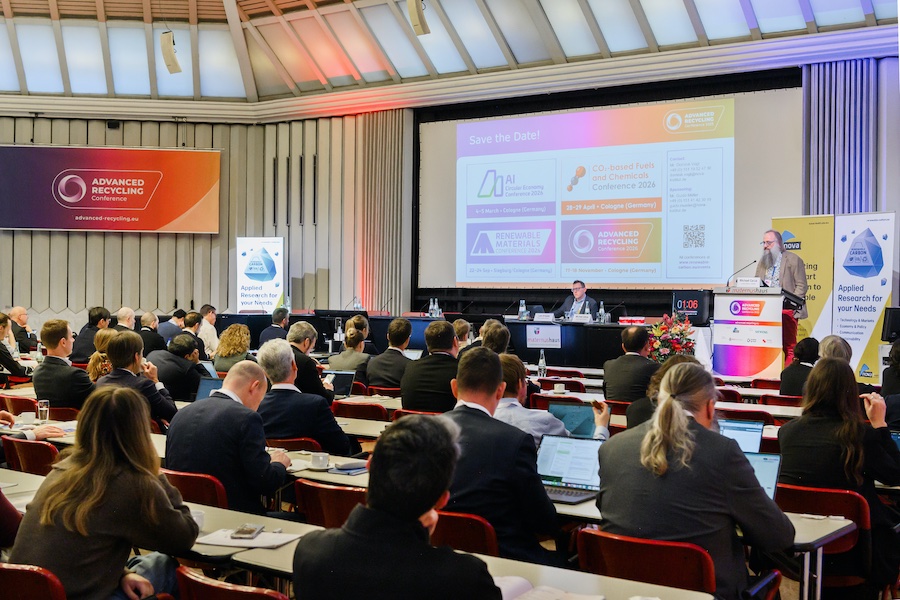
Advanced Recycling Conference 2025 fuels innovation across key waste streams

The Advanced Recycling Conference (ARC) 2025 brought together nearly 220 experts from 28 countries to spotlight pioneering advancements and foster industry collaboration in recycling across diverse waste streams including plastics, textiles, automotive and other materials.

#Recycling / Circular Economy

Advanced Recycling Conference 2025: From industry crossroads to circularity

Alongside core-topics like plastics and polymer recycling, this year’s program explores new developments in biochemical, textile and automotive recycling, plus digital tools supporting scalable solutions for circular systems.

#Recycling / Circular Economy

Advanced Recycling Conference 2025 – Shaping the future of the circular economy

Closing the loop by setting the stage for recycling innovation at Europe’s largest event on advanced recycling technologies. Call for abstracts is now open.

#Research & Development

Joint forces for renewable carbon: Lars Börger appointed as new CEO of nova-Institute

In these challenging times for the sustainable transformation of the chemicals and materials sector, collaboration is more necessary than ever. That is why nova-Institute is proud to welcome Dr. Lars Börger as the new Co-CEO alongside with Michael Carus, the current CEO of nova-Institute. As a team, they will join forces to drive progress towards a greener and fossil-free future for these industries.

More News on Textile chemistry

#Textile chemistry

RUDOLF gets the exclusive global distribution rights for Sanitized® textile technologies

With effect from today, RUDOLF officially assumes exclusive global distribution rights for Sanitized® textile technologies from SANITIZED AG. This is the next milestone in the strategic collaboration announced in 2025, with the partnership between the two companies now fully implemented and expanded worldwide.

#Denim

organIQ seek: smart alternative to potassium permanganate

CHT Group announces new technical findings within its organIQ seek platform that significantly advance the transition toward permanganate-free denim bleaching. Through extensive industrial testing and application research, CHT confirms that organIQ seek can now be used with remarkable effectiveness as a substitute for potassium permanganate in spray bleach, while remaining aligned with sustainability expectations and cost realities in the European market. At the COLOMBIATEX in Medellín as well as at the Exintex in Puebla and the Kingpins Show in Amsterdam the CHT Group will present organIQ seek as an alternative to potassium permanganate.

#Textile chemistry

Archroma brings high-impact textile innovations to Colombiatex 2026

Archroma, a global leader in specialty chemicals towards sustainable solutions, is proud to announce its participation in Colombiatex 2026, one of the most influential textile and apparel industry events in the Americas. The event will take place in Medellín, Colombia, from January 27 to 29, where Archroma will welcome visitors at Booth PC006.

#Textile chemistry

Devan unveils innovative textile solutions to enhance comfort during sleep at Heimtextil 2026

From 13 to 16 January 2026, Devan was exhibiting at Heimtextil in Frankfurt, the world’s leading international trade fair for home and contract textiles. The event brought together key players from across the global textile value chain, providing the ideal platform for Devan to present its latest innovations.

Latest News

#Recycling / Circular Economy

Circulose restarts commercial-scale production at Ortviken plant in Sundsvall

Circulose today announced the restart of its commercial-scale production plant at Ortviken in Sundsvall, Sweden, marking a significant step in scaling next-generation materials for the global fashion industry. The company plans to resume production of CIRCULOSE®, a recycled pulp made entirely from discarded cotton textiles, in the fourth quarter of 2026.

#Textiles & Apparel / Garment

VIATT 2026 to debut German Pavilion, strengthening European participation alongside key Asian textile hubs

Vietnam’s textile and garment sector continues to be a major contributor to the country’s economic growth, with export revenues expected to reach USD 46 billion in 2025, a 5.6% increase from 2024 . From 26 – 28 February, the Vietnam International Trade Fair for Apparel, Textiles and Textile Technologies (VIATT) is set to contribute to economic growth opportunities by accelerating digital transformation and green transition across the entire textile value chain. The upcoming edition will respond to the rising demand for advanced technologies and sustainable materials with the introduction of the German Pavilion, alongside strong exhibitor participation from key Asian sectors, as well as several high-profile fringe events.

#Sustainability

Ying McGuire becomes new CEO of Cascale

Cascale today announced the appointment of Ying McGuire as Chief Executive Officer, effective June 1, 2026.

#Technical Textiles

Sustainable, lightweight, and sound absorbing: Polyester-based front trunk solution for BEVs

As car manufacturers look to further reduce their carbon footprint, Autoneum has developed an innovative front trunk solution for battery electric vehicles (BEVs), made entirely from polyester-based textile. The Ultra-Silent Frunk offers significant weight reduction, improved acoustic and thermal insulation, and uses up to 70 percent recycled material, supporting sustainable and efficient vehicle design. Autoneum, global technology leader in acoustic and thermal management for vehicles, has already received orders for the new frunk from three major OEMs in Asia and Europe to be built in three BEV models. Series production for two BEVs has been underway in China and Germany since last year.

TOP