[pageLogInLogOut]

#Associations

Promoting sustainability, digitalisation and resilience

The EU project ADDTEX has reached an important milestone with the two publications White Book and E-Book. Both publications contain comprehensive guidelines, findings and policy recommendations to support the sustainable, digital and resilient transition of the textile industry. The focus is on technical textiles, whose innovations are considered key to the competitiveness and resilience of the European industry.

The ADDTEX project brings together partners from a total of twelve European countries. The IVGT, Frankfurt is a partner for Germany and represents the interests of its members and the entire technical textiles sector. The aim of the project is to sustainably promote close co-operation between industry, science, politics and civil society. This innovative approach, known as the ‘quadruple helix model’, is intended to help prepare the industry for the challenges of a volatile, uncertain, complex and ambiguous environment (VUCA), which have been exacerbated by crises such as the COVID-19 pandemic. ‘By focusing on green technologies, digitalisation and continuous training, we are making the technical textiles industry fit for the future,’ says Stefan Schmidt, IVGT project manager. ‘We want to strengthen the competitiveness and sustainability of this important sector.’
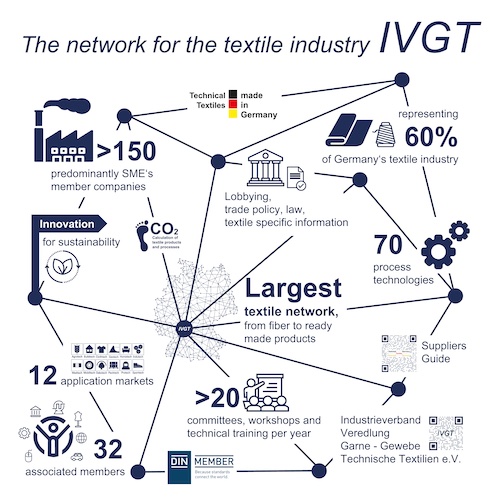
Industry clusters such as the IVGT play a crucial role by strengthening networks between companies, educational institutions and governments. They promote the exchange of knowledge, support the introduction of new technologies and help to drive forward circular economy projects. Picture: IVGT


Workshops as a basis for policy recommendations

Between September and October 2024, the ADDTEX partners organised interactive workshops in Germany, Greece, Italy and Spain. These served as a platform for a broad dialogue between industry, science and politics, in which innovative approaches and concrete strategies for action were developed. The participants focussed on topics such as sustainable practices, digital transformation and promoting resilience in the textile industry.
The future is digital! The IVGT offers a range of programmes to make you fit for the digital transformation. Image: IVGT


Key competences for change

A central aspect of the White Book is the emphasis on education and training to promote the dual transition - green and digital. The most important skills required of employees to shape a sustainable future for the industry are expertise in renewable energy, recycling, environmentally friendly materials and sustainable production (green transition), skills in data analysis, cyber security, IT and the ability to use AI-supported technologies (digital transition), as well as adaptability, innovation, risk management and cross-functional collaboration (promoting resilience). Ten aspects emerged as the most important political recommendations for action (see chart). These include, in particular, the promotion of sustainable practices in companies, investment in digital infrastructure along the textile value chain, support for collaborative research projects and industry-specific training funds to impart the essential skills mentioned. 

Further information www.addtex.eu; www.addtex.eu/resources/
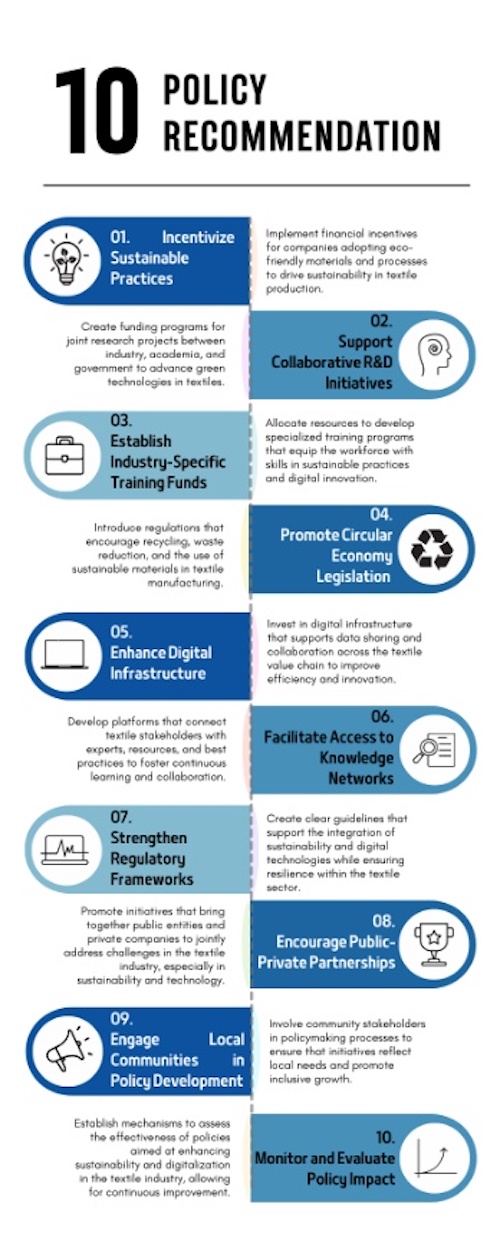


To promote both the double transition and the resilience of the industry, policy should incentivise sustainable practices and investment in green technologies. The developed recommendations for action as a graphic. Picture: ADDTEX


More News from Industrieverband Veredlung - Garne - Gewebe - Technische Textilien e.V.

#Textiles & Apparel / Garment

IVGT: AddTex final meeting in Terrassa

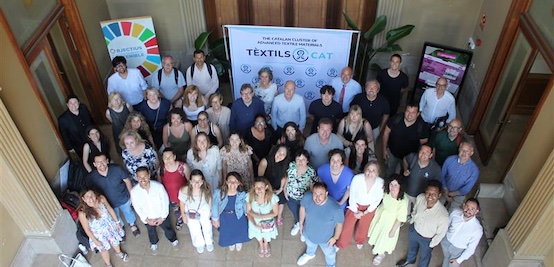
From 25 to 26 June 2025, the final meeting of the ERASMUS+ project AddTex took place in Terrassa, Spain, which aimed to train workers, pupils and students in the textile industry. Over a period of three years, eleven partners from Greece, Ireland, Italy, Portugal, Romania, Sweden, Slovenia, Spain, the Czech Republic and the IVGT association for Germany were involved in the project.

#Associations

IVGT on tour in Albstadt

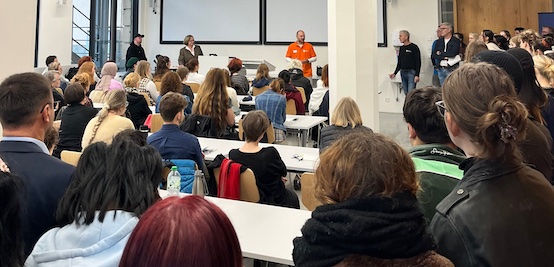
For the second edition of the Albstadt ID industry event on 10 October 2024, more than 300 school students from all over Germany and around 200 other interested parties from the industry came to Albstadt to find out about new training and employment opportunities in the textile and clothing industry through numerous presentations. The IVGT was also there! In room 205-141, Iris Schlomski reported on the current status of the ADDTEX Erasmus+ project and explained in particular the content of the ADDTEX Academy and the Hackathon and Bootcamp programmes that have now been successfully implemented.

#Nonwovens / Technical Textiles

IVGT with the ETT Club at HANNOVER MESSE 2025

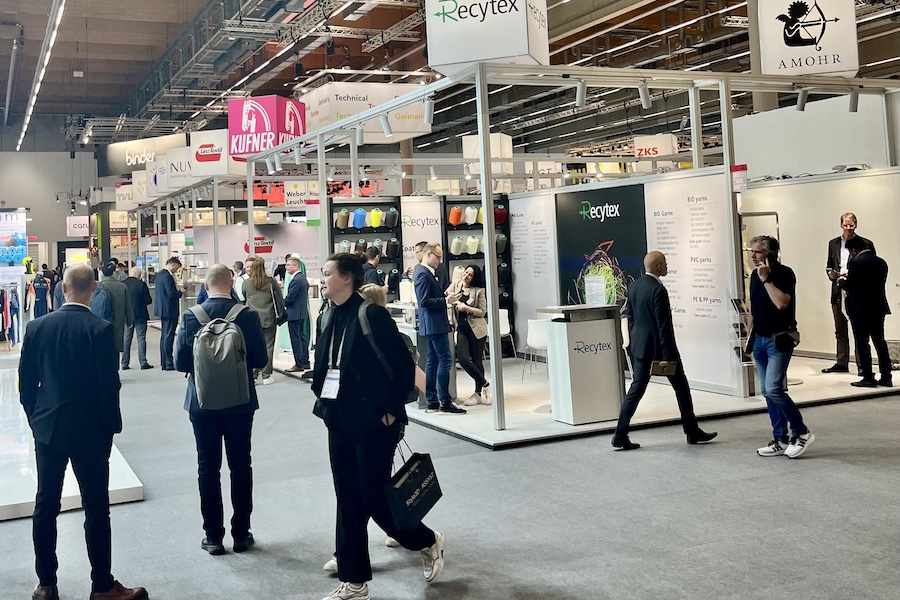
Technical textiles are highly developed materials that have been specially optimised for industrial applications. They are indispensable in many areas, even though they are often invisible. As "hidden champions" in the manufacture of numerous innovative products, technical textiles are a real alternative to conventional materials! HANNOVER MESSE, which will take place from 31 March to 4 April 2025, will bring together these important aspects for the first time and present the joint stand "Technical Textiles" in the innovative Future Hub in Hall 2.

#Techtextil 2024

Successful trade fair appearance of the IVGT members

With a total of 38,000 visitors from 102 countries and 1,700 exhibitors, the 20th Techtextil 2024 from 23 to 26 April in Frankfurt am Main once again maintained its position as the world's largest trade fair for technical textiles and nonwovens. The Industry Association for Finishing – Yarns – Fabrics – Technical Textiles also draws a positive conclusion about the course of the trade fair for its members.

More News on Associations

#Associations

Engineering depth and diversity for composites

Airbond is the latest member of the British Textile Machinery Association (BTMA) to receive recognition for contributions to the composites industry. The engineering firm based in Pontypool, South Wales, has just received the Make UK Energy and Sustainability Award for its Lattice 3D Printing project.

#Composites

Alliance for European Flax-Linen & Hemp expands bio-materials presence at JEC World 2026

The Alliance for European Flax-Linen & Hemp is pleased to announce its participation at JEC World 2026, featuring a significantly expanded presence and an enhanced offering for the global composites industry.

#Europe

FITA, ABIT and EURATEX underline strategic importance of Mercosur – EU Partnership Agreement for the textile and apparel industry

The Argentine Textile Industry Federation (FITA), the Brazilian Textile and Apparel Industry Association (ABIT), and the European Apparel and Textile Confederation (EURATEX) continue to monitor the process of internalizing the Mercosur-European Union Partnership Agreement. This agreement is essential for the competitiveness of our industries, on both sides of the Atlantic.

#Associations

Industry associations warn against state-run EPR models in the EU

European industry associations, led by Euratex, have raised concerns over a growing trend in several EU Member States to introduce state-run Producer Responsibility Organisations (PROs) within Extended Producer Responsibility (EPR) schemes.

Latest News

#Recycling / Circular Economy

Circulose restarts commercial-scale production at Ortviken plant in Sundsvall

Circulose today announced the restart of its commercial-scale production plant at Ortviken in Sundsvall, Sweden, marking a significant step in scaling next-generation materials for the global fashion industry. The company plans to resume production of CIRCULOSE®, a recycled pulp made entirely from discarded cotton textiles, in the fourth quarter of 2026.

#Textiles & Apparel / Garment

VIATT 2026 to debut German Pavilion, strengthening European participation alongside key Asian textile hubs

Vietnam’s textile and garment sector continues to be a major contributor to the country’s economic growth, with export revenues expected to reach USD 46 billion in 2025, a 5.6% increase from 2024 . From 26 – 28 February, the Vietnam International Trade Fair for Apparel, Textiles and Textile Technologies (VIATT) is set to contribute to economic growth opportunities by accelerating digital transformation and green transition across the entire textile value chain. The upcoming edition will respond to the rising demand for advanced technologies and sustainable materials with the introduction of the German Pavilion, alongside strong exhibitor participation from key Asian sectors, as well as several high-profile fringe events.

#Sustainability

Ying McGuire becomes new CEO of Cascale

Cascale today announced the appointment of Ying McGuire as Chief Executive Officer, effective June 1, 2026.

#Technical Textiles

Sustainable, lightweight, and sound absorbing: Polyester-based front trunk solution for BEVs

As car manufacturers look to further reduce their carbon footprint, Autoneum has developed an innovative front trunk solution for battery electric vehicles (BEVs), made entirely from polyester-based textile. The Ultra-Silent Frunk offers significant weight reduction, improved acoustic and thermal insulation, and uses up to 70 percent recycled material, supporting sustainable and efficient vehicle design. Autoneum, global technology leader in acoustic and thermal management for vehicles, has already received orders for the new frunk from three major OEMs in Asia and Europe to be built in three BEV models. Series production for two BEVs has been underway in China and Germany since last year.

TOP