[pageLogInLogOut]

#Denim

EIM, the global standard for measuring the environmental impact of textile finishing, presents its annual report

Denim moves towards sustainability

EIM (Environmental Impact Measurement), the global reference platform for measuring the environmental impact of garment finishing, presents the second edition of its annual report Denim Industry Progress & Insights 2025. The study analyses over 100,000 real denim finishing processes, providing an accurate and up-to-date view of the industry’s evolution towards more sustainable models.


The textile industry, as one of the sectors with the greatest environmental impact, plays a key role in the transition towards more sustainable production models. To move forward, measuring, understanding, and acting are essential. EIM acts as a compass for the industry, enabling the objective assessment of process impacts and supporting decision-making towards more eco-efficient production.

The report confirms that the denim industry continues to make progress in reducing its environmental impact. Currently, 66% of processes are already classified as low impact, reflecting a positive trend driven by process optimization and the adoption of more efficient technologies.

In terms of resource use, significant progress has been made in optimizing water and energy, although there is still room for improvement to reach more advanced standards. Water consumption remains stable at around 30 liters per garment, indicating a plateau after years of continuous improvement. Energy shows the strongest performance, with 85% of processes classified as low impact, driven by equipment modernization and automation.

However, the report highlights that chemical impact remains the industry’s main challenge, with 27% of processes still classified as high impact. Factors such as the use of generic chemicals, lack of transparency in formulations, and the persistence of legacy practices, such as pumice stones or potassium permanganate, continue to limit progress, despite the availability of more sustainable alternatives.

At the same time, worker health impact has improved significantly, with 68% of processes classified as low impact, driven by the increasing adoption of automated technologies replacing more harmful manual techniques.

“The industry has proven that it can improve when it measures its impact, but the next step requires accelerating the adoption of technologies and leaving behind practices that are no longer sustainable,” says Begoña García, creator of EIM and co-author of the report. “Today more than ever, we need reliable data to make informed decisions and move towards a real transformation of the industry.”

This second report further establishes EIM as a global reference standard to measure and track environmental impact in denim finishing. Its annual nature allows brands and manufacturers to benchmark performance, identify improvement areas, and move forward together towards more ambitious sustainability goals.

The full report is available for download and will be updated annually, reinforcing the industry’s commitment to transparency, continuous improvement and environmental impact reduction.

EIM, a global standard to measure and compare environmental impact

EIM, Environmental Impact Measurement, is a globally recognized tool for assessing the environmental performance of garment finishing processes.

It evaluates four key categories, water consumption, energy consumption, chemical impact and worker health impact. Each process is assessed and classified into three levels, low, medium or high impact, according to standardized benchmarks.

EIM includes specific benchmarks for denim finishing, garment washing and garment dyeing, ensuring that results are accurate, comparable and relevant for each type of process.

This methodology enables brands and manufacturers to measure their processes with precision, track improvements and communicate environmental performance in a transparent and verifiable way.

More News from JEANOLOGIA S.L.

#Textile processing

Jeanologia showcases the future of product development

Jeanologia is showcasing how software is transforming product development in the fashion industry at PI Apparel Europe: The Fashion Technology Show, taking place on March 30–31 in London.

#Denim

Jeanologia launches Billy

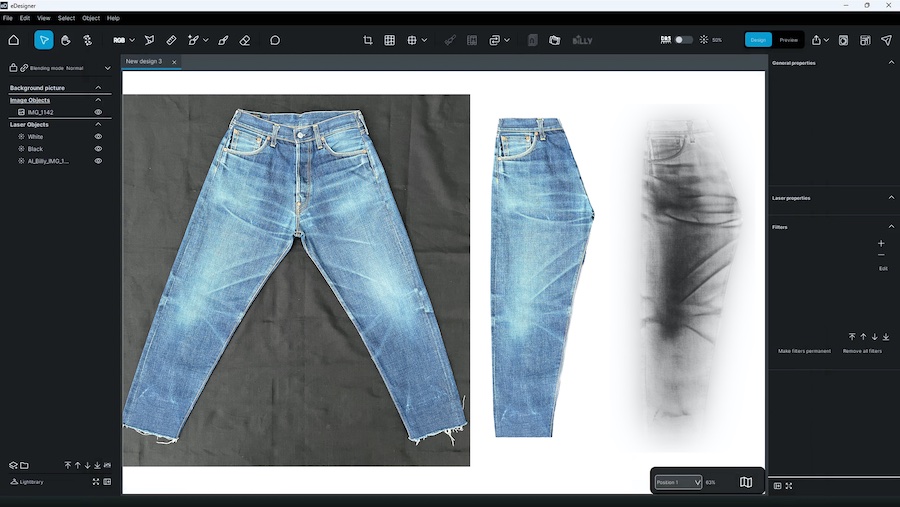
The new AI extracts precise laser designs from a garment image in minutes, transforming how vintage denim is recreated for production. If Jeanologia’s laser changed the way jeans were made at the end of the last century, its AI now takes the next step: moving from reproducing wear to designing it. / archive photo © 2026 Jeanologia

#Textile chemistry

Jeanologia urges industry to accelerate PP Spray phase-out following ZDHC Watchlist update

Potassium permanganate has officially entered the Chemical Watchlist of the ZDHC Foundation, signaling increased scrutiny and potential phase-out of one of the most hazardous chemicals still used in denim finishing. The inclusion confirms an industry shift that Jeanologia anticipated more than a decade ago.

#Denim

Jeanologia celebrates its 30th anniversary transforming how jeans are produced worldwide

Jeanologia celebrates its 30th anniversary reaffirming the mission it was born with in 1994, to transform the textile industry into a more sustainable, efficient, and human-centered sector. Three decades later, that vision has become a global reality. Today, more than 40 percent of all jeans produced worldwide are made using technologies developed by the Valencia-based company.

More News on Denim

#ITM 2026

Uster FiberQ excels for recycled raw materials too

Uster FiberQ is a complete solution for raw material utilization, supporting spinners to achieve consistent quality and profitability every day, building further growth for the future. The Turkish company ORTA relies on FiberQ with recycled yarn for its denim production. Data-driven knowledge puts the producer in control of raw material utilization – ready to make the correct decisions for process efficiency, quality and productivity.

#Denim

SOKO presents low-impact denim finishing innovations at Denim PV Milan

SOKO will present a range of sustainable denim finishing technologies and collaborative projects at the upcoming Denim Première Vision Milan on 20–21 May in Milan. At booth G27 in Superstudio Più, the company will showcase new chemical solutions designed to combine fashionable denim effects with reduced environmental impact.

#Textile chemistry

Officina39 expands in South Asia with dual trade show presence and new low-impact dyeing innovation

Officina39 reinforces its strategic expansion in South Asia by announcing its participation in two key textile industry events in Bangladesh and India, alongside the launch of a new solution designed to reduce the environmental impact of reactive dyeing.

#Denim

Eastman Naia™ debuts at Kingpins Amsterdam, transforming Denim from the inside out

At Kingpins Amsterdam (April 15–16, 2026), Naia™ by Eastman Chemical Company makes its debut, presenting its approach to circularity and comfort in denim at Stand 1, Ground Level (Blue Area). The brand also highlights its growing global ecosystem, connecting mill partners, designers and brands working to expand denim possibilities through fiber innovation.

Latest News

#INDEX 2026

INDEX 2026: Reicofil introduces RF 5.10 upgrade boosting output by 10 percent

At INDEX 2026, Reifenhäuser Reicofil will present its latest developments for the nonwovens industry under the guiding themes “Grow Together”, “Expand Together” and “Transform Together”. On this occasion, the leading manufacturer of nonwoven machinery will be unveiling two brand-new technology advancements – RF 5.10 upgrade and RF Core – at the show.

#Recycled Fibers

Lindex and BASF partner to bring textile-­to­-textile recycled polyamide to lingerie sector

Lindex has partnered with BASF’s loopamid® to accelerate textile-­to-­textile recycling and advance the shift towards more circular material solutions in the fashion industry. Together they introduce loopamid to the lingerie sector.

#Dyeing, Drying, Finishing

Tradition and Innovation – Phoenox Textiles Ltd. relies on state-of-the-art carpet back-coating line from Brückner

For more than 70 years, Phoenox Textiles Ltd. has been synonymous with quality, reliability, and inno-vation in the textile industry. Founded in 1954 in Huddersfield (Yorkshire, UK), a region with a long tradition in textiles, this family-owned business has continued to evolve without losing sight of its roots. Today, in its fourth generation under the leadership of the Mosley family, Phoenox successfully combines decades of experience with a clear, forward-looking corporate strategy.

#Digital Printing

EFI brings high-performance display graphics, packaging, and textile printing innovations to FESPA 2026

Electronics For Imaging, Inc. (EFI™) is bringing a broad range of new hybrid, roll-to-roll, and textile inkjet innovations to FESPA Global Print Expo 2026, taking place 19-22 May at Fira Barcelona Gran Via. Visitors to the EFI stand (Hall 3, #C85) will see the new EFI VUTEk M3h X hybrid LED printer, new EFI VUTEk® FabriVU® 340 i8 eight-colour dye sublimation printer, the EFI VUTEk X5r roll-to-roll LED printer, and the EFI VUTEk Q3h XP seven-colour hybrid printer in action, each designed to help sign and display producers scale output, diversify applications, and drive more profitable growth.

TOP