[pageLogInLogOut]

#EU Textile Strategy

Germany pushes ahead with Producer Responsibility for Textiles
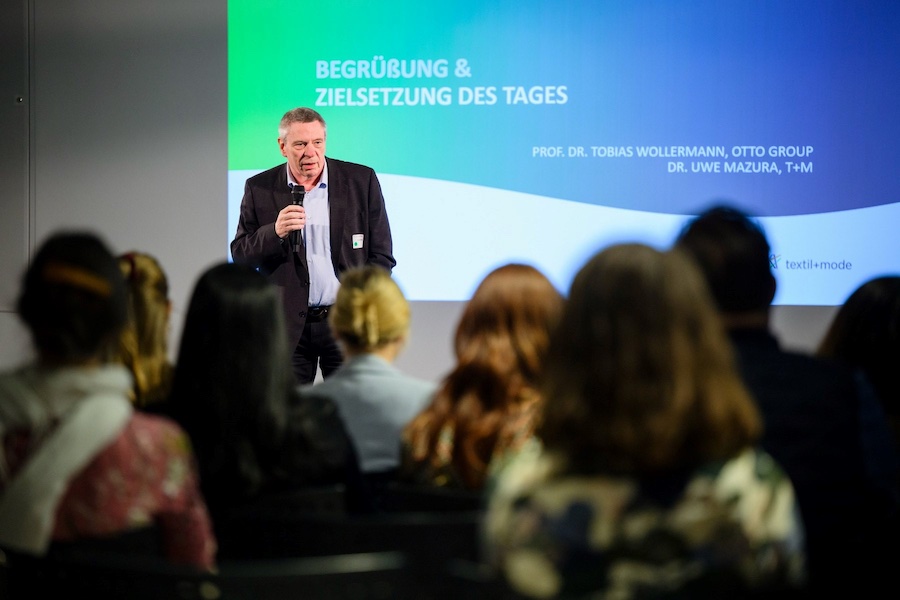
Germany is taking a leading role in shaping extended producer responsibility (EPR) for textiles – a regulatory concept that is gaining traction across the European Union. EPR requires companies that manufacture or sell products such as clothing, home textiles, and shoes to take financial and operational responsibility for the end-of-life management of these goods.
Dr Uwe Mazura, CEO of the German Textile and Fashion Association, speaking at the event © 2025 Gesamtverband textile  mode Foto: Gregor Fischer - Fotografie
Dr Uwe Mazura, CEO of the German Textile and Fashion Association, speaking at the event © 2025 Gesamtverband textile mode Foto: Gregor Fischer - Fotografie


While the European Commission is currently revising the Waste Framework Directive to include EPR for textiles across all EU member states, Germany is preparing for implementation by launching an inclusive national dialogue involving stakeholders from every part of the value chain.

The initiative was spearheaded by the German Textile and Fashion Industry Association (Gesamtverband textil+mode), the Joint Take-Back System Service Company (GRS), and the Otto Group. More than 80 participants—including manufacturers, retailers, political decision-makers, waste management experts, and civil society organisations—gathered on the Otto Group campus in Hamburg to discuss what a fair and effective EPR system for textiles should look like in Germany.

For Dr Uwe Mazura, CEO of the German Textile and Fashion Association, there is no question that the medium-sized textile and fashion industry wants to take responsibility for its products: ‘We say a clear yes to producer responsibility. We have done so in the past and will continue to do so in the future if required by law. However, this also means that we do not just want to pay, but also have a say and play a role in shaping transparent and sustainable take-back systems. Our industry can create genuine recycling loops through extended producer responsibility, but we do not need bureaucratic and expensive structures.’

The stakeholder discussions focused on how to design EPR in a way that reflects real industry needs—transparent, pragmatic, and without excessive bureaucracy. In particular, participants stressed the importance of fair international competition.

“As the name suggests, producer responsibility should also be significantly shaped and borne by producers. What has gone wrong with producer responsibility in other product areas should not be repeated for textiles under any circumstances,” said Dr.-Ing. Julia Hobohm, Managing Director of GRS mbH.

For Otto Group, one of Europe’s leading e-commerce companies, international fairness is crucial. “To create a fair and transparent trading world, we must minimise bureaucracy while ensuring effective market surveillance. Asian platforms should follow the same rules as European online retailers in order to achieve a level playing field, including in the implementation of the circular economy that the EU is pursuing with the Green Deal,” said Prof. Dr. Tobias Wollermann, Vice President Group Corporate Responsibility at Otto Group. “Our goal is to develop cost-effective solutions for manufacturers and retailers and clear definitions to prevent distortions of competition and create space for responsible and forward-looking action.”

In four workshops, the conference participants developed recommendations for action based on the key issues paper presented by the German Textile and Fashion Association last year, focusing on the following questions:

How should an EPR system be designed?

How should a joint manufacturer register textiles and monitor the market?

How should existing collection structures be maintained and further developed?

How should consumers be informed so that the goal of sustainable textile consumption is ultimately achieved?

The participants agreed that an effective and sustainable EPR system can only be established if all stakeholders – from manufacturers to retailers to the waste management industry – work together. The requirements of the manufacturing industry affected must be central to the future design of any system.

‘We will take the many valuable ideas from this dialogue with us into further political discussions. Our goal is an EPR system that is not only ecologically sound, but also economically viable and low on bureaucracy,’ said Uwe Mazura.

The findings from this stakeholder dialogue will now be compiled into a joint concept paper by the German Textile and Fashion Association. This paper will feed directly into Germany’s contribution to EU-level policymaking and serve as a model for implementing extended producer responsibility in the textile sector across Europe.

More News from Gesamtverband textil+mode

More News on EU Textile Strategy

#Sustainability

Textile Exchange Conference 2025 kicks off next week in Lisbon

From October 13 to 17, 2025, the Textile Exchange Conference will take place at the Lisbon Congress Centre, bringing together brands, supply-chain partners, innovators, farmers, NGOs, academics, and more for a week of collaborative learning and exchange. Under the theme “Shifting Landscapes”, this year’s agenda highlights the urgent need for the textile industry to adapt rapidly to changing environmental, political, and economic conditions, while linking adaptation to broader systems transformation.

#EU Textile Strategy

CEMATEX strengthens EU representation and advocacy for the European textile machinery industry

CEMATEX, the European Committee of Textile Machinery Manufacturers, has reinforced its role as the voice of the EU textile machinery industry by enhancing its presence and engagement with EU institutions and stakeholders.

#EU Textile Strategy

Textile ETP at the European Commission's event on the Textiles Ecosystem Transition Pathway

On 4 June 2024, the Textile ETP Secretary General Lutz Walter participated in the European Commission’s Directorate-General for Internal Market, Industry, Entrepreneurship & SMEs (DG GROW) stakeholder event for the Textiles Ecosystem Transition Pathway.

#EU Textile Strategy

2024 is a turning point for the European textiles and clothing industry

From 6 to 9 June 2024, European citizens will vote for a new European Parliament and, based on the results, a new European Commission will be formed. In view of this important election, EURATEX publishes a Manifesto, presenting 15 requests which will help to ensure a competitive European textiles and clothing industry.

Latest News

#Recycling / Circular Economy

Circulose restarts commercial-scale production at Ortviken plant in Sundsvall

Circulose today announced the restart of its commercial-scale production plant at Ortviken in Sundsvall, Sweden, marking a significant step in scaling next-generation materials for the global fashion industry. The company plans to resume production of CIRCULOSE®, a recycled pulp made entirely from discarded cotton textiles, in the fourth quarter of 2026.

#Textiles & Apparel / Garment

VIATT 2026 to debut German Pavilion, strengthening European participation alongside key Asian textile hubs

Vietnam’s textile and garment sector continues to be a major contributor to the country’s economic growth, with export revenues expected to reach USD 46 billion in 2025, a 5.6% increase from 2024 . From 26 – 28 February, the Vietnam International Trade Fair for Apparel, Textiles and Textile Technologies (VIATT) is set to contribute to economic growth opportunities by accelerating digital transformation and green transition across the entire textile value chain. The upcoming edition will respond to the rising demand for advanced technologies and sustainable materials with the introduction of the German Pavilion, alongside strong exhibitor participation from key Asian sectors, as well as several high-profile fringe events.

#Sustainability

Ying McGuire becomes new CEO of Cascale

Cascale today announced the appointment of Ying McGuire as Chief Executive Officer, effective June 1, 2026.

#Technical Textiles

Sustainable, lightweight, and sound absorbing: Polyester-based front trunk solution for BEVs

As car manufacturers look to further reduce their carbon footprint, Autoneum has developed an innovative front trunk solution for battery electric vehicles (BEVs), made entirely from polyester-based textile. The Ultra-Silent Frunk offers significant weight reduction, improved acoustic and thermal insulation, and uses up to 70 percent recycled material, supporting sustainable and efficient vehicle design. Autoneum, global technology leader in acoustic and thermal management for vehicles, has already received orders for the new frunk from three major OEMs in Asia and Europe to be built in three BEV models. Series production for two BEVs has been underway in China and Germany since last year.

TOP