[pageLogInLogOut]

#Knitting & Hosiery

Capsule collection to be launched during Premiere Vision, Paris, 3rd-5th February at the Lenzing stand 6P30

KARL MAYER and Lenzing partner to advance warp knitting with scalable cellulose fiber solutions

Partnership reveals latest innovation project to identify new, efficient ways to process TENCEL™ Lyocell and Modal fibers with Micro Technology, on warp knitting machines
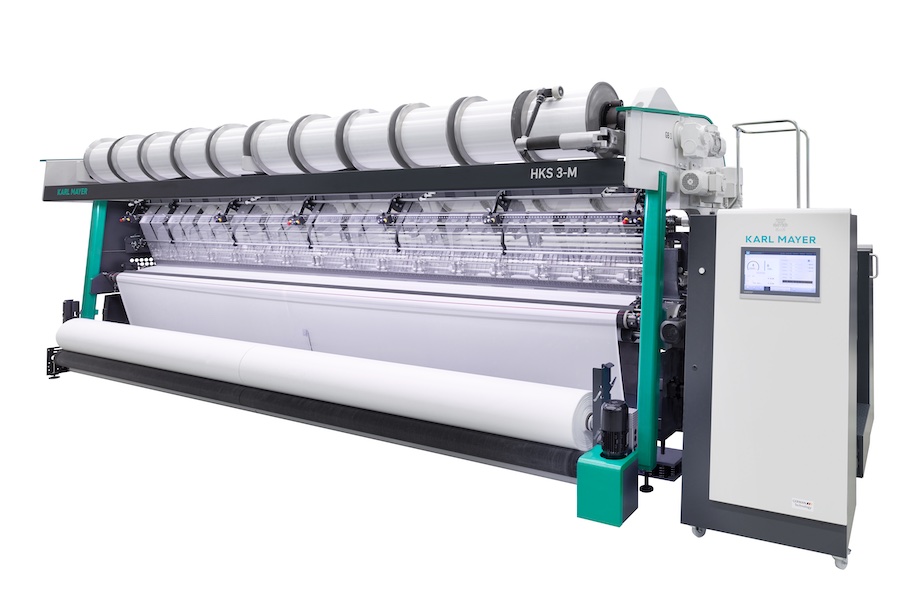
Combining yarns with reduced hairiness and a high level of homogeneity establishes the preconditions for processing several thousand threads at maximum speed without lint contamination. © 2026 KARL MAYER
The Lenzing Group, a leading supplier of regenerated cellulosic fibers for the textile and nonwovens industries, together with KARL MAYER, the global market leader in warp knitting machines and warp preparation systems, debut a joint innovation project during Premiere Vision, Paris.

The collaboration focusing on identifying new, efficient ways to process Lenzing’s TENCEL™ Lyocell and Modal fibers with Micro Technology, made from the natural material wood, sourced from certified or controlled sources [1] and manufactured using a responsible production process with a low environmental impact [2], on warp knitting machines, whilst demonstrating their suitability for high-quality textile applications.

TENCEL™Lyocell and Modal fibers produced with Micro Technology are characterized by their fine titers which enable the production of finer yarns, resulting in smooth and consistent fabrics that deliver softness and lightness for enhanced comfort, whilst yielding superior drape and movement.

Cellulose fibers offer consistent fiber length uniformity, forming the basis for high mechanical performance. Despite this advantage, the production of warp-knitted fabrics from cellulose fibers presents significant technical challenges. To address this complexity, the two partners joined forces to develop a new innovation project; Lenzing contributing extensive expertise in fiber production and yarn development, including the downstream spinning process, whilst KARL MAYER complemented with many years of experience in warp beam production from staple fibers and their processing on high-performance warp knitting machines. The manufacturer's machines are renowned on the market for their maximum efficiency, reliability and quality.

© 2026 Lenzing
© 2026 Lenzing


Yarn properties: Minimal hairiness, homogeneous cross-section

The first step within the project development was to select fibers and spinning technologies that would result in yarns with reduced hairiness. Low hairiness prevents contamination by lint or flying fibers during the beaming and warp knitting process.

In addition, a uniform yarn cross-section is important. A high level of homogeneity of the yarns ensures the tensile strength required to process several thousand threads at maximum speed on KARL MAYER warp knitting machines. Four different yarns were used, each made from two fiber raw materials and two spinning processes.

“We opted for Ring Compact and SIRO Compact spinning technology because it guarantees yarns with low hairiness and better performance and quality of the fabrics made from them,“ says Bernd Schleuchardt, Senior Manager Apparel in the Business Development Division at Lenzing. “By combining fiber innovation with downstream processing expertise, we aim to support scalable, industrial solutions that open up new commercial opportunities for cellulose fibers in warp knitting.”

Bernd Schleuchardt © 2026 Lenzing


Specifically, the choice fell on:

1. TENCEL™ Modal with Micro technology Ne 60/1 ( Nm 100/1) Ring Compact – from Gebr. Otto GmbH + Co. KG, 89165 Dietenheim (Germany)

2. TENCEL™ Lyocell with Micro technology Ne 60/1 ( Nm 100/1) Ring Compact – from Gebr. Otto GmbH + Co. KG, 89165 Dietenheim (Germany)

3. TENCEL™ Modal with Micro technology Ne 60/1 ( Nm 100/1) SIRO Compact – from Inovafil - Fiação, S.A., 4770-583 Vila Nova de Famalicão (Portugal)

4. TENCEL™ Lyocell with Micro Technology Ne 60/1 ( Nm 100/1) SIRO Compact – from Inovafil - Fiação, S.A., 4770-583 Vila Nova de Famalicão (Portugal)


Processing: High efficiency, good quality

The yarn material was warped to a high standard, particularly in terms of lint and used on a high-performance warp knitting machine in a gauge of E 28 with two guide bars. This resulted in three different articles for the clothing sector from each yarn: an open worked three-stitch tulle net, a close-knit fabric made counter-lapped open tricot lap and a fabric made from a counter-lapped atlas lap, also with a dense surface.

The processing tests revealed a clear winner: SIRO Compact impressed with significantly reduced hairiness, resulting in less fiber abrasion and less contamination of the machine.

“The project with Lenzing has shown that efficient processing of cellulose fibers on knitting machines is possible by using the right fibers and the right spinning process. We are currently working on optimisations to achieve even higher output,” says Markus Otte, Senior Expert, Textile Development at KARL MAYER.
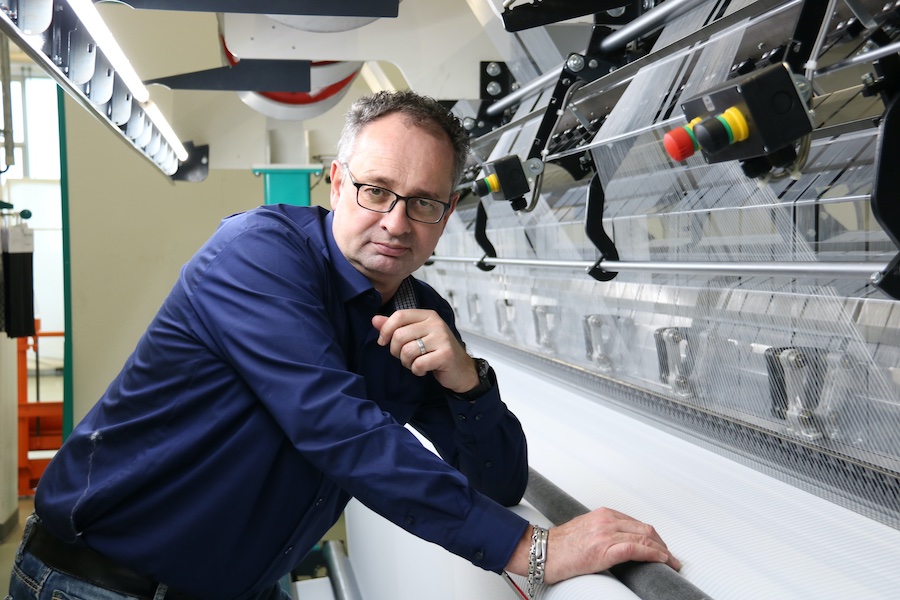
Markus Otte © 2026 KARL MAYER


Debut showcase: Market ready solutions

The results of the innovation project will be presented to the textile world during Premiere Vision, Paris, 3rd-5th February, introducing a capsule collection as a mix of applications across lingerie, innerwear and lifestyle pieces for everyday wear.

The Lenzing team will be at the Lenzing stand 6P30 to welcome guests, engage in discussions on all the latest innovations across the Lenzing portfolio, whilst exploring the new applications across the capsule.

More News from KARL MAYER Textilmaschinenfabrik GmbH

#Knitting & Hosiery

The new RE 6 EL from KARL MAYER shows what it can do

KARL MAYER’s new RE 6 EL from KARL MAYER brings a breath of fresh air to raschel fabric production. The latest samples from the textile product development department of this innovative textile machine manufacturer demonstrate the extensive design possibilities on offer.

#Knitting & Hosiery

KARL MAYER opens a new TEXTILE INNOVATION CENTRE – a new era of textile innovation begins

KARL MAYER is opening its new TEXTILE INNOVATION CENTRE (TIC), sending a strong signal that it is driving textile innovation forward and opening up new perspectives for the textile industry. The TIC brings together the latest developments in Warp Knitting, Technical Textiles and Warp Preparation – KARL MAYER’s core areas of expertise.

#Knitting & Hosiery

Proven performance, optimised costs – the new RE 6 EL

Nowadays textile companies increasingly need to produce small production runs and respond to market changes with instantaneous pattern changes in order to operate profitably – meaning they require machines that offer maximum flexibility, reliability and cost efficiency. KARL MAYER understands the challenges of the market and is launching its new RE 6 EL. The Raschel machine offers the core strengths of the classic RSE 6 EL and essentially the same performance parameters, but has been further cost-optimised largely due to local production advantages. This makes the newcomer an efficiency champion in production, especially when it comes to frequent pattern changes.

#Knitting & Hosiery

Live more beautifully and comfortably with Warp Knits

Knitted fabrics are the all-rounders among home textiles. They can be designed in many different ways and are used in mattresses, blankets and pillows as well as in terry towelling, curtains and upholstery fabrics to create trendy designs, constantly new products and good business.

More News on Knitting & Hosiery

#Knitting & Hosiery

Huixing acquires insolvent Mayer & Cie.

Insolvency proceedings for the circular knitting and braiding machine manufacturer Mayer & Cie. were opened on December 1, 2025. Immediately following the opening of proceedings, the complete cessation of business operations was initiated. Most employees were subsequently given notice effective the end of February 2026. The production of the remaining orders in the circular knitting segment is expected to be completed by the end of the month. As early as December 2025, Mayer & Cie.’s braiding machine division was sold to an Italian investor.

#Knitting & Hosiery

SHIMA SEIKI to exhibit at GMMSA Expo India

Leading Japanese computerized flat knitting technologist SHIMA SEIKI MFG., LTD. of Wakayama, Japan, together with its Indian sales representative Universal MEP Projects & Engineering Services, Ltd., will participate in the upcoming Garments Machinery Manufacturers & Suppliers Association (GMMSA) Expo India 2026 exhibition to be held in Ludhiana, India next month. Through its lineup at GMMSA, SHIMA SEIKI aims to further strengthen its presence within the Indian market with an exhibit that caters to diverse needs, consisting of seam-free WHOLEGARMENT® knitting technology as well as a brand-new shaping machine with high productivity and excellent cost performance.

#Knitting & Hosiery

Terrot introduces T-Frame platform to redefine stability and flexibility in large-diameter circular knitting

Terrot Textilmaschinen GmbH has unveiled the new T-Frame, a universal machine frame platform for large-diameter circular knitting machines. Designed to meet growing demands for flexibility, stability, and operational safety, the T-Frame provides a next-generation foundation for both current and future industrial knitting machines, combining German engineering expertise with a modular, future-ready design approach.

#Knitting & Hosiery

SHIMA SEIKI returns to ShanghaiTex

Leading flat knitting solutions provider SHIMA SEIKI MFG., LTD. of Wakayama, Japan, together with its Hong Kong and Chinese market subsidiary SHIMA SEIKI (HONG KONG) LTD., will exhibit at the ShanghaiTex 2025 exhibition (Booth No.: Hall N3, Booth A20) held in Shanghai, China this month. This marks the return of SHIMA SEIKI to ShanghaiTex after a 14-year hiatus, its last exhibit at the show having been in 2011.

Latest News

#Recycling / Circular Economy

Circulose restarts commercial-scale production at Ortviken plant in Sundsvall

Circulose today announced the restart of its commercial-scale production plant at Ortviken in Sundsvall, Sweden, marking a significant step in scaling next-generation materials for the global fashion industry. The company plans to resume production of CIRCULOSE®, a recycled pulp made entirely from discarded cotton textiles, in the fourth quarter of 2026.

#Textiles & Apparel / Garment

VIATT 2026 to debut German Pavilion, strengthening European participation alongside key Asian textile hubs

Vietnam’s textile and garment sector continues to be a major contributor to the country’s economic growth, with export revenues expected to reach USD 46 billion in 2025, a 5.6% increase from 2024 . From 26 – 28 February, the Vietnam International Trade Fair for Apparel, Textiles and Textile Technologies (VIATT) is set to contribute to economic growth opportunities by accelerating digital transformation and green transition across the entire textile value chain. The upcoming edition will respond to the rising demand for advanced technologies and sustainable materials with the introduction of the German Pavilion, alongside strong exhibitor participation from key Asian sectors, as well as several high-profile fringe events.

#Sustainability

Ying McGuire becomes new CEO of Cascale

Cascale today announced the appointment of Ying McGuire as Chief Executive Officer, effective June 1, 2026.

#Technical Textiles

Sustainable, lightweight, and sound absorbing: Polyester-based front trunk solution for BEVs

As car manufacturers look to further reduce their carbon footprint, Autoneum has developed an innovative front trunk solution for battery electric vehicles (BEVs), made entirely from polyester-based textile. The Ultra-Silent Frunk offers significant weight reduction, improved acoustic and thermal insulation, and uses up to 70 percent recycled material, supporting sustainable and efficient vehicle design. Autoneum, global technology leader in acoustic and thermal management for vehicles, has already received orders for the new frunk from three major OEMs in Asia and Europe to be built in three BEV models. Series production for two BEVs has been underway in China and Germany since last year.

TOP