[pageLogInLogOut]

#Recycled_Fibers

© 2025

EREMA Group partners with Australian technology pioneer BlockTexx®
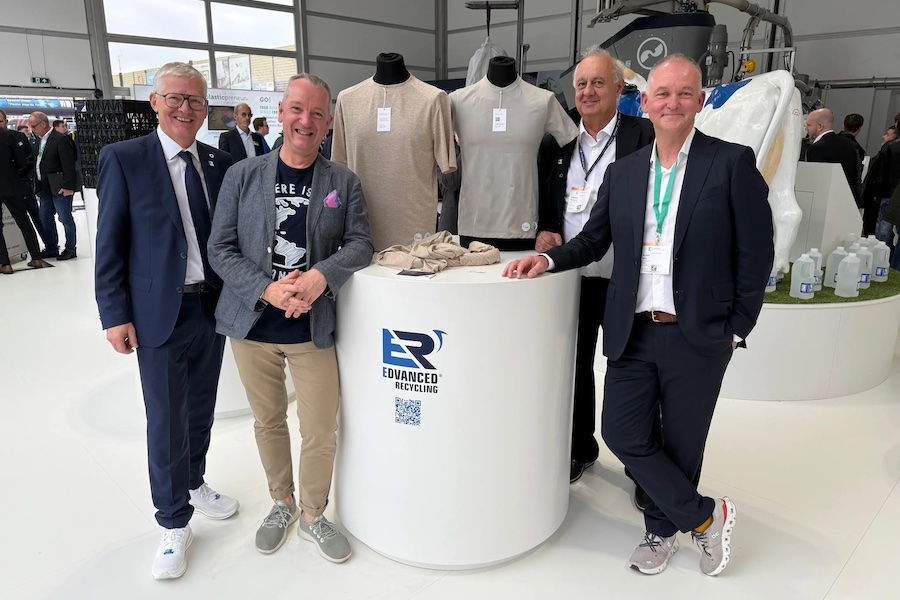
From left: Manfred Hackl (EREMA Group), Graham Ross (BlockTexx®), Wolfgang Hermann (EREMA Group), and Adrian Jones (BlockTexx®) next to T-shirts made from 100% recycled polyester. © 2025 EREMA
At K show in Düsseldorf, the world’s leading trade fair for plastics and rubber, EREMA Group announced a strategic investment in clean technology company BlockTexx®. The Australian pioneer has developed a process that separates polyester and cellulose from blended textiles. By combining both companies’ technologies, the partnership aims to scale post-consumer textile-to-textile recycling to industrial levels.


Through the strategic collaboration the EREMA Group emphasizes its commitment to returning polyester to the apparel production cycle and scaling up textile-to-textile recycling. “The PET fibre industry is three times the size of the PET bottle industry. We have been investing in the research and development of textile and fibre recycling for several years. With the technology we already provide for PET fibre recycling, our next step is to aim for full-scale industrial textile recycling. We consider BlockTexx® a key partner in this. Their technology paves the way for used textiles to re-enter the production cycle,” said Manfred Hackl, CEO of EREMA Group.

BlockTexx®‘s process separates polyester and cellulose from post-consumer textiles and clothing, providing the polyester for EREMA’s technology. The INTAREMA® FibrePro:IV system will process the polyester into recycled pellets suitable for new garment production. “Our thermomechanical recycling system is a core element for textile recycling,” said Wolfgang Hermann, Business Development Manager for Fibres & Textiles at EREMA Group. “However, full-scale textile recycling requires a combination of technologies, with BlockTexx® unlocking the solution for processing polyester-blended textiles.“

Industrial-scale expansion

BlockTexx® operates its first plant in Australia with a processing capacity of 10,000 tonnes per year, with plans for a second plant of 50,000 tonnes per year. Scaling up requires a strong investment partner. “Blended textiles like cotton-polyester account for over 60 per cent of global apparel production but are notoriously difficult to recycle due to fibre incompatibility and chemical contamination”, says Adrian Jones, co-founder of BlockTexx®. EREMA Group’s investment brings not only capital but also deep recycling expertise, proven technology and infrastructure. From the very beginning, it felt like a true partnership, Jones notes: “Both companies share the same intellectual curiosity and EREMA Group was committed to this journey from day one.”
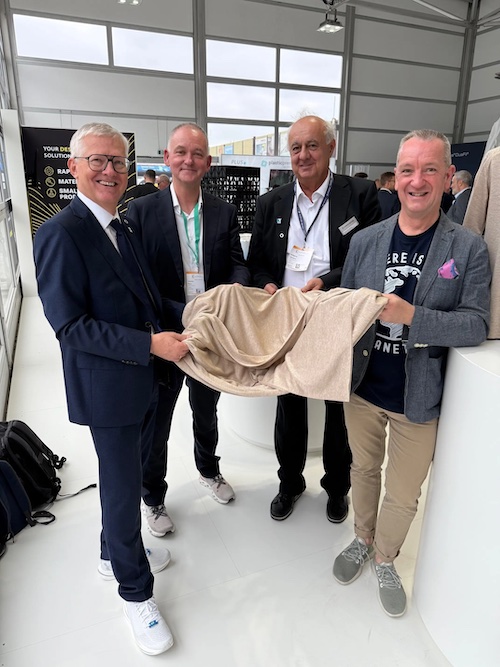
The same representatives  holding the new fabric made from 100% recycled polyester at the Edvanced Recycling Center, where EREMA demonstrates live recycling and products made of recyclate during the K show. © 2025 EREMA
The same representatives holding the new fabric made from 100% recycled polyester at the Edvanced Recycling Center, where EREMA demonstrates live recycling and products made of recyclate during the K show. © 2025 EREMA


Textile industry faces recycling challenges

According to global non-profit Textile Exchange 75 million tonnes of synthetic fibres were produced in 2023, with polyester being the most common, accounting for 57 per cent of total fibre production. Recycling rates for polyester are estimated at only 1 per cent. “Currently, nearly all the recycled polyester in the clothing you see in retail stores is derived from PET plastic bottles” says Graham Ross, co-founder of BlockTexx®. As per Textile Exchange, recycled fibres constituted 7.7 per cent of the global fibre market in 2023, with 7 per cent being recycled polyester from waste PET bottles. Hackl emphasizes: “The goal must be to ensure that rPET from bottles is returned to new bottles. This investment is not only positive for the textile industry, but also for the plastics industry. By keeping rPET in the bottle-to-bottle loop, we can stabilize supply and prices for the market.”

With the EU recently adopting binding legislation that will make textile producers responsible for the collection, sorting and recycling of textile waste through mandatory Extended Producer Responsibility (EPR) schemes, the sector is set for change. As these rules come into force over the coming years, the demand for post-consumer textile recycling solutions is expected to grow significantly. “The EU legislation could fundamentally transform the sector. While most textile production takes place in Asia, Europe is a major consumer of fashion. This legislation will therefore have a significant global impact”, Ross notes.

Setting new standards for circularity

By combining mechanical processing, chemical separation, and fibre regeneration, the partnership establishes a model that sets new industrial standards for circularity. “Twenty-five years ago, people could not imagine bottle-to-bottle recycling. Today it is standard. I believe the same will happen for textile-to-textile recycling”, says Hackl. “The textile industry has been slow to recognize the importance of recycling, often citing difficulties as an excuse. Now there are no more excuses. Textile-to-textile recycling will become a reality at industrial-scale through the collaboration between EREMA and BlockTexx®,” adds Jones.


More News from EREMA

More News on Recycled_Fibers

#Recycling / Circular Economy

Circulose restarts commercial-scale production at Ortviken plant in Sundsvall

Circulose today announced the restart of its commercial-scale production plant at Ortviken in Sundsvall, Sweden, marking a significant step in scaling next-generation materials for the global fashion industry. The company plans to resume production of CIRCULOSE®, a recycled pulp made entirely from discarded cotton textiles, in the fourth quarter of 2026.

#Recycled_Fibers

Advancing the future of stretch: Fashion for Good launches new project to validate bio-based and recycled elastane

Launched today, Stretching Circularity is a collaborative project initiated by Fashion for Good dedicated to accelerating the adoption of lower-impact elastane alternatives that are compatible with circular textile systems. By validating bio-based and recycled elastane solutions through pilot-scale testing and demonstrator garments, the initiative aims to remove one of the most significant technical barriers to a circular textile economy.

#Yarns

Biella Yarn launches Collection “Reimagined” for Spring/Summer 2027 with fresh approach to fibre design

Biella Yarn, the flat knitting brand of Suedwolle Group, introduces its Spring/Summer 2027 collection “Reimagined” featuring refined yarn blends and advanced spinning technologies designed for contemporary summer knitwear. Under the motto “And the story goes on…”, Biella Yarn continues to push the boundaries of responsible yarn development, offering versatile materials that elevate modern craftsmanship.

#Recycled_Fibers

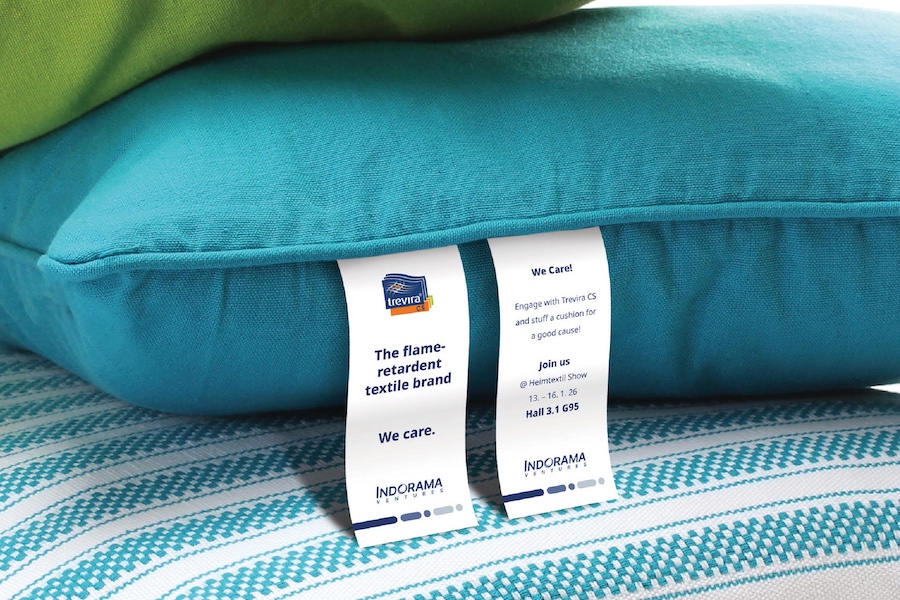
Circular progress: Trevira® CS Eco fabrics can now be made using textile-recycled, permanently flame-retardant fibers and yarns

Indorama Ventures, a global sustainable chemical company, takes an important next step toward making textiles more circular for homes and public spaces. To support fabric makers in creating a more sustainable version of the well-known flame-retardant Trevira CS fabric, the company now offers Trevira® flame-retardant fibers and filament yarns that contain 50% recycled textile material. First customers were introduced to the new offering during Heimtextil trade show mid-January in Frankfurt, Germany.

Latest News

#Textiles & Apparel / Garment

VIATT 2026 to debut German Pavilion, strengthening European participation alongside key Asian textile hubs

Vietnam’s textile and garment sector continues to be a major contributor to the country’s economic growth, with export revenues expected to reach USD 46 billion in 2025, a 5.6% increase from 2024 . From 26 – 28 February, the Vietnam International Trade Fair for Apparel, Textiles and Textile Technologies (VIATT) is set to contribute to economic growth opportunities by accelerating digital transformation and green transition across the entire textile value chain. The upcoming edition will respond to the rising demand for advanced technologies and sustainable materials with the introduction of the German Pavilion, alongside strong exhibitor participation from key Asian sectors, as well as several high-profile fringe events.

#Sustainability

Ying McGuire becomes new CEO of Cascale

Cascale today announced the appointment of Ying McGuire as Chief Executive Officer, effective June 1, 2026.

#Technical Textiles

Sustainable, lightweight, and sound absorbing: Polyester-based front trunk solution for BEVs

As car manufacturers look to further reduce their carbon footprint, Autoneum has developed an innovative front trunk solution for battery electric vehicles (BEVs), made entirely from polyester-based textile. The Ultra-Silent Frunk offers significant weight reduction, improved acoustic and thermal insulation, and uses up to 70 percent recycled material, supporting sustainable and efficient vehicle design. Autoneum, global technology leader in acoustic and thermal management for vehicles, has already received orders for the new frunk from three major OEMs in Asia and Europe to be built in three BEV models. Series production for two BEVs has been underway in China and Germany since last year.

#Raw Materials

Modern testing methods for raw cotton

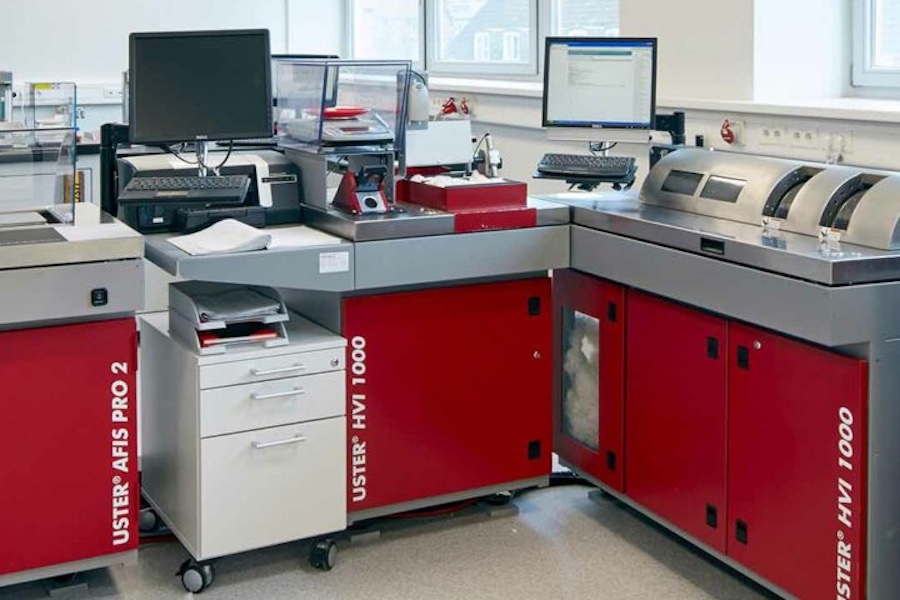
The 38th International Cotton Conference Bremen will take place from 25 to 27 March 2026 at the Bremen Parliament. This conference has traditionally stood for in-depth expertise and international exchange. The program will focus on technical innovations, market trends, and regulatory frameworks across the entire value chain – from agriculture to the circular economy. With high-profile speakers, the conference is regarded as the key meeting point for the global cotton industry. Today’s focus: Cotton quality and testing methods.

TOP