[pageLogInLogOut]

#Recycling / Circular Economy

Toray develops recycling technology that retains carbon fiber strength and surface quality

- Promoting application development from carbon fiber nonwoven fabrics -

Toray Industries, Inc., announced today that it has developed a recycling technology that can decompose diverse carbon fiber reinforced plastics (CFRP) made from thermosetting resins while retaining the strength and surface quality of those fibers. The company drew on this technology to create a nonwoven fabric employing recycled carbon fibers.


Toray has started providing prototype samples to customers with a view to them developing performance and decorative materials for diverse applications, such as automobiles, construction, electricals and electronics, and daily necessities. The company will push ahead with technical assessments matching customer needs.

CFRP applications include aircraft and wind turbines. Chemical recycling as a reducing agent in steel furnaces is gaining traction for recycling CFRP. Technologies are emerging pyrolyzing waste CFRP at high temperatures to recover and reuse fibers, with the market expanding particularly for injection molding applications. To broaden applications, there is a need for technology that can suppress thermal damage (see note 1) to recycled carbon fibers and control resin residue (note 2) and that can be applied to diverse types of waste CFRP.
© 2025 Toray
© 2025 Toray


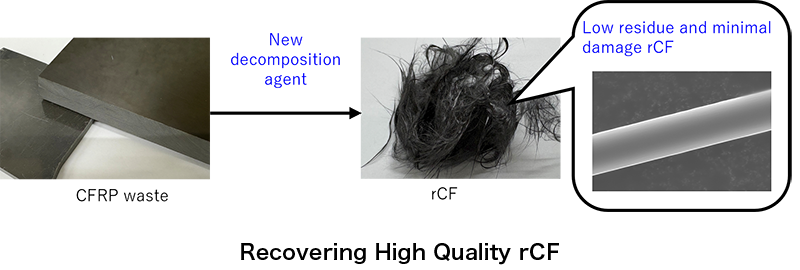
Toray applied its accumulated expertise in organic synthesis and polymer polymerization to innovate a decomposition agent that breaks down degradation-resistant, three-dimensionally crosslinked (note 3) thermosetting resins at lower temperatures than conventional methods. The company used this agent to decompose CFRP waste from aircraft, wind turbines, automobiles, and other sources. The recycled carbon fiber from this process retains over 95% of the single-fiber tensile strength of petroleum-derived virgin carbon fiber. Toray expects carbon dioxide emissions from this technology to be less than half those from manufacturing virgin carbon fiber.

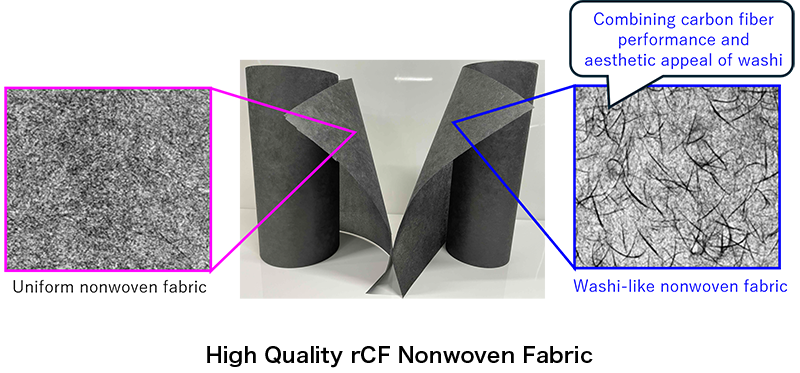
Recycled carbon fiber from this technology is stronger than conventional counterparts and minimizes fiber breakage in post-processing. Its low resin residue and excellent surface quality enables processing for more diverse applications. In particular, efforts to disperse short fibers and process them into sheet-form nonwoven fabrics have led to success. The recycled carbon fibers produced using this technology exhibits controllable water dispersibility, allowing for the fabrication of uniform nonwoven structures as well as those with distinctive texture reminiscent of washi (traditional Japanese paper). This fabric combines the functionality of carbon fiber, including radio frequency shielding and thermal conductivity, with the aesthetic appeal of washi. Toray aims to expand applications for this new material across many industries.
© 2025 Toray
© 2025 Toray


This innovative fabric features in the interior and exterior components of the concept car (vision model) that Mazda Motor Corporation will exhibit at the Japan Mobility Show at Tokyo Big Sight from October 30 through November 9.

Toray developed its recycling technology and carbon fiber nonwoven fabric processing technology as part of a fiscal 2024 through 2025 Ministry of the Environment program to promote establishment of decarbonized and circular economy.

One goal of the Toray Group Sustainability Vision for 2050 is to contribute to “a world where resources are sustainably managed.” The company will continue to progress with R&D to help create a circular society, in line with its corporate philosophy of “contributing to society through the creation of new value with innovative ideas, technologies and products.”


Notes

Thermal damage (degraded physical and chemical properties) occurs when exposing carbon fibers to high temperatures or oxidization during pyrolysis.

Residue refers to undecomposed or partially decomposed resin on carbon fiber surfaces during separation.

Three-dimensional cross-linking results from chemical or physical bonding between polymer chains.


Reference

Japan Mobility Show 2025

Organizer: Japan Automobile Manufacturers Association, Inc.

Dates: October 30 (Thu), through November 9 (Nov), 2025

Venue: Tokyo Big Sight

Website: https://www.japan-mobility-show.com/en/


More News from Toray Engineering Co. Ltd.

#Man-Made Fibers

Toray develops AURLIST™ polyester filament fiber with luxurious luster and ultra-fine structure

Toray Industries has developed AURLIST™, a new polyester filament fiber designed to combine luxurious luster, soft loft and a subtle fibrillated surface texture. The company primarily targets applications in women’s apparel such as tops, bottoms and dresses.

#Composites

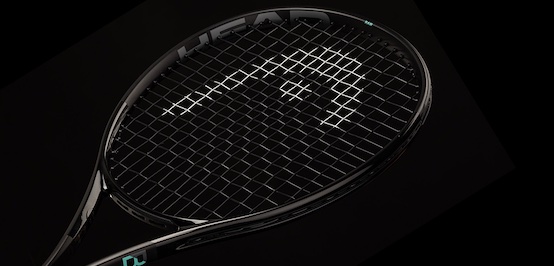
HEAD launches more sustainable(1) BOOM RAW racquet on Earth Day by using Toray’s bio-circular carbon fibers

HEAD continues to innovate with the launch of the BOOM RAW tennis racquet, an encouraging development in the search for a more sustainable future for racquet sports. All of the carbon fibers are bio-circular carbon fibers in the limited-edition and highly innovative BOOM RAW racquet, which offers the same explosive power - along with the same fun, feel and easy playability - as the regular, in-line BOOM racquet. The bio-circular carbon fibers are manufactured by Toray and its subsidiary Toray Carbon Fibers Europe.

#Recycling / Circular Economy

Companies in Japan initiate demonstration to expand the automotive recycling process

DENSO CORPORATION and other partners have been chosen by an industry-government-academia collaborative project aiming to expand the recycle content for automobile in the fiscal year 2023 supported by Ministry of the Environment, Japan.

#Yarn & Fiber

Toray develops durable reverse osmosis membrane

Toray Industries, Inc., announced today that it has developed a highly durable reverse osmosis (RO) membrane (see glossary note 1). This innovative offering guarantees the long-term provision of high-quality water. It also maintains the superior removal performance of Toray’s existing membranes vital for reusing industrial wastewater and treating sewage.

More News on Recycling / Circular Economy

#Recycling / Circular Economy

Reju secures €135 Million in Dutch NIKI Funding for industrial-scale textile-to-textile regeneration hub at Chemelot Industrial Park, the Netherlands

Reju™, the progressive textile-to-textile regeneration company, has been awarded €135 million in funding under the Netherlands’ Nationale Investeringsregeling Klimaatprojecten Industrie (NIKI) program. The funding will support Reju’s planned industrial-scale Regeneration Hub at Chemelot Industrial Park in Sittard-Geleen, covering both the investment phase and ongoing operations, and represents a critical milestone on the path toward final investment decision.

#Recycling / Circular Economy

eeden is now a Canopy partner

eeden is committed to enable circular textiles by developing recycling technologies that turn textile waste into valuable raw materials. But the commitment goes further – eeden advocates for supply chain solutions that uphold responsible environmental and ethical standards, protecting global ecosystems including Ancient and Endangered Forests.

#Recycling / Circular Economy

Infinited Fiber Company’s environmental permit for Kemi advances to statutory appeal phase

Infinited Fiber has reached an important regulatory milestone in Finland, as the environmental permit process for a potential facility in Kemi has progressed to the statutory appeal phase.

#Recycling / Circular Economy

Carbios confirms Longlaville plant in France following financing progress

Carbios has reaffirmed its plans to build its Longlaville plant in France within a project financing framework, targeting the start of production in the first half of 2028. The company also reports a solid cash position of around €60 million at the end of 2025 and has appointed Benoît Grenot as Deputy Chief Executive Officer to support the execution of its strategic projects.

Latest News

#Raw Materials

New study shows low environmental impact by Cotton made in Africa Organic Cotton from Tanzania

Today, the Aid by Trade Foundation (AbTF) is announcing the results of a comprehensive life-cycle analysis (LCA) for cotton produced in Tanzania under the Cotton made in Africa Organic (CmiA Organic) standard. The study emphasises the small ecological footprint of CmiA Organic verified cotton. This can largely be traced back to the absence of synthetic pesticides, artificial fertilisers, and artificial irrigation. Consequently, CmiA Organic cotton can help the textile industry meet regulatory requirements as well as science-based targets. The results also show that the consequences of climate change threaten the livelihoods of these cotton farmers, even though the type of agriculture they practise barely contributes to climate change.

#Raw Materials

Better Cotton Initiative strengthens regenerative focus in standard update

The Better Cotton Initiative (BCI) has strengthened the regenerative focus of its field-level standard with the launch of a new version of its Principles & Criteria (P&C), which marks the next step in the organisation’s journey to becoming a regenerative standards system.

#Man-Made Fibers

Selenis and Kintra Fibers partner to scale 100% bio-based synthetic fiber technology

Selenis, a leading global specialty polyester manufacturer, today announced a strategic manufacturing partnership with materials science company Kintra Fibers to scale Kintra’s patented fiber-grade PBS resin - a 100% bio-based and biodegradable material designed for textile applications.

#Functional Fabrics

PERFORMANCE DAYS proves its relevance as the industry’s key meeting point

Held on March 18–19, 2026, PERFORMANCE DAYS once again confirmed its position as a leading international platform for functional textiles. A total of 3.366 trade visitors and around 560 exhibitors gathered in Munich, with the event already kicking off successfully on DAY 0, which received highly positive feedback for its interactive format. Despite challenging conditions caused by the public transport strike in Munich, the event saw strong attendance and a consistently high level of activity across both exhibition days.

TOP