[pageLogInLogOut]

#Recycling / Circular Economy

Project REWEAR investigates diverse economies of rewear as a global practice of circularity

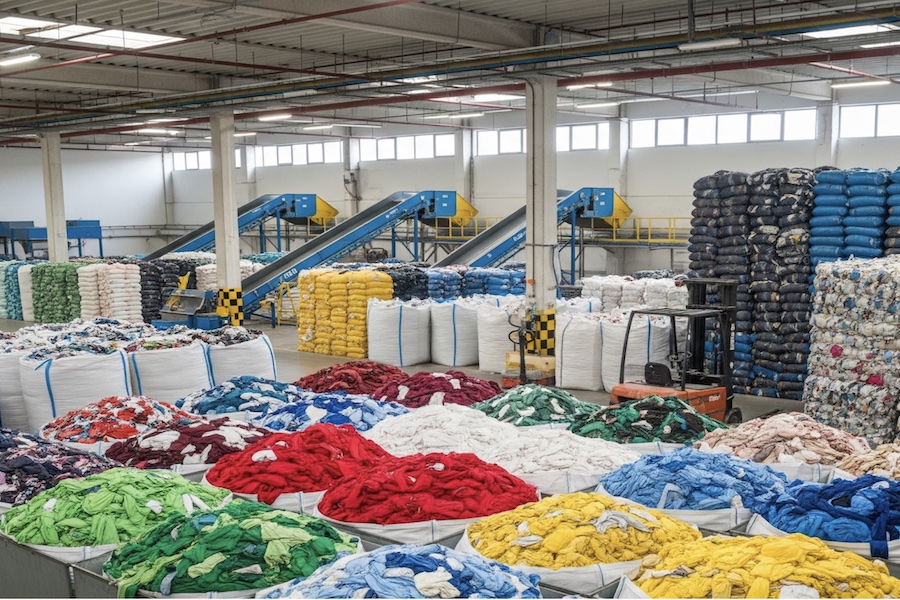
Every year, European households discard millions of tonnes of clothing. Around a quarter of what gets separately collected is exported, much of it classified as rewearable. A significant share ends up in markets like Kantamanto in Accra, Ghana, where an estimated 15 million garments arrive every week. New research published today reveals what happens when that clothing arrives.


The Sorting for Circularity: Project Rewear report, published by Fashion for Good and Circle Economy, is a year-long investigation into the real mechanics of the global secondhand clothing system. The research combines quantitative garment analysis across four EU countries, original fieldwork conducted by local partners in Ghana and Pakistan, and three innovation pilots exploring the practical and economic viability of repair, AI-powered sorting, and digital aftersales infrastructure.

Key findings include:

  • Most discarded clothes are wearable. Of 8,280 garments examined across four EU countries, 37% had no damage and 41% had one minor flaw. The barrier to rewear is economic, not material.
  • Over 86% of garments sampled at Ghana's Kantamanto Market arrived damaged despite being exported as rewearable, leaving traders who had purchased bales without any guarantee of contents to absorb the full financial and environmental cost of unsellable stock.
  • The economics of circularity are shiftable. AI-powered sorting modelled a profit shift from zero to €6.5 million annually for a mid-sized facility. Repair works well for outerwear and denim. For fast fashion basics, costs consistently outweigh resale value.
  • Rewear alone is not the answer. Without reducing production, circular strategies risk functioning as a parallel market rather than a systemic solution.

The full report is available now:

https://www.fashionforgood.com/case-study/sorting-for-circularity-rewear/?utm_source=MPL&utm_medium=MPL&utm_campaign=MPL

More News from Fashion for Good

#Recycling / Circular Economy

Solving the Feedstock Gap: Unlocking Post-consumer Feedstocks for Textile-to-Textile Recycling in Europe

Fashion for Good launches Project FAE (Feedstock Activation Europe) to develop the sorting and pre-processing infrastructure needed to channel non-rewearable post-consumer textiles into textile-to-textile (T2T) recycling at scale. The project is a practical response to one of the most pressing problems in textile circularity: making post-consumer waste a viable, commercially competitive raw material for recyclers.

#Raw Materials

Fashion for Good mobilises industry to adopt mass balance attribution and accelerate decarbonisation

Fashion for Good launches today the Mass Balance Demonstrator project, a collaborative industry initiative to implement and scale the mass balance attribution (MBA) chain-of-custody model for biomass-attributed PET in textile applications. The project represents a concrete step toward accelerating brand-driven decarbonisation across the apparel value chain.

#Recycled Fibers

Advancing the future of stretch: Fashion for Good launches new project to validate bio-based and recycled elastane

Launched today, Stretching Circularity is a collaborative project initiated by Fashion for Good dedicated to accelerating the adoption of lower-impact elastane alternatives that are compatible with circular textile systems. By validating bio-based and recycled elastane solutions through pilot-scale testing and demonstrator garments, the initiative aims to remove one of the most significant technical barriers to a circular textile economy.

#Recycling / Circular Economy

Fashion for Good releases open-source blueprint for near-net-zero textile manufacturing

Fashion for Good launches the first open-source blueprint for near-net-zero textile manufacturing, tackling one of fashion’s biggest emissions hotspots. Developed under the Future Forward Factory project, the blueprint offers Tier 2 manufacturers in India five practical, financially viable pathways to reduce carbon emissions by up to 93%.

More News on Recycling / Circular Economy

#Recycled Fibers

Lindex and BASF partner to bring textile-­to­-textile recycled polyamide to lingerie sector

Lindex has partnered with BASF’s loopamid® to accelerate textile-­to-­textile recycling and advance the shift towards more circular material solutions in the fashion industry. Together they introduce loopamid to the lingerie sector.

#ITM 2026

BB Engineering unveils new, patented “Val-uePack” spin pack at ITM

At the upcoming ITM in Istanbul, taking place June 9–13 at the Tüyap Fair Convention and Congress Center in Hall 7, Booth 702B, BB Engineering will once again be represented at a joint booth with its parent company, Barmag, and its representative, Tekstil Servis. The German machine manufacturer will show-case its expertise in man-made fiber and recycling technology, presenting its entire product portfolio, which includes compo-nents such as extruders and filters, as well as complete sys-tems for spinning synthetic fibers, air-texturing, and PET recy-cling.

#Recycled Fibers

Syre expands partnership with Target to advance next-generation recycled materials at scale

Advancing next-generation materials to support scalable circular solutions across global retail Stockholm, May 2026 — Syre, the textile impact company hyperscaling textile-to-textile recycling today announced an expanded collaboration with Target to accelerate the adoption of next-generation recycled materials across retail at scale.

#Recycling / Circular Economy

RE&UP contributes to Global Fashion Summit 2026 circularity discussion

RE&UP contributed to the global conversation on textile circularity at Global Fashion Summit 2026 in Copenhagen, where Fatih Konukoğlu, Chairman of RE&UP and Vice Chairman of Sanko Holding, took part in both the keynote session “The New Rules” and the panel discussion “A Reckoning and Renewal for Circular Horizons”, alongside leaders from H&M Group, Looper Textile Co. and Sourcing Journal.

Latest News

#INDEX 2026

INDEX 2026: Reicofil introduces RF 5.10 upgrade boosting output by 10 percent

At INDEX 2026, Reifenhäuser Reicofil will present its latest developments for the nonwovens industry under the guiding themes “Grow Together”, “Expand Together” and “Transform Together”. On this occasion, the leading manufacturer of nonwoven machinery will be unveiling two brand-new technology advancements – RF 5.10 upgrade and RF Core – at the show.

#Dyeing, Drying, Finishing

Tradition and Innovation – Phoenox Textiles Ltd. relies on state-of-the-art carpet back-coating line from Brückner

For more than 70 years, Phoenox Textiles Ltd. has been synonymous with quality, reliability, and inno-vation in the textile industry. Founded in 1954 in Huddersfield (Yorkshire, UK), a region with a long tradition in textiles, this family-owned business has continued to evolve without losing sight of its roots. Today, in its fourth generation under the leadership of the Mosley family, Phoenox successfully combines decades of experience with a clear, forward-looking corporate strategy.

#ITM 2026

Uster FiberQ excels for recycled raw materials too

Uster FiberQ is a complete solution for raw material utilization, supporting spinners to achieve consistent quality and profitability every day, building further growth for the future. The Turkish company ORTA relies on FiberQ with recycled yarn for its denim production. Data-driven knowledge puts the producer in control of raw material utilization – ready to make the correct decisions for process efficiency, quality and productivity.

#Digital Printing

EFI brings high-performance display graphics, packaging, and textile printing innovations to FESPA 2026

Electronics For Imaging, Inc. (EFI™) is bringing a broad range of new hybrid, roll-to-roll, and textile inkjet innovations to FESPA Global Print Expo 2026, taking place 19-22 May at Fira Barcelona Gran Via. Visitors to the EFI stand (Hall 3, #C85) will see the new EFI VUTEk M3h X hybrid LED printer, new EFI VUTEk® FabriVU® 340 i8 eight-colour dye sublimation printer, the EFI VUTEk X5r roll-to-roll LED printer, and the EFI VUTEk Q3h XP seven-colour hybrid printer in action, each designed to help sign and display producers scale output, diversify applications, and drive more profitable growth.

TOP