[pageLogInLogOut]

#Recycling / Circular Economy

AI Circular Economy Conference 2026 fuels innovation at the intersection of AI and Circular Economy

Industry, research and AI development experts explore how digital intelligence accelerates the transition to renewable carbon and circular materials
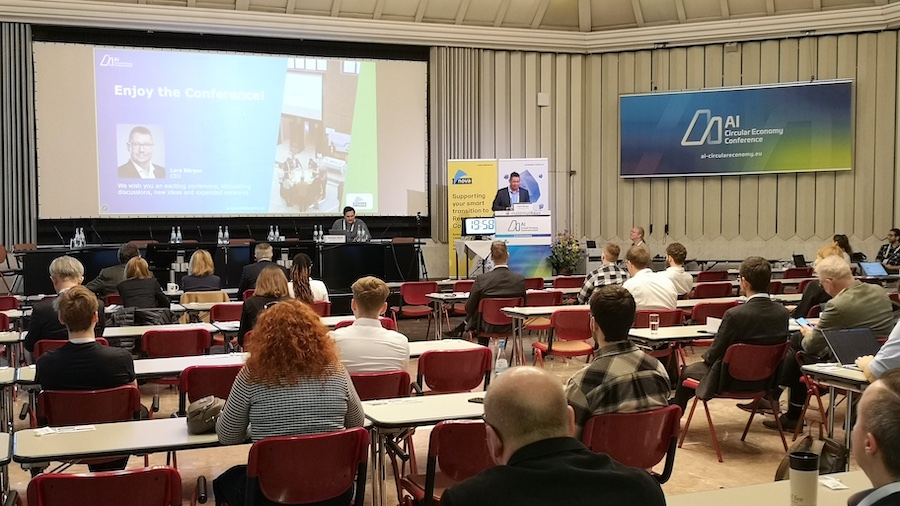
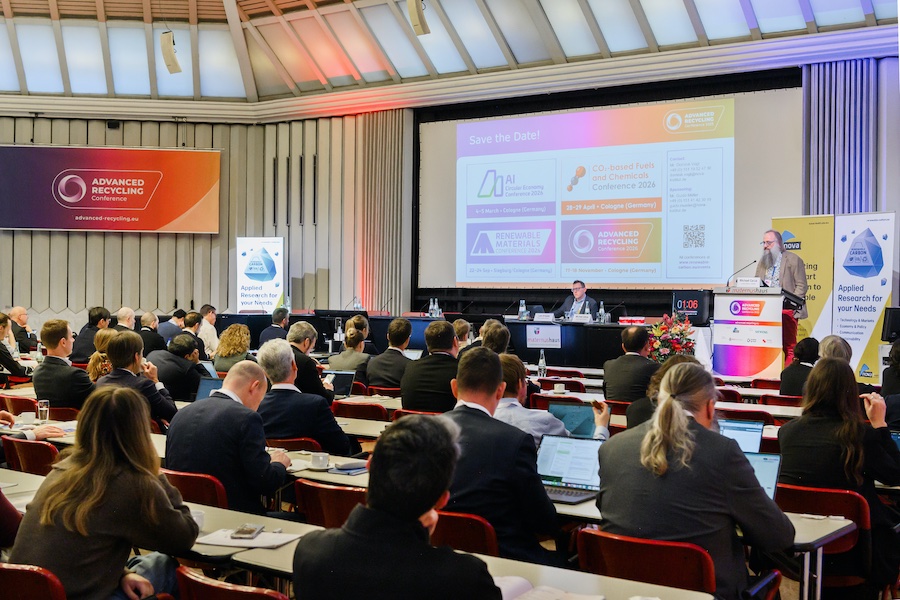
Lars Börger, CEO of the nova-Institute, opens the AI Circular Economy Conference 2026 and welcomes international participants in Cologne. Source: © nova-Institut
The AI Circular Economy Conference 2026, organised by nova-Institute, brought together 116 participants from 15 countries in Cologne and online to explore the transformation of the chemical and materials industry supported and accelerated by artificial intelligence. During the two-day event, leading experts from industry, research, start-ups and the investment community discussed how AI can maximise the potential of renewable carbon creating efficient circular value chains. The conference featured 24 presentations and multiple panel discussions, highlighting the growing convergence of digital technologies and circular material systems. It demonstrated how artificial intelligence is progressing from the experimental stage to real industrial implementation within the circular economy.

Where two worlds meet: Artificial Intelligence and the Circular Economy

As Lars Börger, CEO of nova-Institute, put it, the conference motto can be summarised as follows: “When two bubbles meet, they collide. In that moment of collision, something new can emerge, often something bigger and more powerful than either bubble on its own.”

Artificial intelligence and the circular economy are two rapidly evolving fields. When they intersect, they create opportunities for innovation, efficiency and systemic change. Therefore, the conference focused not only on technological progress, but also on new forms of collaboration, open data ecosystems, and interdisciplinary exchange between software developers, materials scientists, industrial practitioners, and policy experts.

Five thematic blocks show the breadth of AI applications

The conference programme was divided into five sections, each of which focused on a different aspect of AI applications within the circular economy. Across the event, speakers from industry, start-ups, academia and investment illustrated how AI is increasingly being applied along the entire circular value chain — from production and materials development to recycling, resource management and market decision-making.

Examples from companies, start-ups and research institutions such as Covestro, Schneider Electric, ExoMatter, Volkswagen, RWTH Aachen University and the European Circular Bioeconomy Fund (ECBF) showed how AI-driven tools are already supporting industrial transformation. Applications ranged from digital twins, predictive maintenance and real-time process optimisation in manufacturing to machine learning approaches that accelerate the discovery of new catalysts, polymers and bio-based materials. At the same time, AI-powered sorting technologies, hyperspectral imaging and advanced data platforms are helping industries better understand complex waste streams, improve feedstock quality and enable higher-value recycling pathways.

Across many presentations, one message became clear: AI alone is not the solution. Its real potential emerges when high-quality data, industrial expertise and digital capabilities come together — enabling companies to make better decisions, optimise processes and gradually build more efficient and circular material systems.

AI as a catalyst for the renewable carbon economy?

One message emerged clearly from across all sessions: artificial intelligence is rapidly becoming a key enabler of the renewable carbon economy.

AI has the potential to significantly improve productivity, sustainability and competitiveness in the chemical and materials industries by accelerating material discovery and digital twins, advancing recycling and optimising supply chains. 

By facilitating faster innovation cycles, improving resource efficiency and enabling smarter decision-making, AI can assist in the transition from fossil-based value chains to circular systems centred on biomass, captured CO₂ and recycled materials.

Partners

The AI Circular Economy Conference 2026 is supported by a strong network of partners and media organisations committed to advancing innovation at the intersection of artificial intelligence and the circular economy.

Strategic partners of the conference include organisations and industry networks closely connected to the transformation towards renewable carbon and circular material systems, such as CLIB – Cluster Industrial Biotechnology, IBB Netzwerk GmbH, Chemie-Cluster Bayern, C.A.R.M.E.N. e.V., the Renewable Carbon Initiative (RCI), kunststoffland NRW, the Institute for Textile Technology (ITA) of RWTH Aachen University, the German AI Association (KI Bundesverband), and CO₂ Value Europe. 

Continuing the dialogue on AI and circular innovation

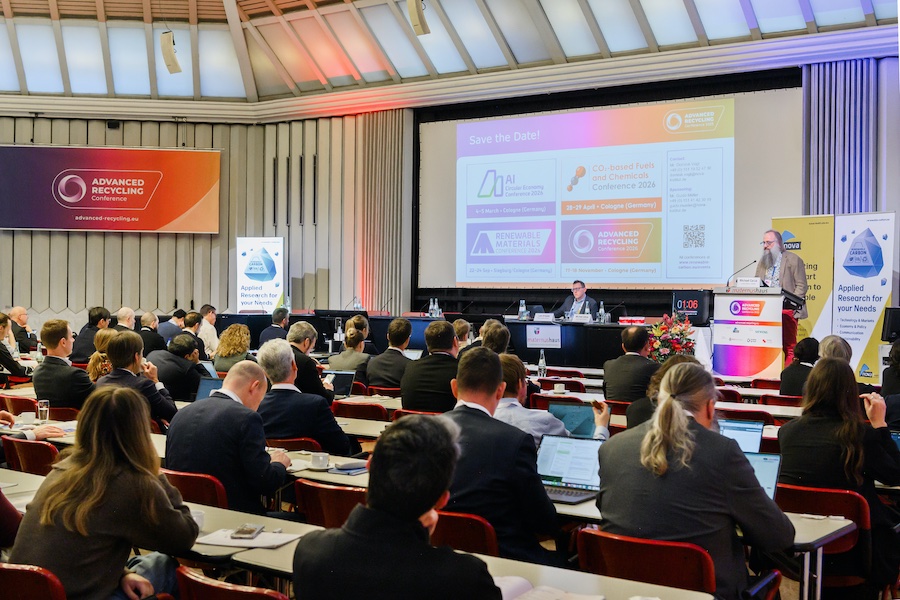
The discussion on artificial intelligence and circular economy will continue at several upcoming nova-Institute conferences. The topic of AI as an enabler for circular and renewable carbon value chains will also play an important role at the Carbon Capture & Utilisation Conference (CCU) from 28–29 April 2026 in Cologne, the Renewable Materials Conference (RMC), 22–24 September 2026 in Siegburg/Cologne, and the Advanced Recycling Conference (ARC), 17–18 November in Cologne.

Across these events, experts from industry, research and technology will continue exploring how digital intelligence, data infrastructures and AI-driven tools can accelerate innovation, improve resource efficiency and support the transition towards a circular and renewable carbon economy.

More News from nova-Institut für politische und ökologische Innovation GmbH

#Recycling / Circular Economy

Advanced Recycling Conference 2026 to showcase innovations – Call for abstracts

The call for abstracts is now open for the Advanced Recycling Conference (ARC) 2026, taking place on 17–18 November 2026 in Cologne, Germany, and online. Europe’s leading platform for advanced recycling brings together hands-on solutions and cutting-edge research on recycling technologies for various waste streams like plastics, polymers, textiles or automotive, highlighting progress towards a circular renewable carbon economy.

#Research & Development

Pioneer of the first hour: Michael Carus steps down after more than 30 years from nova-Institute’s Management

After more than three decades at the helm, founder and CEO Michael Carus is set to step down as head of the Renewable Carbon division on 1 March 2026. Lars Börger as the new CEO, will take over this key position of the nova-Institute together with COO Linda Engel, while Carus will remain with the research and consulting company as a senior advisor and shareholder. This change takes place after a one-year transition phase, as planned.

#Sustainability

The nova-Institute establishes new Renewable Feedstock Department to lay the groundwork for industrial defossilisation

The transition from fossil-based to renewable carbon – sourced from biomass, CO₂ utilisation and recycling – is the cornerstone of a climate-neutral chemical industry. The nova-Institute’s new department is dedicated to providing the essential data, analyses and strategic roadmaps required to secure a reliable future feedstock supply and make this transition a commercial and ecological reality.

#Recycling / Circular Economy

Advanced Recycling Conference 2025 fuels innovation across key waste streams

The Advanced Recycling Conference (ARC) 2025 brought together nearly 220 experts from 28 countries to spotlight pioneering advancements and foster industry collaboration in recycling across diverse waste streams including plastics, textiles, automotive and other materials.

More News on Recycling / Circular Economy

#Recycling / Circular Economy

Reju secures €135 Million in Dutch NIKI Funding for industrial-scale textile-to-textile regeneration hub at Chemelot Industrial Park, the Netherlands

Reju™, the progressive textile-to-textile regeneration company, has been awarded €135 million in funding under the Netherlands’ Nationale Investeringsregeling Klimaatprojecten Industrie (NIKI) program. The funding will support Reju’s planned industrial-scale Regeneration Hub at Chemelot Industrial Park in Sittard-Geleen, covering both the investment phase and ongoing operations, and represents a critical milestone on the path toward final investment decision.

#Recycling / Circular Economy

eeden is now a Canopy partner

eeden is committed to enable circular textiles by developing recycling technologies that turn textile waste into valuable raw materials. But the commitment goes further – eeden advocates for supply chain solutions that uphold responsible environmental and ethical standards, protecting global ecosystems including Ancient and Endangered Forests.

#Recycling / Circular Economy

Infinited Fiber Company’s environmental permit for Kemi advances to statutory appeal phase

Infinited Fiber has reached an important regulatory milestone in Finland, as the environmental permit process for a potential facility in Kemi has progressed to the statutory appeal phase.

#Recycling / Circular Economy

Carbios confirms Longlaville plant in France following financing progress

Carbios has reaffirmed its plans to build its Longlaville plant in France within a project financing framework, targeting the start of production in the first half of 2028. The company also reports a solid cash position of around €60 million at the end of 2025 and has appointed Benoît Grenot as Deputy Chief Executive Officer to support the execution of its strategic projects.

Latest News

#Raw Materials

New study shows low environmental impact by Cotton made in Africa Organic Cotton from Tanzania

Today, the Aid by Trade Foundation (AbTF) is announcing the results of a comprehensive life-cycle analysis (LCA) for cotton produced in Tanzania under the Cotton made in Africa Organic (CmiA Organic) standard. The study emphasises the small ecological footprint of CmiA Organic verified cotton. This can largely be traced back to the absence of synthetic pesticides, artificial fertilisers, and artificial irrigation. Consequently, CmiA Organic cotton can help the textile industry meet regulatory requirements as well as science-based targets. The results also show that the consequences of climate change threaten the livelihoods of these cotton farmers, even though the type of agriculture they practise barely contributes to climate change.

#Raw Materials

Better Cotton Initiative strengthens regenerative focus in standard update

The Better Cotton Initiative (BCI) has strengthened the regenerative focus of its field-level standard with the launch of a new version of its Principles & Criteria (P&C), which marks the next step in the organisation’s journey to becoming a regenerative standards system.

#Man-Made Fibers

Selenis and Kintra Fibers partner to scale 100% bio-based synthetic fiber technology

Selenis, a leading global specialty polyester manufacturer, today announced a strategic manufacturing partnership with materials science company Kintra Fibers to scale Kintra’s patented fiber-grade PBS resin - a 100% bio-based and biodegradable material designed for textile applications.

#Functional Fabrics

PERFORMANCE DAYS proves its relevance as the industry’s key meeting point

Held on March 18–19, 2026, PERFORMANCE DAYS once again confirmed its position as a leading international platform for functional textiles. A total of 3.366 trade visitors and around 560 exhibitors gathered in Munich, with the event already kicking off successfully on DAY 0, which received highly positive feedback for its interactive format. Despite challenging conditions caused by the public transport strike in Munich, the event saw strong attendance and a consistently high level of activity across both exhibition days.

TOP