[pageLogInLogOut]

#Research & Development

Textile daylight management when the winter sun is at an angle
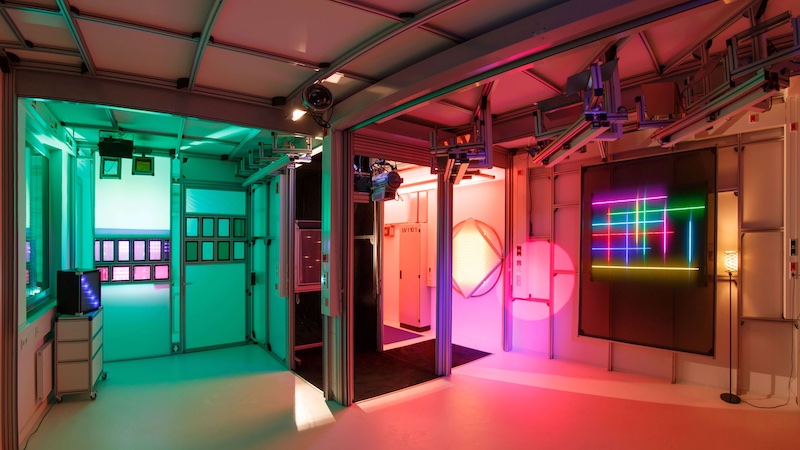
When the sun is currently shining, shading textiles face particular challenges. On the one hand, they should allow as much daylight as possible into the rooms during the dark season. On the other hand, the angle of incidence of the sun's rays is so low that the light is particularly dazzling - much more so than in summer. The German Institutes of Textile and Fiber Research (DITF) are using special light measurement techniques to research suitable shading textiles.
The DITF light lab. Photo: DITF


Daylight enhances well-being and has many advantages over artificial lighting. Sensible daylight management can therefore increase the ability to perform and concentrate. As less artificial light is required and solar gains and losses are used for room air conditioning, daylight management also saves energy.
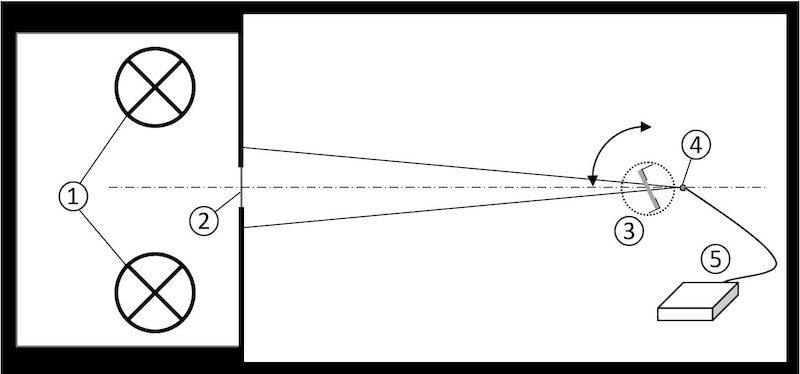
Scheme for determination of the cut-off angle with 1 light source, 2 diffuser, 3 measurement sample on motorized rotating stage, 4 collimating lens, 5 spectrometer. Drawing: DITF


Textile daylight systems influence the incidence of light and are mainly designed to be movable. Internal systems include, for example, roller blinds, folding blinds and curtains. External systems are external venetian blinds, awnings and screens that are guided in front of the façade. The DITF can precisely measure daylight behavior in its light and dark laboratories - even beyond existing standardized test methods.

A test method developed in Denkendorf allows the glare control of solar protection devices to be re-evaluated and has been included in the standard to determine the cut-off angle. This cut-off angle describes the extent to which a solar protection device can block the transmission of direct light from a certain angle of incidence. In the currently valid standard, glare control is quantified using the two characteristics of normal and diffuse light transmittance. For solar protection devices with an openness coefficient of 1-3 %, a higher glare control class can be achieved. This applies to cut-off angles of 65° or less. The cut-off angle is determined by an angle-dependent measurement of the direct light transmittance. During the test, the solar protection textile is rotated in a modified test sample holder from the zero point until the direct light transmittance falls below a defined threshold value. This process is repeated after a gradual azimuthal rotation of the test sample, in other words a rotation of the textile in the test sample holder. Depending on the symmetry properties of the sample, up to 29 individual measurements may be required to determine the cut-off angle.

At the DITF, testing and development facilities for other photometric requirements such as incident light, self-luminous textiles and light-conducting textiles are available for industrial product developments.
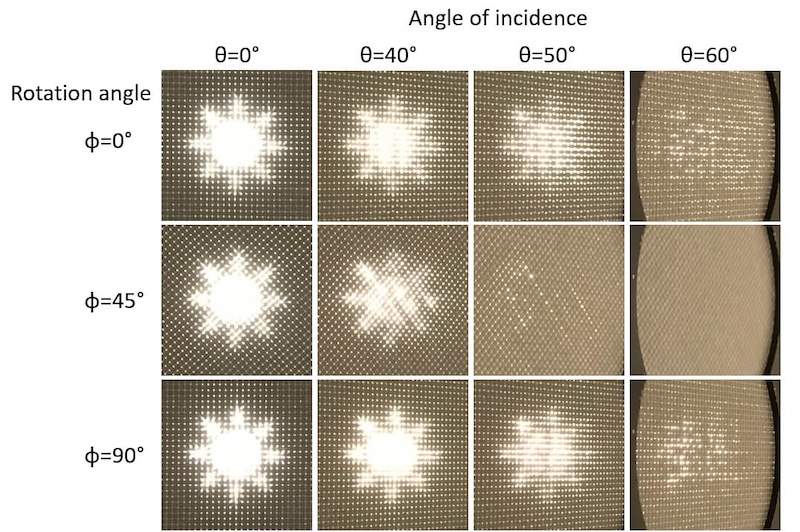
The direct transmission of a textile screen when changing the angle of incidence and the specific angle of rotation. Photos: DITF


More News from Institut für Textil- und Verfahrenstechnik Denkendorf

More News on Research & Development

#Research & Development

More safety and comfort for protective clothing thanks to auxetic fabrics

When everyday materials are pulled, they stretch or elongate in the direction of the pull and become narrower in cross-section. We can also observe this property in two-dimensional textiles. Auxetic structures behave differently here. They have the striking property of not changing under tensile stress or even increasing their width or thickness. These properties are advantageous, for example, in protective textiles or textile filter media. The DITF are researching auxetic fabrics for various applications.

#Research & Development

Fraunhofer CCPE presents the “Monomaterial Design Set” – Innovative solutions for circular product design

Composite materials made from different types of plastic often extend the lifetime of products but make recycling more difficult in the circular economy. That is why Fraunhofer CCPE has developed the “Monomaterial Design Set”. This new approach helps to reduce the variety of plastics used in durable products and offers circular solutions for designers and product developers.

#Research & Development

How innovations drive BASF’s success

“Innovation has always been part of BASF’s DNA. Especially in these volatile times, it is crucial to leverage our innovative strength to develop competitive solutions that differentiate us as a company in our markets and give us a competitive edge,” said Dr. Stephan Kothrade, Member of the Board of Executive Directors of BASF and Chief Technology Officer, at the company’s Research Press Briefing held today. To achieve this, BASF implemented its “Winning Ways” strategy about a year ago with the clear goal of becoming the preferred chemical company to enable its customers’ green transformation.

#Research & Development

Small tolerances, big impact and a recyclable alternative to elastane

ITA Master's student Janne Warnecke investigated tension differences over the fabric width in the weaving process and thereby contributed to quality assurance; ITA Bachelor's student Jasmin Roos found a basis for the development of recyclable yarns and textiles. For these developments, they were awarded the Walter Reiners Foundation's Promotion and Sustainability Prizes on 27 November. Peter D. Dornier, Chairman of the Walter Reiners Foundation, presented the awards at the Aachen-Dresden-Denkendorf International Textile Conference (ADD-ITC) in Aachen, Germany.

Latest News

#People

Happy Holidays!

Dear reader, the year 2025 is drawing to a close. We are entering what we hope will be a peaceful holiday season, spending time with our families and taking a moment to pause and reflect. We hope we have been able to support you once again this year with relevant news and articles, and we look forward to surprising you with many innovations in the coming year. Enjoy the festive season, stay healthy, and we wish you a happy and joyful holiday season.

#Weaving

Lindauer Dornier announces leadership transition in weaving machine business

After more than ten successful years at Lindauer DORNIER GmbH, Mr Wolfgang Schöffl will leave the family-owned company at the end of the year to enter well-deserved retirement.

#Heimtextil 2026

Texpertise Focus AI: Messe Frankfurt puts Artificial Intelligence centre stage at its international textile and apparel trade fairs

Under the banner 'Texpertise Focus AI, Messe Frankfurt will place a strong emphasis on Artificial Intelligence (AI) across its international textile and apparel trade fairs from 2026 onwards, setting a future-shaping signal for the industry. The initiative highlights the responsible use of AI along the entire textile value chain, from fibre production to the point of sale. The programme will launch at Heimtextil in Frankfurt in January 2026.

#Technical Textiles

Autoneum and Polestar set new benchmarks for passenger experience and sustainability

As the global market leader in sustainable acoustic and thermal management, Autoneum is a key supplier of interior and exterior components for the highly anticipated Polestar 5 model. The successful collaboration between Autoneum and Polestar marks a significant milestone in sustainable automotive engineering: the electric grand tourer sports car features several innovations in lightweight, fully recyclable polyester-based components that ensure a superior driving experience. Polestar 5 was revealed at the IAA Mobility 2025 in Munich and is available in 24 markets.

TOP