[pageLogInLogOut]

#Research & Development

Soft interfaces: Textile-integrated light switches, made possible by printable Liquid Metal Ink
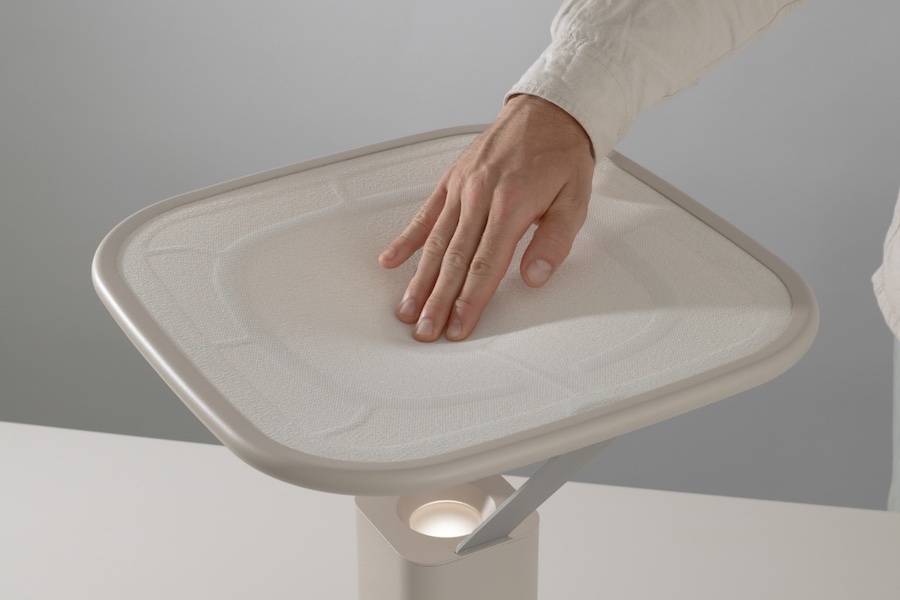
A look at the demonstrator © WINT Design Lab / Michelle Mantel
A gentle tap on the knitted lampshade is enough to switch on the light. The lamp developed by Fraunhofer IZM in cooperation with WINT Design Lab works with a revolutionary conductive ink. Visitors can find out more and try the lamp themselves at the Berlin Science Week on November 1st and 2nd.


Lukas Werft and Christian Dils of the Fraunhofer Institute for Reliability and Microintegration IZM and their counterparts, Robin Hoske and Felix Rasehorn of WINT Design Lab, are coming to the Berlin Science Week to reveal their »Soft Interfaces« project to the waiting public. The aim of this innovative research is to develop textiles that can respond to touch and interact intelligently with their environment. The project’s magic lies in the newly developed and fully printable Liquid Metal Ink (LMI) made with Galinstan. The electrically conductive ink is covered in highly elastic thermoplastic polyurethane (TPU) and can be laminated right into knitted textiles to create surfaces that are not just functionally usable, but also flexible, stretchable, pleasing to touch and pleasing to the eye.

Showcasing the technology with a special lamp

One great example that shows the capabilities of the technology is an interactive, 3D-printed lamp with a special textile lampshade. The clean lines of the 3D-printed lamp are not harmed by any intrusive switches or buttons. Only a subtle difference in the knitted pattern invites users to touch the flat lampshade, intuitively switching the light on or off. LEDs are integrated into the body of the lamp that can be dimmed or change their color in this way.

The lampshade is made from a knitted fabric stretched over a 3D-printed frame. It includes seven LMI sensor units for controlling the light intuitively. With a simple touch, the user can turn the light on or off, dim the light, or change the color temperature. The fabric itself becomes the user interface, opening up a whole new dimension of interactivity.

Innovative technology

All of this is made possible by the newly invented Liquid Metal Ink (LMI), an electrically conductive, but also environmentally friendly ink that works with Galinstan. This alloy of gallium, indium, and tin is mixed with a solution of thermoplastic polyurethane (TPU), resulting in the viscous LMI that can be printed onto elastic substrates to create structures that work like resistive strain sensors. Gentle pressure is enough, and the resistivity of the material changes, alerting the light controllers to switch on the lamp, dim the light, or change its color.
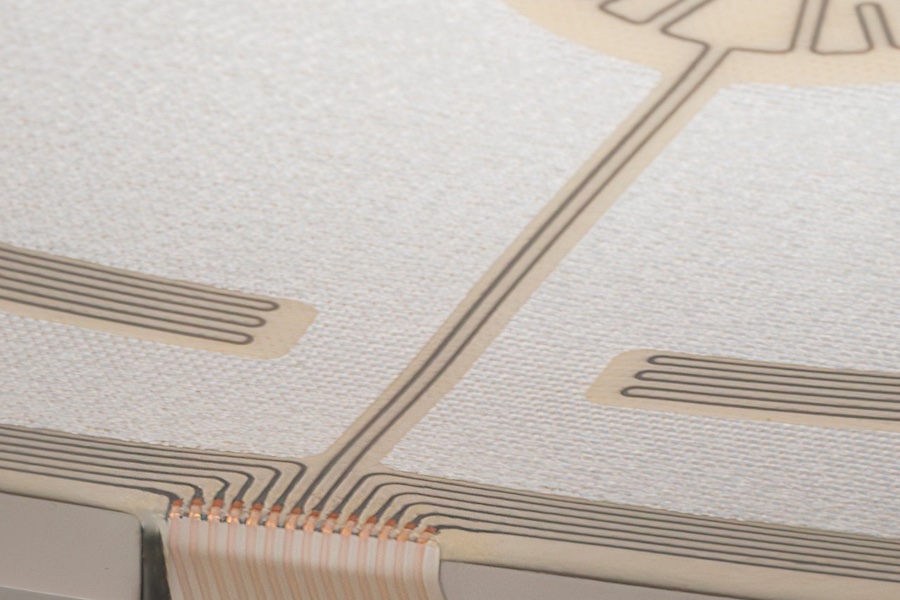
© WINT Design Lab / Michelle Mantel


Interdisciplinary collaboration

The project was born from the close cooperation between design and material science that is supported by the Fraunhofer Network »Science, Art, Design. « Regular workshopsand collaborative work at Fraunhofer IZM and WINT Design Lab brought together technological know-how and product and interaction design insights into a streamlined tactile user experience.

Future opportunities

»Soft Interfaces« shows the great potential of liquid metal conductors for diverse applications in elastic fabrics, from novel control interfaces for smart home textiles, intuitively functional surfaces for vehicles, or wearable sensors to soft robotics. The technology is currently still limited to laboratory or prototype uses, but is very promising for scalable, energy-efficient products.

On November 1st and 2nd, 2025 researchers from the Fraunhofer network »Science, Art, Design« will be on site at the Museum of Natural History’s CAMPUS as part of the Berlin Science Week. For more information, visit: https://berlinscienceweek.com/programme/textilien-die-fuhlen-mit-intelligenten-oberflachen-zur-neuartigen-interaktion


Credits:

Technical Management: Fraunhofer IZM (Lukas Werft, Christian Dils, Carlos Wisbar, Raphael Mgeladse)

Design: WINT Design Lab (Felix Rasehorn, Robin Hoske, Julia Huhnholz)

Fabric Development: Case Studies (Laura Krauthausen, Konstantin Laschkow)

Video und Fotografie: Michelle Mantel

Project Funding: Fraunhofer Network »Science, Art, Design (WKD)«


More News from Fraunhofer-Institut für Zuverlässigkeit und Mikrointegration IZM

More News on Research & Development

#Research & Development

New DIN SPEC assesses environmental impact of textile fragments in soil

Textile products made from synthetic fibres, finished fabrics or dyed materials release fibre fragments into the environment at every stage of their life cycle. With the new DIN SPEC 19296, Hohenstein has developed a standardised testing method to analyse how these fragments behave in soil under natural conditions. Until now, little was known about their environmental behaviour or potential ecological effects once released.

#Research & Development

Solid Air Dynamics wins second place at RWTH Innovation Award

On 30 January, RWTH spin-off Solid Air Dynamics was awarded second place in the RWTH Innovation Awards for its research in the field of aerogel fibres. Manufactured from renewable raw materials, aerogel fibres offer outstanding thermal insulation, are extremely lightweight and completely biodegradable, and can consist of over 90 per cent air.

#Research & Development

Testing and research laboratory ensures safe and more sustainable products worldwide

For 80 years, Hohenstein has stood for independent testing, scientific expertise and practical solutions. Today, the testing and research service provider supports manufacturers and brands worldwide in making textiles, hardlines and medical devices safe, more sustainable and market-ready – thereby building trust among consumers. With an international presence and interdisciplinary expertise, Hohenstein supports its customers from production through to market launch, helping them navigate an environment of growing regulatory and societal demands.

#Research & Development

Award-winning research for sustainable carbon fibre cycles

Sustainable recycling of carbon fibres is possible through targeted electrochemical surface modification, which makes the sizing of carbon fibres resistant to solvolysis. ITA PhD student Sabina Dann was awarded the MSW Award from RWTH Aachen University for her master's thesis on this development. The award ceremony took place on 12 November 2025 in Aachen.

Latest News

#Recycling / Circular Economy

Circulose restarts commercial-scale production at Ortviken plant in Sundsvall

Circulose today announced the restart of its commercial-scale production plant at Ortviken in Sundsvall, Sweden, marking a significant step in scaling next-generation materials for the global fashion industry. The company plans to resume production of CIRCULOSE®, a recycled pulp made entirely from discarded cotton textiles, in the fourth quarter of 2026.

#Textiles & Apparel / Garment

VIATT 2026 to debut German Pavilion, strengthening European participation alongside key Asian textile hubs

Vietnam’s textile and garment sector continues to be a major contributor to the country’s economic growth, with export revenues expected to reach USD 46 billion in 2025, a 5.6% increase from 2024 . From 26 – 28 February, the Vietnam International Trade Fair for Apparel, Textiles and Textile Technologies (VIATT) is set to contribute to economic growth opportunities by accelerating digital transformation and green transition across the entire textile value chain. The upcoming edition will respond to the rising demand for advanced technologies and sustainable materials with the introduction of the German Pavilion, alongside strong exhibitor participation from key Asian sectors, as well as several high-profile fringe events.

#Sustainability

Ying McGuire becomes new CEO of Cascale

Cascale today announced the appointment of Ying McGuire as Chief Executive Officer, effective June 1, 2026.

#Technical Textiles

Sustainable, lightweight, and sound absorbing: Polyester-based front trunk solution for BEVs

As car manufacturers look to further reduce their carbon footprint, Autoneum has developed an innovative front trunk solution for battery electric vehicles (BEVs), made entirely from polyester-based textile. The Ultra-Silent Frunk offers significant weight reduction, improved acoustic and thermal insulation, and uses up to 70 percent recycled material, supporting sustainable and efficient vehicle design. Autoneum, global technology leader in acoustic and thermal management for vehicles, has already received orders for the new frunk from three major OEMs in Asia and Europe to be built in three BEV models. Series production for two BEVs has been underway in China and Germany since last year.

TOP