[pageLogInLogOut]

#Research & Development

Catching heart disease early with AI-based sensor system
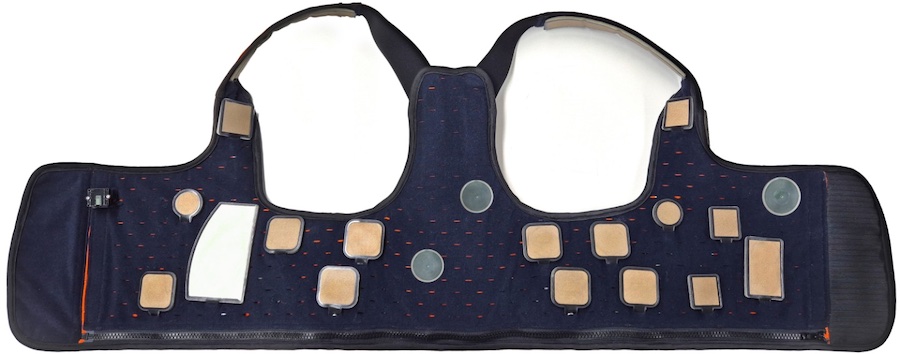
The vest can be worn by different patients and adjusted for their specific body types for greater comfort and optimum sensor readings © Fraunhofer IZM
It slips on like a normal vest: Fraunhofer IZM has created a smart sensor system in cooperation with the Charité and the Technical University of Berlin. The vest records a vast array of cardiovascular parameters, which an AI-based system uses to support medical diagnostics and spot potentially dangerous developments.

Cardiovascular diseases cause a large proportion of deaths worldwide. If they are detected in time, the chances of successful treatment are good. But long waiting lists or simply long distances for patients to see cardiac specialists often prevent an early diagnosis. Even for patients in the system, a cardiovascular problem means long and detailed analyses and regular visits to their doctor, in a local clinic or at a hospital.

As part of the joint Fraunhofer project „Medical Artificial Intelligence Applications - Center for Applied AI in Medicine“ (maia), the Fraunhofer Institute for Reliability and Microintegration IZM has teamed up with the Charité University Hospital and the Technical University of Berlin to create a sensor system that can monitor cardiovascular health in a gentle, non-invasive way.

The hardware is integrated into a smart textile vest that the patient can easily slip on and that can even be laundered. Inside the vest, there are sensors picking up more than 110 parameters, with a thousand measurements each taken every second. This makes the vest the world’s first system to capture such a large range of diagnostic parameters at the same time, and all of that continuously. On top of this information, a chatbot is at hand to ask the patient about any symptoms or issues they may be experiencing.

AI support for diagnostics and medical risk assessments

The platform is supported by a mobile edge computing module that processes the signals locally and can transmit the data wirelessly. The newly developed hybrid analytical framework combines conventional methods for processing sensor signals with cutting-edge machine learning to level up the quality of the resulting data.

The sensor data, the patient’s statements, and the doctor’s assessment are used by the AI-based system to form not just a likely diagnosis for medical personnel, but also a risk assessment for the patient, based on real-time information. This can give everybody involved crucial support for managing the cardiovascular health of the patient. It will improve access to telemedical support for patients who live in rural areas or who have mobility restrictions.

Data is captured by way of several non-invasive methods, including bioimpedance spectroscopy (BIS), electrocardiography (ECG), seismocardiography (SCG), phonocardiography (PCG), and photoplethysmography (PPG). Additional sensors are planned for the system in the future, adding echo cardiography and other capabilities. The readings are used to calculate relevant medical indicators, such as blood pressure or the size of potential edemas.

Reliable sensors in a comfortable package

The system uses innovative multichannel smart textile electrodes. To make sure that these work reliable and stay comfortable for the wearer, they come in a biocompatible and semidry form, eliminating the need for a conductive gel that could irritate and dry out the patient’s skin. The wearer simply slips on the vest, and its modular design helps keep the electrodes in the right place for stable signals, whatever shape and size the patient.

The vision is to integrate the entire system in a set of reusable stick-on patches. Made from polyurethane, the thin and dermatologically friendly material will make the system even more comfortable to wear, restrict people suffering from cardiac problems less, and ensure uninterrupted monitoring at the same time.

Fraunhofer IZM will be showcasing the system at Compamed 2025, the leading medical technology expo, coming to Düsseldorf between 17 and 20 November.


More News from Fraunhofer Institute for Reliability and Microintegration IZM

More News on Research & Development

#Research & Development

New DIN SPEC assesses environmental impact of textile fragments in soil

Textile products made from synthetic fibres, finished fabrics or dyed materials release fibre fragments into the environment at every stage of their life cycle. With the new DIN SPEC 19296, Hohenstein has developed a standardised testing method to analyse how these fragments behave in soil under natural conditions. Until now, little was known about their environmental behaviour or potential ecological effects once released.

#Research & Development

Solid Air Dynamics wins second place at RWTH Innovation Award

On 30 January, RWTH spin-off Solid Air Dynamics was awarded second place in the RWTH Innovation Awards for its research in the field of aerogel fibres. Manufactured from renewable raw materials, aerogel fibres offer outstanding thermal insulation, are extremely lightweight and completely biodegradable, and can consist of over 90 per cent air.

#Research & Development

Testing and research laboratory ensures safe and more sustainable products worldwide

For 80 years, Hohenstein has stood for independent testing, scientific expertise and practical solutions. Today, the testing and research service provider supports manufacturers and brands worldwide in making textiles, hardlines and medical devices safe, more sustainable and market-ready – thereby building trust among consumers. With an international presence and interdisciplinary expertise, Hohenstein supports its customers from production through to market launch, helping them navigate an environment of growing regulatory and societal demands.

#Research & Development

Award-winning research for sustainable carbon fibre cycles

Sustainable recycling of carbon fibres is possible through targeted electrochemical surface modification, which makes the sizing of carbon fibres resistant to solvolysis. ITA PhD student Sabina Dann was awarded the MSW Award from RWTH Aachen University for her master's thesis on this development. The award ceremony took place on 12 November 2025 in Aachen.

Latest News

#Recycling / Circular Economy

Circulose restarts commercial-scale production at Ortviken plant in Sundsvall

Circulose today announced the restart of its commercial-scale production plant at Ortviken in Sundsvall, Sweden, marking a significant step in scaling next-generation materials for the global fashion industry. The company plans to resume production of CIRCULOSE®, a recycled pulp made entirely from discarded cotton textiles, in the fourth quarter of 2026.

#Textiles & Apparel / Garment

VIATT 2026 to debut German Pavilion, strengthening European participation alongside key Asian textile hubs

Vietnam’s textile and garment sector continues to be a major contributor to the country’s economic growth, with export revenues expected to reach USD 46 billion in 2025, a 5.6% increase from 2024 . From 26 – 28 February, the Vietnam International Trade Fair for Apparel, Textiles and Textile Technologies (VIATT) is set to contribute to economic growth opportunities by accelerating digital transformation and green transition across the entire textile value chain. The upcoming edition will respond to the rising demand for advanced technologies and sustainable materials with the introduction of the German Pavilion, alongside strong exhibitor participation from key Asian sectors, as well as several high-profile fringe events.

#Sustainability

Ying McGuire becomes new CEO of Cascale

Cascale today announced the appointment of Ying McGuire as Chief Executive Officer, effective June 1, 2026.

#Technical Textiles

Sustainable, lightweight, and sound absorbing: Polyester-based front trunk solution for BEVs

As car manufacturers look to further reduce their carbon footprint, Autoneum has developed an innovative front trunk solution for battery electric vehicles (BEVs), made entirely from polyester-based textile. The Ultra-Silent Frunk offers significant weight reduction, improved acoustic and thermal insulation, and uses up to 70 percent recycled material, supporting sustainable and efficient vehicle design. Autoneum, global technology leader in acoustic and thermal management for vehicles, has already received orders for the new frunk from three major OEMs in Asia and Europe to be built in three BEV models. Series production for two BEVs has been underway in China and Germany since last year.

TOP