[pageLogInLogOut]

#Spinning

Mini-Spinning, new lab-scale shredding machine & recycling in textiles

Given the announced community directives that will soon impose in many countries the reuse of resources and the reduction of waste, the circular economy and recycling are topics of very high interest nowadays, with increasingly widespread applications in all industries, but above all in the world of textiles.

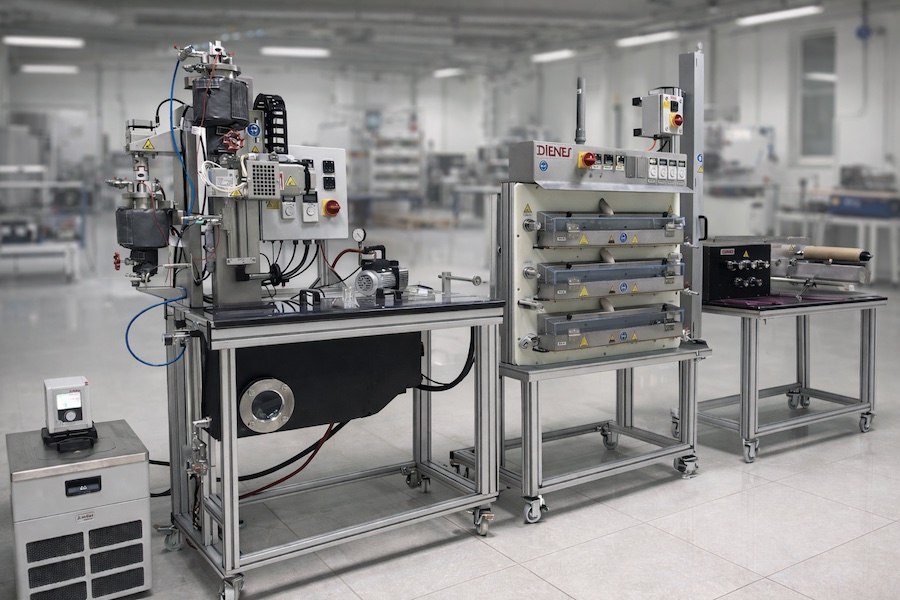
The Mesdan Mini-spinning line, in addition to its main function (teaching, R&D, sampling), is increasingly contemplated as an integral part of recycling projects: apparel manufacturers and famous brands, R&D laboratories and new startups are showing great interest in the Mesdan lines for either laboratory or small production purposes, for the recycling of old cloths, fabrics and yarn waste as well as the recovery of valuable waste fibers.

In recent years, various research institutes around the world have included the Mesdan Mini-spinning line in their textile recycling projects. The required equipment for this kind of assessment includes the card with the attached sliver web condenser, the drawing frame with the flyer for better resistance and uniformity of the roving and the ring spinning machine. Some have completed the line with the addition of machines for the production of twisted yarns (assembly winder, twisting machine) or a knitting machine, all in lab scale.


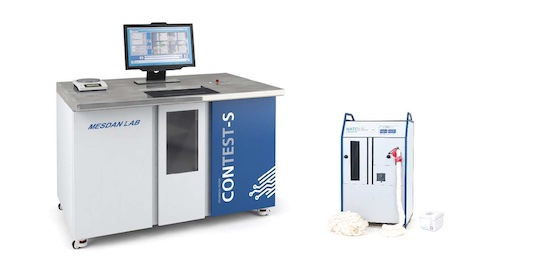
The novelty that Mesdan presented at the ITMA 2023 in Milan is the laboratory scale Shredding machine.

The machine is characterized by versatility, flexibility high performance, thanks to the possibility of customizing and saving the different settings, modifying the machine's working parameters (work cylinder rotation speed, product feeding speed and suction of the finished product).

A "standard" mechanical recycling process can be simplified as follows:

- selection and sanitization of the textile to be recycled,

- removal of non-textile parts (metal or plastic parts, such as buttons, zippers, etc),

- cutting of incoming material and Shredding,

- fiber mixing (with the possible addition of other non-recycled fibres) and carding,

- drawing plus spinning to obtain the final product (yarn with desired % composition, count and tpm)

With a production capacity of approximately 1kg/min (60kg/h), the laboratory Shredding machine is also contemplated with interest as a stand-alone recycling tool, by medium-small sized companies, for applications not necessarily aimed for reuse in spinning mills, but for different technical applications, such as non-woven, thermal/acoustic insulation materials, padding, etc.
More News from Mesdan S.p.A.

More News on Spinning

#Spinning

Rieter responds to higher raw material prices

Global political and economic developments have been leading to rising raw material and energy costs for some time. The textile machinery industry is also affected by this trend. Rieter machines and components consist to a large extent of steel, copper, aluminum and electronics. These materials in particular have seen higher demand and higher prices in recent months.

#ITM 2026

The hub of smart and sustainable transformation in yarn technologies: ITM 2026

With global fiber production projected to reach 169 million tons by 2030, yarn manufacturing is becoming one of the most strategic fields within the textile machinery industry. Located in Halls 6, 7, and 10, the Yarn Hall at ITM 2026 is set to bring together industry professionals with innovative solutions developed around automation, energy efficiency, digitalization, and circular production.

#Spinning

Barmag: DTY efficiency for the future of fancy yarns

Fancy yarns continue to gain importance in the textile market: Whether in fashion, home textiles or the automotive industry - the trend towards individuality is fueling the demand for textured, haptically differentiated and at the same time comfortable yarns.”

#Spinning

Perfect quality through collaboration: Machinery from Trützschler, Toyota and Murata at Zirve Tekstil

In today’s textile industry, excellence is not achieved by chance – it’s the result of deliberate decisions, technical expertise, and the courage to go beyond conventional paths. The Turkish company Zirve Tekstil has done just that: by combining the best technologies from Trützschler, Toyota and Murata, they’ve created a production setup that delivers outstanding yarn quality – recognized worldwide.

Latest News

#Recycling / Circular Economy

Circulose restarts commercial-scale production at Ortviken plant in Sundsvall

Circulose today announced the restart of its commercial-scale production plant at Ortviken in Sundsvall, Sweden, marking a significant step in scaling next-generation materials for the global fashion industry. The company plans to resume production of CIRCULOSE®, a recycled pulp made entirely from discarded cotton textiles, in the fourth quarter of 2026.

#Textiles & Apparel / Garment

VIATT 2026 to debut German Pavilion, strengthening European participation alongside key Asian textile hubs

Vietnam’s textile and garment sector continues to be a major contributor to the country’s economic growth, with export revenues expected to reach USD 46 billion in 2025, a 5.6% increase from 2024 . From 26 – 28 February, the Vietnam International Trade Fair for Apparel, Textiles and Textile Technologies (VIATT) is set to contribute to economic growth opportunities by accelerating digital transformation and green transition across the entire textile value chain. The upcoming edition will respond to the rising demand for advanced technologies and sustainable materials with the introduction of the German Pavilion, alongside strong exhibitor participation from key Asian sectors, as well as several high-profile fringe events.

#Sustainability

Ying McGuire becomes new CEO of Cascale

Cascale today announced the appointment of Ying McGuire as Chief Executive Officer, effective June 1, 2026.

#Technical Textiles

Sustainable, lightweight, and sound absorbing: Polyester-based front trunk solution for BEVs

As car manufacturers look to further reduce their carbon footprint, Autoneum has developed an innovative front trunk solution for battery electric vehicles (BEVs), made entirely from polyester-based textile. The Ultra-Silent Frunk offers significant weight reduction, improved acoustic and thermal insulation, and uses up to 70 percent recycled material, supporting sustainable and efficient vehicle design. Autoneum, global technology leader in acoustic and thermal management for vehicles, has already received orders for the new frunk from three major OEMs in Asia and Europe to be built in three BEV models. Series production for two BEVs has been underway in China and Germany since last year.

TOP