[pageLogInLogOut]

#Sustainability

Lindauer DORNIER continues to rely on solar power
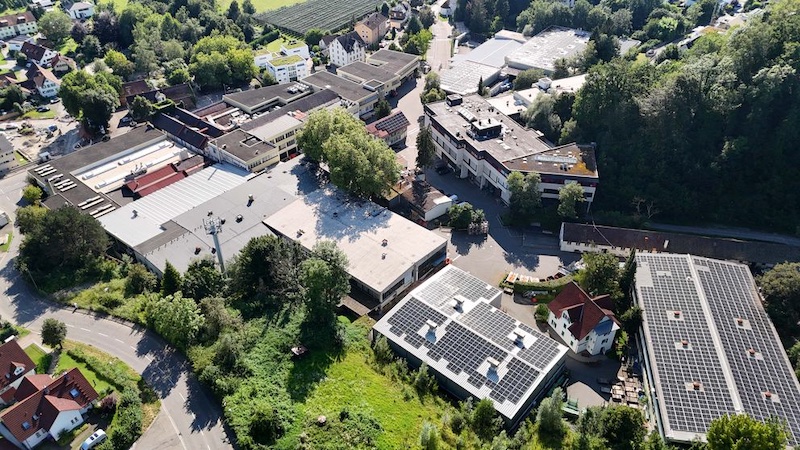
Lindauer DORNIER has put a new photovoltaic system into operation at its main plant in Lindau. Following the system at the Esseratsweiler plant, which was connected to the grid at the end of 2022, this is the machine and plant manufacturer's second photovoltaic system. In future, it will not only supply the company's own production, but also the public power grid with environmentally friendly solar energy. The family-owned company's aim is to cover its electricity needs entirely from renewables in the long term.
The aim of the family-owned company DORNIER is to cover its energy needs entirely from renewables in the long term and to reduce its CO2 footprint © Lindauer DORNIER


With a maximum output of up to 880 kWp (kilowatt peak), the new photovoltaic system can generate up to 880,000 kWh of solar power per year under optimal conditions. This amount could supply around 220 average four-person households with electricity for a year. Spread over six roofs and with a total area of around 4,000 m², the new system is the largest rooftop system in the district of Lindau, according to Energie-Atlas Bayern. ‘The project was a bit tricky because the feed-in points are spread across the entire factory premises, some of which are listed buildings – but the high planning effort paid off,’ says Franz-Peter Matheis, CFO at DORNIER. DORNIER uses the majority of the solar power generated for the production of its air-jet and rapier weaving machines. The surplus electricity is fed into the public power grid and thus also supplies private households in the region with environmentally friendly solar energy. ‘Our thanks go above all to Stadtwerke Lindau, who have supported us at all times, especially with the fast processing and certification of the system,’ says Matheis. If the company's own electricity supply is not sufficient, it obtains 100% green electricity from hydropower by cooperating with Stadtwerke Lindau as a regional electricity provider.

Aim: to cover energy needs entirely from renewables

The new photovoltaic system is part of large investments that DORNIER has recently made to strengthen sustainability and secure the future of its two production sites in Lindau and Esseratsweiler. In addition to the photovoltaic system on the roof of the film stretching system production hall in Esseratsweiler, which was commissioned in 2022, this also includes investments in the modernisation of the machinery, the expansion of digitisation, the self-supply of nitrogen (which eliminates CO2-intensive transport) and the construction of a new training centre for up to 75 trainees and dual students in Lindau.
More News from Lindauer DORNIER GmbH

#Techtextil 2026

From carbon to canvas: DORNIER presents flexible and reliable weaving technologies for 3D weaving and dynamic markets at Techtextil

At Techtextil from 21 to 24 April 2026 in Frankfurt am Main (Hall 12.0, Stand D95), Lindauer DORNIER will be showcasing reliable and flexible weaving technologies for ever-changing market requirements. The machine and plant manufacturer will present retrofits for existing machines, the new TRITOS® FLEX 3D weaving technology, intuitive automation concepts and software solutions for data-sovereign networking of the weaving machine fleet.

#Weaving

Lindauer Dornier announces leadership transition in weaving machine business

After more than ten successful years at Lindauer DORNIER GmbH, Mr Wolfgang Schöffl will leave the family-owned company at the end of the year to enter well-deserved retirement.

#ITMA Asia + CITME Singapore 2025

DORNIER celebrates its anniversary at ITMA Asia + CITME

To mark its 75th anniversary, machine and plant manufacturer Lindauer DORNIER will be presenting the latest developments in its rapier and air-jet weaving machines at ITMA Asia + CITME in Singapore (Hall 2, Stand B401) from 28 to 31 October 2025. The focus will be on energy-efficient weaving technologies, new IoT solutions for networked textile production and systems for the series production of modern fibre composite components.

#Weaving

From the Venus flytrap to foldable aircraft wings: Peter Dornier Foundation Prize 2025 honours bionic research on 3D weaving technology

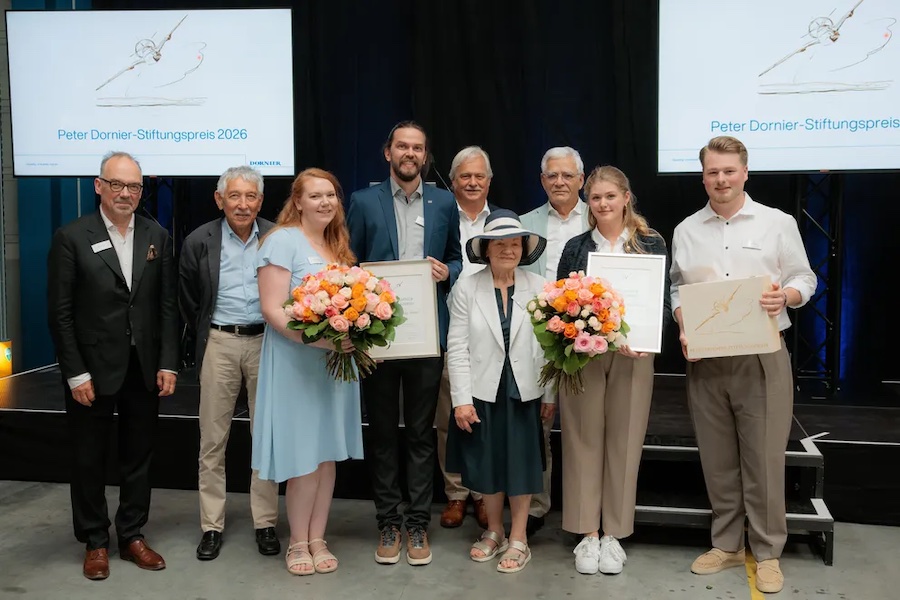
Long wings with foldable tips have the potential to reduce aircraft fuel consumption and make aviation more sustainable. An interdisciplinary research team has now developed a new solution based on the Venus flytrap: Freely movable wingtips made of fibre composites which are produced using innovative 3D weaving technology. For this pioneering combination of textile technology, aviation and bionics, researchers Patrick Meyer (TU Braunschweig) and Michael Vorhof (TU Dresden) were awarded the Peter Dornier Foundation Prize 2025 in mid-July.

More News on Sustainability

#Sustainability

A new standard to combat plastic waste in forests

With DIN SPEC 35808 “Tree Shelter for Forestry Applications,” the testing and research service provider Hohenstein, in collaboration with Rottenburg University of Forestry, as well as forestry authorities and industry partners, has established a clear framework for bio-based and fully biodegradable tree shelters. The pre-standard defines requirements and practical testing methods designed to reduce plastic waste in forests and strengthen the long-term protection of soil and the environment.

#Denim

Denim moves towards sustainability

EIM (Environmental Impact Measurement), the global reference platform for measuring the environmental impact of garment finishing, presents the second edition of its annual report Denim Industry Progress & Insights 2025. The study analyses over 100,000 real denim finishing processes, providing an accurate and up-to-date view of the industry’s evolution towards more sustainable models.

#Recycling / Circular Economy

Europe’s textile future at a turning point: New 2030 Circularity Blueprint aims to scale recycling and unlock investment opportunities

The EU textile system is at a critical crossroads. Today, less than 1% of discarded garments are recycled into new garments, despite EU-wide obligations for separate collection. In response, Global Fashion Agenda (GFA) is launching the 2030 Circularity Blueprint, in partnership with ReHubs. This ambitious initiative is designed to support the transformation of the EU textile ecosystem to advance textile-to-textile recycling and drive the transition to a circular economy.

#Sustainability

Number of GOTS-certified facilities grow 15% globally as demand for credible sustainability standards continues to strengthen

Global Organic Textile Standard (GOTS) certification continued to grow in 2025, with nearly 18,000 certified facilities worldwide, despite ongoing geopolitical uncertainty and rapidly evolving regulatory requirements across global textile supply chains.

Latest News

#INDEX 2026

INDEX 2026: Reicofil introduces RF 5.10 upgrade boosting output by 10 percent

At INDEX 2026, Reifenhäuser Reicofil will present its latest developments for the nonwovens industry under the guiding themes “Grow Together”, “Expand Together” and “Transform Together”. On this occasion, the leading manufacturer of nonwoven machinery will be unveiling two brand-new technology advancements – RF 5.10 upgrade and RF Core – at the show.

#Recycled Fibers

Lindex and BASF partner to bring textile-­to­-textile recycled polyamide to lingerie sector

Lindex has partnered with BASF’s loopamid® to accelerate textile-­to-­textile recycling and advance the shift towards more circular material solutions in the fashion industry. Together they introduce loopamid to the lingerie sector.

#Dyeing, Drying, Finishing

Tradition and Innovation – Phoenox Textiles Ltd. relies on state-of-the-art carpet back-coating line from Brückner

For more than 70 years, Phoenox Textiles Ltd. has been synonymous with quality, reliability, and inno-vation in the textile industry. Founded in 1954 in Huddersfield (Yorkshire, UK), a region with a long tradition in textiles, this family-owned business has continued to evolve without losing sight of its roots. Today, in its fourth generation under the leadership of the Mosley family, Phoenox successfully combines decades of experience with a clear, forward-looking corporate strategy.

#ITM 2026

Uster FiberQ excels for recycled raw materials too

Uster FiberQ is a complete solution for raw material utilization, supporting spinners to achieve consistent quality and profitability every day, building further growth for the future. The Turkish company ORTA relies on FiberQ with recycled yarn for its denim production. Data-driven knowledge puts the producer in control of raw material utilization – ready to make the correct decisions for process efficiency, quality and productivity.

TOP