[pageLogInLogOut]

#Sustainability

Pioneering open-source framework shows how early innovation drives a just and net-zero fashion future

Since 2015, its flagship initiative, the Global Change Award, has supported 56 teams from 23 countries with 10 million euros in grants, paving the way for circular and decarbonised business models across the textile value chain.
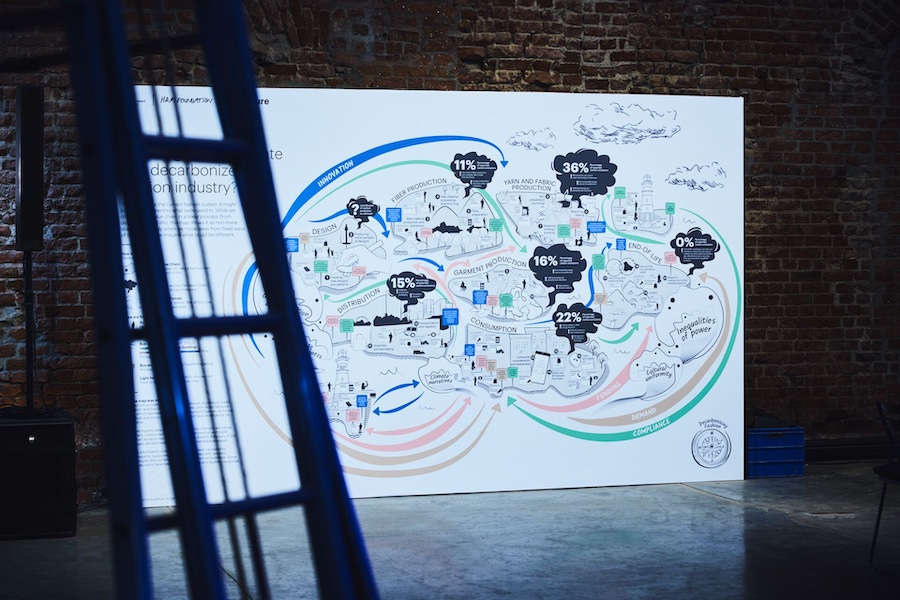
The non-profit H&M Foundation, in collaboration with Accenture, has unveiled From Signals to Systems Change, an insight report calling on the fashion industry to rethink its role in transformation. At its core is the Reimagined System Map, a pioneering open-source framework that visualises how early-stage innovation could drive a just and net-zero textile future.

Grounded in insights from innovation, philanthropy and systems thinking, From Signals to Systems Change explores how early ideas can become a catalyst for a just and decarbonised textile future. It maps the key forces reshaping fashion, from AI and geopolitics to resource scarcity and biodiversity loss, and calls on industry leaders, investors and policymakers to recognise their place in an interconnected system.

“By looking at the fashion system as it is today and reimagining what it could become, we visualised how scaling early-stage innovations might ripple across the industry“, says Annie Lindmark, Programme Director, Innovation at the H&M Foundation. Our hope is that different stakeholders will explore the System Map and ask themselves where in the system they have the most power to influence change, and in doing so, ignite new sparks of transformation.”


Annie Lindmark, Programme Director Innovation © 2025 H&M


A glimpse of a reimagined fashion system

To understand what early-stage innovation can achieve at scale, Accenture applied its 360-degree value approach to estimate the potential impact of four Global Change Award 2025 winners: Loom, PulpaTronics, Renasens and The Revival Circularity Lab. The findings show that small ideas, when supported early, can deliver outsized returns for both climate and communities. By 2050, their innovations could:

+++ Save 570,000 tonnes of CO2 annually, equal to the life-cycle emissions of 170 million cotton T-shirts.

+++ Save 160 billion litres of water, enough for the annual drinking needs of 200 million people.

+++ Create 30,000 designer jobs and reduce 3,000 tonnes of e-waste each year.

Philanthropy as a catalyst for systems change

As an independent, privately funded philanthropic organisation, the H&M Foundation uses philanthropy as risk capital, funding early ideas, breakthrough research and collaborations often considered too early or too uncertain. Since 2015, its flagship initiative, the Global Change Award, has supported 56 teams from 23 countries with 10 million euros in grants, paving the way for circular and decarbonised business models across the textile value chain.

From Signals to Systems Change builds on that mission by showing how early-stage ideas could unlock systemic opportunities and accelerate transformation across the industry. When changemakers thrive, systems change follows. The report is part of the Foundation’s ongoing work to support the textile industry in halving its greenhouse gas emissions every decade while promoting a just transition for both people and planet.

An open invitation

The report closes with a challenge to every actor in the system, from brands and suppliers to investors and citizens:

+++ Where in the system do you have the most power to influence change?

+++ Who must you collaborate with to turn ideas into action?

+++ What decision can you make today that signals real commitment to transformation?

From Signals to Systems Change is not just a report. It is an open invitation to imagine, collaborate and act.

Explore the report here:

https://hmfoundation.com/wp-content/uploads/2025/10/GCA-2025-Insight-Report.pdf


More News from H&M Group

#Sustainability

Practical toolkit to drive coordinated climate action launched

An open-access workshop toolkit enables brands, suppliers, policymakers and investors across the textile industry to apply the System Map in their own work, identifying leverage points to halve emissions and enable a just transition.

#Sustainability

H&M Foundation funds pioneering initiative to build the factories of the future

The H&M Foundation is committing SEK 53 million (approx. EUR 5 million) towards Future Forward Factories, a five-year initiative led by Fashion for Good, to address fashion’s most polluting stage: tier 2 textile processing.

#Textiles & Apparel / Garment

Global Change Award 2026: Nominations now open

On 1 September, the H&M Foundation launched the nomination round for the Global Change Award 2026. The international innovation challenge is looking for early-stage ideas that can drive the textile and fashion industry towards circularity and climate neutrality.

#Sustainability

Ten bold ideas to decarbonise fashion: Meet the winners of Global Change Award 2025

The H&M Foundation has revealed the ten winners of the Global Change Award 2025 – spotlighting groundbreaking ideas aimed at decarbonising the fashion industry in a just way. Each winner will receive a €200,000 grant and take part in the yearlong GCA Changemaker Programme – one of the few programmes of its kind focused on early-stage fashion innovation. Designed to accelerate the industry’s journey toward net-zero, the programme offers a mix of innovation support, systems thinking and personal growth.

More News on Sustainability

#Sustainability

A new standard to combat plastic waste in forests

With DIN SPEC 35808 “Tree Shelter for Forestry Applications,” the testing and research service provider Hohenstein, in collaboration with Rottenburg University of Forestry, as well as forestry authorities and industry partners, has established a clear framework for bio-based and fully biodegradable tree shelters. The pre-standard defines requirements and practical testing methods designed to reduce plastic waste in forests and strengthen the long-term protection of soil and the environment.

#Denim

Denim moves towards sustainability

EIM (Environmental Impact Measurement), the global reference platform for measuring the environmental impact of garment finishing, presents the second edition of its annual report Denim Industry Progress & Insights 2025. The study analyses over 100,000 real denim finishing processes, providing an accurate and up-to-date view of the industry’s evolution towards more sustainable models.

#Recycling / Circular Economy

Europe’s textile future at a turning point: New 2030 Circularity Blueprint aims to scale recycling and unlock investment opportunities

The EU textile system is at a critical crossroads. Today, less than 1% of discarded garments are recycled into new garments, despite EU-wide obligations for separate collection. In response, Global Fashion Agenda (GFA) is launching the 2030 Circularity Blueprint, in partnership with ReHubs. This ambitious initiative is designed to support the transformation of the EU textile ecosystem to advance textile-to-textile recycling and drive the transition to a circular economy.

#Sustainability

Number of GOTS-certified facilities grow 15% globally as demand for credible sustainability standards continues to strengthen

Global Organic Textile Standard (GOTS) certification continued to grow in 2025, with nearly 18,000 certified facilities worldwide, despite ongoing geopolitical uncertainty and rapidly evolving regulatory requirements across global textile supply chains.

Latest News

#INDEX 2026

INDEX 2026: Reicofil introduces RF 5.10 upgrade boosting output by 10 percent

At INDEX 2026, Reifenhäuser Reicofil will present its latest developments for the nonwovens industry under the guiding themes “Grow Together”, “Expand Together” and “Transform Together”. On this occasion, the leading manufacturer of nonwoven machinery will be unveiling two brand-new technology advancements – RF 5.10 upgrade and RF Core – at the show.

#Recycled Fibers

Lindex and BASF partner to bring textile-­to­-textile recycled polyamide to lingerie sector

Lindex has partnered with BASF’s loopamid® to accelerate textile-­to-­textile recycling and advance the shift towards more circular material solutions in the fashion industry. Together they introduce loopamid to the lingerie sector.

#Dyeing, Drying, Finishing

Tradition and Innovation – Phoenox Textiles Ltd. relies on state-of-the-art carpet back-coating line from Brückner

For more than 70 years, Phoenox Textiles Ltd. has been synonymous with quality, reliability, and inno-vation in the textile industry. Founded in 1954 in Huddersfield (Yorkshire, UK), a region with a long tradition in textiles, this family-owned business has continued to evolve without losing sight of its roots. Today, in its fourth generation under the leadership of the Mosley family, Phoenox successfully combines decades of experience with a clear, forward-looking corporate strategy.

#ITM 2026

Uster FiberQ excels for recycled raw materials too

Uster FiberQ is a complete solution for raw material utilization, supporting spinners to achieve consistent quality and profitability every day, building further growth for the future. The Turkish company ORTA relies on FiberQ with recycled yarn for its denim production. Data-driven knowledge puts the producer in control of raw material utilization – ready to make the correct decisions for process efficiency, quality and productivity.

TOP