[pageLogInLogOut]

#Textile chemistry

PFAS: TÜV Rheinland expands global testing capabilities

TÜV Rheinland is expanding its testing capacity worldwide to meet the growing global demand for testing services for per- and polyfluoroalkyl substances (PFAS). The testing services provider has seen demand increase by more than 30 per cent year-on-year. PFAS, a group of more than 10,000 known substances, are used in many industries for their functional properties, including textiles, food packaging, furniture and carpet fabrics, as well as mechanical and automotive engineering. However, their potential risk to the environment and human health is increasingly the focus of regulatory and public attention.


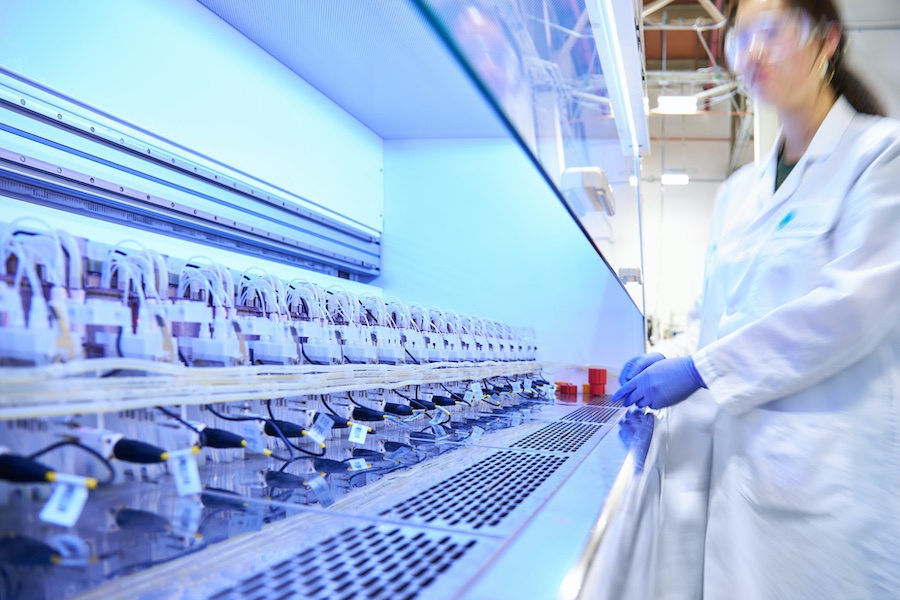
In view of increasing demand for PFAS testing services, TÜV Rheinland is expanding its testing capacities worldwide (photo: TÜV Rheinland).

The chemical ban on PFAS in many countries in the world poses new challenges for manufacturers and retailers and requires a lot of development and testing. Companies that manufacture, trade or import products will need to monitor and reduce PFAS. TÜV Rheinland is helping companies prepare for changes in legislation by providing accurate chemical analysis. "This enables companies to adapt to changes in the legal situation at an early stage, establish responsible action as a quality feature and thus remain competitive," explains Steffen Tümptner, an expert at TÜV Rheinland.

PFAS in industry – further restrictions on the horizon

In the EU, several classes of PFAS are already subject to restrictions, for example under the REACH and POP regulations. In September 2024, EU Regulation 2024/2462 was adopted, which will phase in bans on PFHxA (C6 PFAS) in certain applications over a five-year period. This includes a ban on PFAS in clothing, footwear, paper and board in contact with food and in cosmetics from October 2026. From October 2027, the ban will be extended to other textiles and leather products. European authorities are currently considering further restrictions that could cover more and more PFAS in the long term. The US authorities are also taking far-reaching action to restrict PFAS at the national level. In April 2024, the US Environmental Protection Agency (EPA) issued nationwide limits for six groups of substances in tap water, making them among the strictest in the world.

Accurate analysis and expert advice from TÜV Rheinland

TÜV Rheinland's testing packages, training and on-site audits provide the tools needed to analyse products, find suitable alternatives and ensure more sustainable production. More information on PFAS for interested parties and companies is available at: www.tuv.com/pfas



More News from TÜV Rheinland

More News on Textile chemistry

#Denim

SOKO presents low-impact denim finishing innovations at Denim PV Milan

SOKO will present a range of sustainable denim finishing technologies and collaborative projects at the upcoming Denim Première Vision Milan on 20–21 May in Milan. At booth G27 in Superstudio Più, the company will showcase new chemical solutions designed to combine fashionable denim effects with reduced environmental impact.

#Sustainability

bluesign technologies introduces bluepass

bluesign technologies ag (www.bluesign.com) today announces the launch of bluepass, a new certification mark and product labeling system created to deliver clear, substantiated, and verifiable sustainability claims at scale.

#Textile chemistry

Officina39 expands in South Asia with dual trade show presence and new low-impact dyeing innovation

Officina39 reinforces its strategic expansion in South Asia by announcing its participation in two key textile industry events in Bangladesh and India, alongside the launch of a new solution designed to reduce the environmental impact of reactive dyeing.

#Techtextil 2026

Speed and connectivity: Techtextil and Texprocess provided market-ready solutions for industries under pressure

With more than 36,000 visitors and 1,700 exhibitors from a total of 112 countries, Techtextil and Texprocess 2026 demonstrated how innovation comes into industrial use. The convergence of research, industry and application proved to be a breeding ground for new material solutions, manufacturing and processing technologies. Natural fibres, performance apparel, connected systems and AI-driven processing technologies emerged as key growth and future markets.

Latest News

#INDEX 2026

INDEX 2026: Reicofil introduces RF 5.10 upgrade boosting output by 10 percent

At INDEX 2026, Reifenhäuser Reicofil will present its latest developments for the nonwovens industry under the guiding themes “Grow Together”, “Expand Together” and “Transform Together”. On this occasion, the leading manufacturer of nonwoven machinery will be unveiling two brand-new technology advancements – RF 5.10 upgrade and RF Core – at the show.

#Recycled Fibers

Lindex and BASF partner to bring textile-­to­-textile recycled polyamide to lingerie sector

Lindex has partnered with BASF’s loopamid® to accelerate textile-­to-­textile recycling and advance the shift towards more circular material solutions in the fashion industry. Together they introduce loopamid to the lingerie sector.

#Dyeing, Drying, Finishing

Tradition and Innovation – Phoenox Textiles Ltd. relies on state-of-the-art carpet back-coating line from Brückner

For more than 70 years, Phoenox Textiles Ltd. has been synonymous with quality, reliability, and inno-vation in the textile industry. Founded in 1954 in Huddersfield (Yorkshire, UK), a region with a long tradition in textiles, this family-owned business has continued to evolve without losing sight of its roots. Today, in its fourth generation under the leadership of the Mosley family, Phoenox successfully combines decades of experience with a clear, forward-looking corporate strategy.

#ITM 2026

Uster FiberQ excels for recycled raw materials too

Uster FiberQ is a complete solution for raw material utilization, supporting spinners to achieve consistent quality and profitability every day, building further growth for the future. The Turkish company ORTA relies on FiberQ with recycled yarn for its denim production. Data-driven knowledge puts the producer in control of raw material utilization – ready to make the correct decisions for process efficiency, quality and productivity.

TOP