[pageLogInLogOut]

#Textile processing

Automatex introduces game changing quilting machine
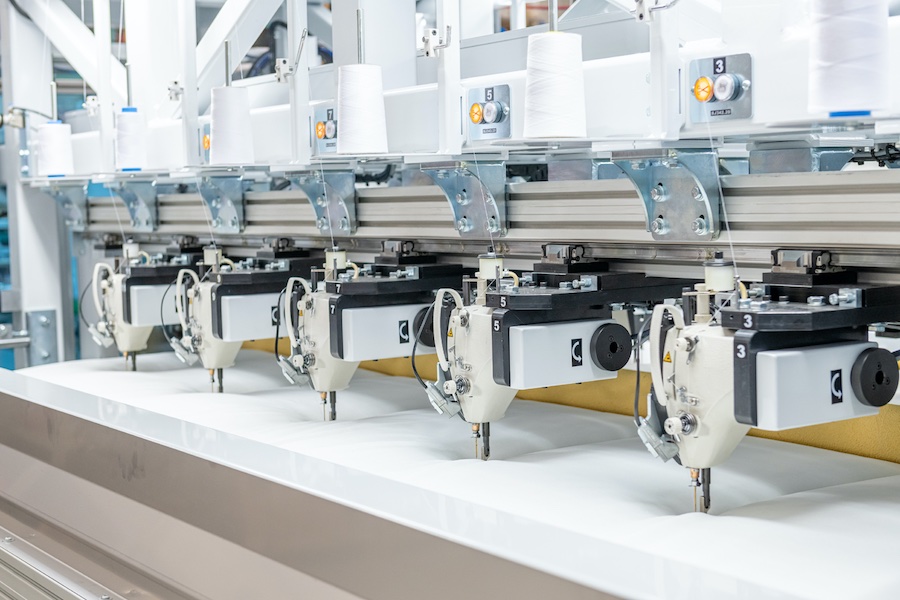
The quilting module is equipped with twelve modified servo-driven lock stitch sewing heads © 2026 Automatex
Having achieved rapid market success with its fully automated fitted sheet system, Automatex, a member of TMAS, the Swedish textile machinery association, has developed a game changing quilting machine which doubles productivity compared to what has previously been achievable.

The P12-PB Automatic Lock Stitch Quilting Unit is engineered to deliver continuous, programmable quilting while reducing manual intervention in the stitching of bedding and padded home textiles.

“Across our member companies we are seeing automation move beyond individual machines towards intelligent, interconnected production environments,” says TMAS General Secretary Therese Premler-Andersson. “Solutions like this demonstrate how textile technology manufacturers are pushing the boundaries of consistency, productivity and digital control in areas that were traditionally dependent on operator skill.”

Maximising uptime

Designed for high-volume manufacturers, the new P12-PB platform feeds fabric and filling directly into a quilting module equipped with twelve modified servo-driven lock stitch sewing heads. Arranged in two programmable banks of six, the heads allow producers to switch between straight line quilting and different shaped patterns without mechanical changeover, enabling flexible production runs while maintaining consistent stitch geometry. 

At the core of the Automatex system is an automation architecture focused on maximising uptime. Each sewing head incorporates an automatic bobbin case changer supported by a retrieval system, allowing uninterrupted production during thread depletion. Thread break detectors further minimise defects, while servo indexing ensures accurate needle positioning across the working width. A colour touch screen interface simplifies pattern programming and machine operation and remote access capability enables troubleshooting and technical support without on-site intervention. 

Operating at speeds of up to 12 metres per minute, the P12-PB is suitable for filling weights from 100-450gsm with stitch lengths between 3-4 mm. The machine produces various stitching patterns and straight lines at 21.7cm needle spacing, supporting a wide range of quilt constructions. It has been engineered for installation within standard industrial utility frameworks. 
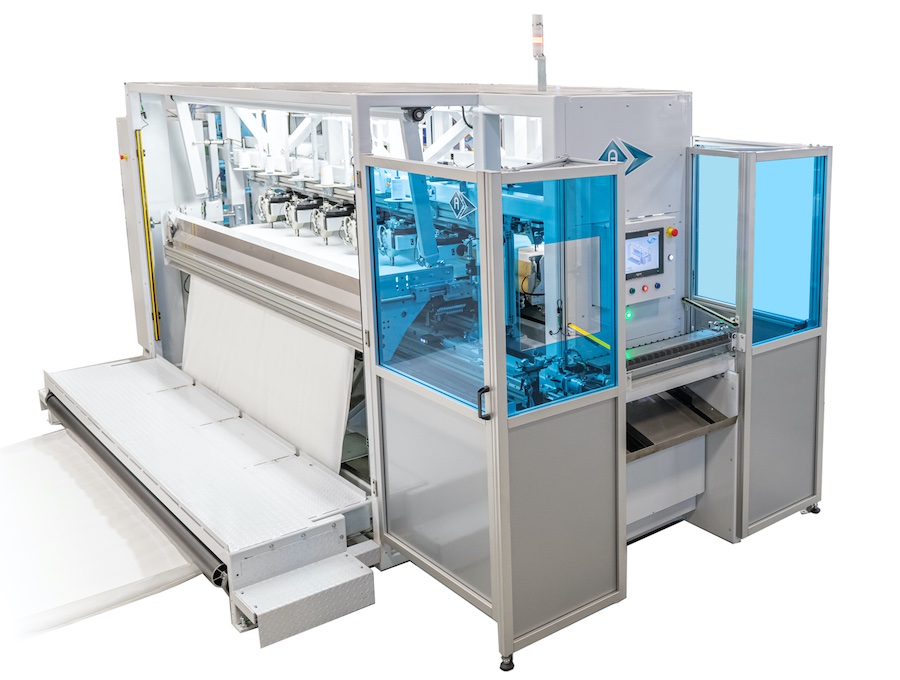
The new P12-PB platform  © 2026 Automatex<br />
The new P12-PB platform © 2026 Automatex


Continuous production

Automatex has also designed the unit for full line integration. 

“The P12-PB can be connected directly in-line with our automated sewing and folding systems to form a continuous production chain, from fibre processing through to finished product handling,” says Automatex Director of Business Development Chuck deSousa. “This approach reflects a broader industry shift toward labour-light manufacturing, traceable production and repeatable quality across large batch volumes.”




More News from Automatex

More News on Textile processing

#Textile processing

Jeanologia showcases the future of product development

Jeanologia is showcasing how software is transforming product development in the fashion industry at PI Apparel Europe: The Fashion Technology Show, taking place on March 30–31 in London.

#Techtextil 2026

Groz-Beckert showcases cross-segment innovations for technical textiles in Frankfurt

From April 21 to 24, 2026, Groz-Beckert will present its latest innovations and solutions across the product areas of knitting, weaving, nonwovens and sewing at Techtextil 2026 in Frankfurt (Hall 12, Booth B90).

#Textile processing

Major expansion for ACG Kinna follows record year

In response to growing demand for its full textile and finished product line automation services, ACG Kinna – a member of TMAS, the Swedish textile machinery association – has inaugurated a 1,000-square-metre expansion at its headquarters in Skene, Sweden.

#Texprocess 2026

Texprocess 2026: Automation, digitalisation and AI reshape textile processing

Investment decisions in textile processing have become increasingly complex. Rising energy prices, labour shortages and geopolitical uncertainties are forcing companies to prioritise technologies that deliver measurable improvements in efficiency and process stability. This applies not only to apparel production, but also to the processing of technical textiles and high-performance materials. Modernisation projects are therefore being evaluated more selectively – but the pressure to upgrade production systems continues to grow. Texprocess 2026 reflects this tension between cautious investment behaviour and increasing technological demand.

Latest News

#Raw Materials

New study shows low environmental impact by Cotton made in Africa Organic Cotton from Tanzania

Today, the Aid by Trade Foundation (AbTF) is announcing the results of a comprehensive life-cycle analysis (LCA) for cotton produced in Tanzania under the Cotton made in Africa Organic (CmiA Organic) standard. The study emphasises the small ecological footprint of CmiA Organic verified cotton. This can largely be traced back to the absence of synthetic pesticides, artificial fertilisers, and artificial irrigation. Consequently, CmiA Organic cotton can help the textile industry meet regulatory requirements as well as science-based targets. The results also show that the consequences of climate change threaten the livelihoods of these cotton farmers, even though the type of agriculture they practise barely contributes to climate change.

#Raw Materials

Better Cotton Initiative strengthens regenerative focus in standard update

The Better Cotton Initiative (BCI) has strengthened the regenerative focus of its field-level standard with the launch of a new version of its Principles & Criteria (P&C), which marks the next step in the organisation’s journey to becoming a regenerative standards system.

#Man-Made Fibers

Selenis and Kintra Fibers partner to scale 100% bio-based synthetic fiber technology

Selenis, a leading global specialty polyester manufacturer, today announced a strategic manufacturing partnership with materials science company Kintra Fibers to scale Kintra’s patented fiber-grade PBS resin - a 100% bio-based and biodegradable material designed for textile applications.

#Functional Fabrics

PERFORMANCE DAYS proves its relevance as the industry’s key meeting point

Held on March 18–19, 2026, PERFORMANCE DAYS once again confirmed its position as a leading international platform for functional textiles. A total of 3.366 trade visitors and around 560 exhibitors gathered in Munich, with the event already kicking off successfully on DAY 0, which received highly positive feedback for its interactive format. Despite challenging conditions caused by the public transport strike in Munich, the event saw strong attendance and a consistently high level of activity across both exhibition days.

TOP