[pageLogInLogOut]

#Composites

DORNIER presents new developments of its machines and systems for composite series production at JEC World 2024

The fact that fibre composite components improve sustainability due to their low weight has already been proven in many applications, from cars to aircraft. As increasing demand brings scalable composite production more into focus, the German family-owned company from Lindau on Lake Constance will be presenting new developments for the economical series production of fibre composite components at JEC World 2024 (5 to 7 March in Paris, Hall 6, Stand C 73).

In addition to established applications in the aerospace industry, fibre composite solutions are also playing an increasingly important role in sectors such as construction, energy and automotive. DORNIER has developed the production system PROTOS® (Polymer and Roving to Sheet) to enable companies to economically manufacture fibre composite structures suitable for large-scale production. PROTOS® systems can be used to produce thermoplastic fibre composite components based on unidirectional continuous fibre reinforcements (UD tapes) and organic sheets with very good drapability in high quality.

This is also interesting for companies in the automotive industry. "We want to enable automotive suppliers to produce customised and series-produced fibre composite components on an internationally competitive basis – with the desired geometry, the right mix of fibres and matrix as well as optimal mechanical properties," explains Klingele. In addition to the technology centre at Lake Constance, a tape weaving machine has therefore recently been made available for test runs at the US subsidiary of Lindauer DORNIER for interested parties – also from other industries. It can be used to process binder-fixed, fully impregnated tapes and other tape-shaped materials into semi-finished textile products. "In terms of flexibility and costs, it makes a big difference whether you buy finished sheets and then thermoform them or whether you produce them yourself with PROTOS® exactly as required," confirms Oliver Meier, VP of American DORNIER Corporation. With this new offering, we are acknowledging the great importance of the American market and invite our customers and OEMs to visit us in Charlotte, N.C. to discover this powerful technology for themselves," he adds.

Series production of lightweight components on DORNIER systems

With the production system TRITOS® (Textile Roving into Three-dimensionally Oriented Structure), DORNIER proves that complex 3D fabrics with very good damage tolerance and high dynamic load-bearing capacity can also be reliably manufactured in industrial production areas with high cost pressure. Highly specialised suppliers use TRITOS® systems to produce 3D fabrics with thicknesses of up to 100 mm for high-performance applications. "Economical series production of high-quality, customised composites is becoming increasingly important in many industrial branches," says Josef Klingele, Head of the Composite Systems product line at DORNIER.
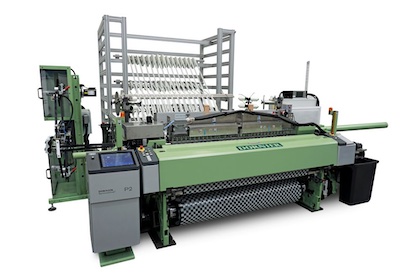

DORNIER P2 rapier weaving machine © 2024 DORNIER


News on the P2 rapier weaving machine

Variants of the DORNIER P2 rapier weaving machine which were specially developed for composites will also play a role at JEC World 2024. On the P2 Roving, the global benchmark for production systems for high-quality fabrics made of carbon, glass and aramid fibres, it is possible to produce technical reinforcing fabrics for high-end applications extremely economically thanks to its high insertion capacity and its patented and maintenance-free DORNIER SyncroDrive®. With the new integrated electronically controlled ECW+ cloth winder, high winding qualities can be achieved on a reproducible basis.

The P2 Mono Roving guarantees reliable production from heavy tow to speciality fabrics made from the finest ceramic threads. In combination with the DORNIER Zero Twist Feeder and special Zero Twist technologies for weft insertion, the P2 Mono Roving ZT allows the twist-free insertion of two weft colours at high speed and with a wide variety of patterns. Thanks to its innovative modular design, fibre composite manufacturers can use the P2 Mono Roving ZT to flexibly process a wide range of tape-shaped materials.
More News from Lindauer DORNIER GmbH

#Weaving

Lindauer Dornier announces leadership transition in weaving machine business

After more than ten successful years at Lindauer DORNIER GmbH, Mr Wolfgang Schöffl will leave the family-owned company at the end of the year to enter well-deserved retirement.

#ITMA Asia + CITME Singapore 2025

DORNIER celebrates its anniversary at ITMA Asia + CITME

To mark its 75th anniversary, machine and plant manufacturer Lindauer DORNIER will be presenting the latest developments in its rapier and air-jet weaving machines at ITMA Asia + CITME in Singapore (Hall 2, Stand B401) from 28 to 31 October 2025. The focus will be on energy-efficient weaving technologies, new IoT solutions for networked textile production and systems for the series production of modern fibre composite components.

#Weaving

From the Venus flytrap to foldable aircraft wings: Peter Dornier Foundation Prize 2025 honours bionic research on 3D weaving technology

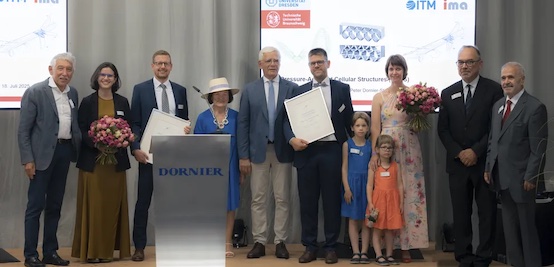
Long wings with foldable tips have the potential to reduce aircraft fuel consumption and make aviation more sustainable. An interdisciplinary research team has now developed a new solution based on the Venus flytrap: Freely movable wingtips made of fibre composites which are produced using innovative 3D weaving technology. For this pioneering combination of textile technology, aviation and bionics, researchers Patrick Meyer (TU Braunschweig) and Michael Vorhof (TU Dresden) were awarded the Peter Dornier Foundation Prize 2025 in mid-July.

#Weaving

Pattern-controlled “pic-a-pic” setting of rapier release timing on right-hand side

DORNIER PIRO enables the operator to set the timing of the rapier release on the right-hand side of the machine “pic-a-pic” and pattern-controlled. For applications with weft yarns of different fineness or elasticity, the optimum timing can be set for each weft channel. This offers great potential for reducing weft waste on the right-hand side.

More News on Composites

Latest News

#Recycling / Circular Economy

Circulose restarts commercial-scale production at Ortviken plant in Sundsvall

Circulose today announced the restart of its commercial-scale production plant at Ortviken in Sundsvall, Sweden, marking a significant step in scaling next-generation materials for the global fashion industry. The company plans to resume production of CIRCULOSE®, a recycled pulp made entirely from discarded cotton textiles, in the fourth quarter of 2026.

#Textiles & Apparel / Garment

VIATT 2026 to debut German Pavilion, strengthening European participation alongside key Asian textile hubs

Vietnam’s textile and garment sector continues to be a major contributor to the country’s economic growth, with export revenues expected to reach USD 46 billion in 2025, a 5.6% increase from 2024 . From 26 – 28 February, the Vietnam International Trade Fair for Apparel, Textiles and Textile Technologies (VIATT) is set to contribute to economic growth opportunities by accelerating digital transformation and green transition across the entire textile value chain. The upcoming edition will respond to the rising demand for advanced technologies and sustainable materials with the introduction of the German Pavilion, alongside strong exhibitor participation from key Asian sectors, as well as several high-profile fringe events.

#Sustainability

Ying McGuire becomes new CEO of Cascale

Cascale today announced the appointment of Ying McGuire as Chief Executive Officer, effective June 1, 2026.

#Technical Textiles

Sustainable, lightweight, and sound absorbing: Polyester-based front trunk solution for BEVs

As car manufacturers look to further reduce their carbon footprint, Autoneum has developed an innovative front trunk solution for battery electric vehicles (BEVs), made entirely from polyester-based textile. The Ultra-Silent Frunk offers significant weight reduction, improved acoustic and thermal insulation, and uses up to 70 percent recycled material, supporting sustainable and efficient vehicle design. Autoneum, global technology leader in acoustic and thermal management for vehicles, has already received orders for the new frunk from three major OEMs in Asia and Europe to be built in three BEV models. Series production for two BEVs has been underway in China and Germany since last year.

TOP