[pageLogInLogOut]

#Europe

EEA Scientific Committee elects new chair and vice-chairs
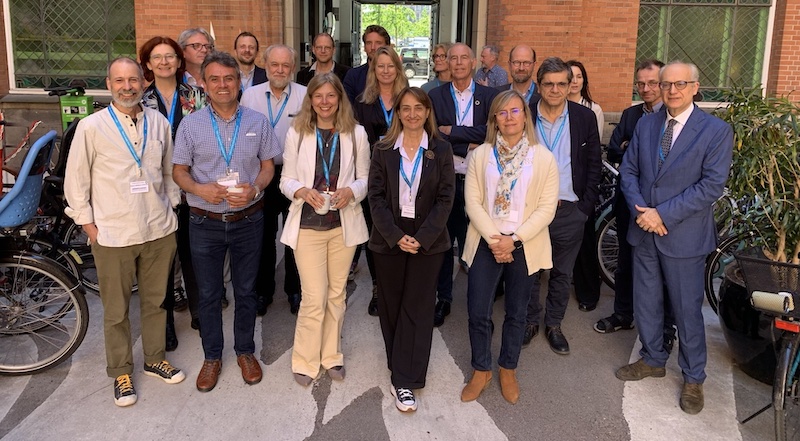
The European Environment Agency’s (EEA) Scientific Committee has elected a new chair and two vice-chairs at its spring meeting held over two days at the EEA headquarters in Copenhagen.
© 2025 EEA
© 2025 EEA


Dr. Louis Meuleman, Special Visiting Professor in Public Governance at Leuven University, Belgium, was elected as the new chair. A member of the committee since 2020, Dr. Meuleman has previously served as both vice-chair and acting chair. He will lead the committee’s efforts to ensure strategic guidance and compliance with the EEA Regulation and Scientific Committee Rules of Procedure. 

Professor Adina Dumitru and Professor Teis Hansen, both newly appointed members in 2025, were elected as vice-chairs. They bring broad expertise in environmental psychology and innovation studies, respectively. 

Professor Dumitru is Professor of Psychology at the University of A Coruña, Spain, and President of the International Association of People-Environment Studies (IAPS). Professor Hansen is Professor of Innovation and Entrepreneurship at the University of Copenhagen’s Department of Food and Resource Economics. 

Leena Ylä-Mononen, EEA Executive Director, commented: "The EEA Scientific Committee has been busy, starting the year by welcoming nine new members and this week electing a new chair and two new vice-chairs. The committee gives invaluable ‘hands-on’ input to EEA knowledge and contributes to the scientific quality of our work. I look forward to working closely with the newly-elected chair and vice-chairs as well as the other committee members over the coming years."

"I am very pleased and honored that the members have elected me to lead the committee in the coming years, in a leadership team with the two vice-chairs. In these very turbulent times, scientifically sound environmental evidence will be crucial to maintain and improve the EU’s environmental sustainability. The committee is well-placed and equipped to support the EEA with advice. We kick-started this week with discussions on future environmental knowledge needs and the challenges posed by widespread mis- and disinformation, among others", said Dr. Louis Meuleman, Chair of the EEA Scientific Committee.
More News from European Environment Agency

#Europe

State of Europe’s environment not good: threats to nature and impacts of climate change top challenges

State of Europe’s environment not good: threats to nature and impacts of climate change top challenges Significant progress has been made in reducing greenhouse gas emissions and air pollution, but the overall state of Europe’s environment is not good, especially its nature which continues to face degradation, overexploitation and biodiversity loss. The impacts of accelerating climate change are also an urgent challenge, according to the European Environment Agency’s (EEA) most comprehensive, ‘state of environment’ report, published today. The outlook for most environmental trends is concerning and poses major risks to Europe’s economic prosperity, security and quality of life.

#Sustainability

What are the impacts of PFAS polymers on our health and the environment?

The widespread use of PFAS polymers in everything from consumer products to green technologies can lead to contamination of water, air, soil, food and people. A European Environment Agency (EEA) assessment, published today, says that these chemicals can also contribute to global warming and ozone depletion.

#Europe

Consumption of clothing, footwear, other textiles in the EU reaches new record high

Europeans are buying and discarding more clothing, footwear and other textiles than ever before, which as a result, is putting more pressure on our climate and environment, according to a European Environment Agency (EEA) briefing released today. The updated consumption data highlights the need for policymakers, industry and consumers to play their role in helping Europe shift away from the fast-fashion trend, to produce better, longer lasting quality textiles which are designed to last long, and can be reused, repaired and recycled.

More News on Europe

#Europe

Antwerp Declaration community urges EU leaders to deliver emergency measures as Europe’s competitiveness crisis deepens

EURATEX, representing the European textile and fashion industry, joins the Antwerp Declaration Community’s call on EU Heads of State and Government to adopt emergency measures that restore industrial competitiveness and deliver tangible results for Europe’s manufacturing base in 2026.

#Europe

New EU rules to stop the destruction of unsold clothes and shoes

The European Commission today (Feb 9) adopted new measures under the Ecodesign for Sustainable Products Regulation (ESPR) to prevent the destruction of unsold apparel, clothing, accessories and footwear.

#Europe

FITA, ABIT and EURATEX underline strategic importance of Mercosur – EU Partnership Agreement for the textile and apparel industry

The Argentine Textile Industry Federation (FITA), the Brazilian Textile and Apparel Industry Association (ABIT), and the European Apparel and Textile Confederation (EURATEX) continue to monitor the process of internalizing the Mercosur-European Union Partnership Agreement. This agreement is essential for the competitiveness of our industries, on both sides of the Atlantic.

#Europe

Commission adopts a first-ever EU Visa Strategy

Today, the European Commission is adopting its first-ever EU Visa Strategy. It sets out a framework for a visa policy that is more strategic and that advances the EU's long-term interests, allowing it to be better equipped for growing mobility as well as the consequences of regional instability and geopolitical competition.

Latest News

#Recycling / Circular Economy

Circulose restarts commercial-scale production at Ortviken plant in Sundsvall

Circulose today announced the restart of its commercial-scale production plant at Ortviken in Sundsvall, Sweden, marking a significant step in scaling next-generation materials for the global fashion industry. The company plans to resume production of CIRCULOSE®, a recycled pulp made entirely from discarded cotton textiles, in the fourth quarter of 2026.

#Textiles & Apparel / Garment

VIATT 2026 to debut German Pavilion, strengthening European participation alongside key Asian textile hubs

Vietnam’s textile and garment sector continues to be a major contributor to the country’s economic growth, with export revenues expected to reach USD 46 billion in 2025, a 5.6% increase from 2024 . From 26 – 28 February, the Vietnam International Trade Fair for Apparel, Textiles and Textile Technologies (VIATT) is set to contribute to economic growth opportunities by accelerating digital transformation and green transition across the entire textile value chain. The upcoming edition will respond to the rising demand for advanced technologies and sustainable materials with the introduction of the German Pavilion, alongside strong exhibitor participation from key Asian sectors, as well as several high-profile fringe events.

#Sustainability

Ying McGuire becomes new CEO of Cascale

Cascale today announced the appointment of Ying McGuire as Chief Executive Officer, effective June 1, 2026.

#Technical Textiles

Sustainable, lightweight, and sound absorbing: Polyester-based front trunk solution for BEVs

As car manufacturers look to further reduce their carbon footprint, Autoneum has developed an innovative front trunk solution for battery electric vehicles (BEVs), made entirely from polyester-based textile. The Ultra-Silent Frunk offers significant weight reduction, improved acoustic and thermal insulation, and uses up to 70 percent recycled material, supporting sustainable and efficient vehicle design. Autoneum, global technology leader in acoustic and thermal management for vehicles, has already received orders for the new frunk from three major OEMs in Asia and Europe to be built in three BEV models. Series production for two BEVs has been underway in China and Germany since last year.

TOP