[pageLogInLogOut]

#Man-Made Fibers

The updated poster on biodegradable Polymers in various environments has been released
© 2026 nova-Institute
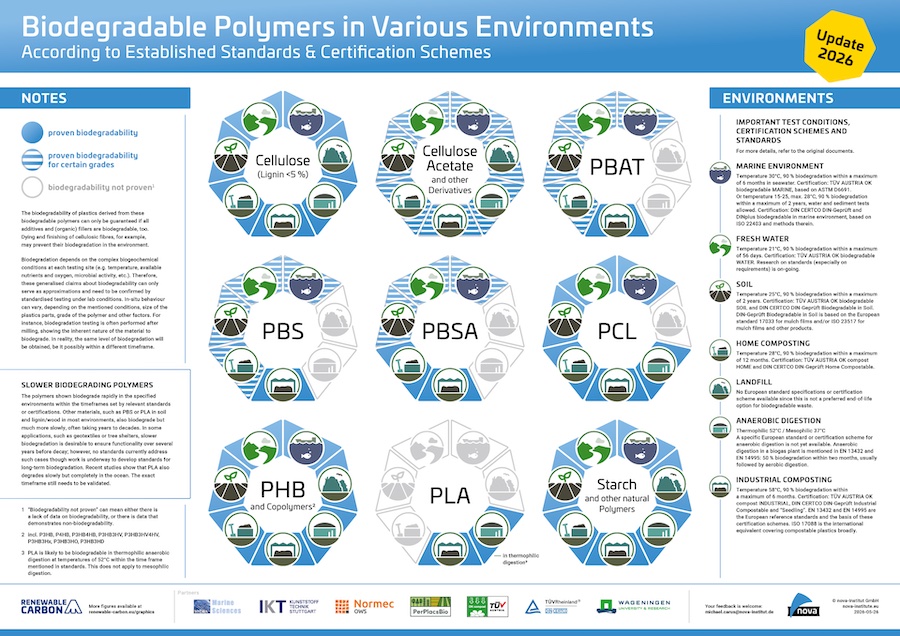
As part of the PerPlacsBio project, nova-Institute has updated its popular poster on the biodegradability of polymers in different environments. The updated version reflects current standards, certifications and the latest scientific findings. The poster can be used to assess biodegradable alternatives for use in agriculture and forestry, and it is now available in German for the first time.

    The nova-Institute has published an updated version of its popular poster, 'Biodegradable Polymers in Various Environments'. This updated version provides a more detailed and comprehensive overview of the biodegradability of polymers in different environments according to various standards. This practical reference tool remains invaluable for industry professionals, policymakers, and researchers working on sustainable plastics and end-of-life solutions in various environments

    The new version introduces several significant updates that reflect the latest scientific and regulatory developments. Notably, PBSA, PBS and PBAT are now classified as having 'proven biodegradability' in soil, marine and freshwater environments, and in home composting for PBS. This acknowledges advances in material-specific data and testing.

    The 2026 update also expands and clarifies the standards landscape. Additional references have been included, such as ISO 17088 (industrial compostability), ISO 23517 (soil biodegradability) and NF T 51-800 (home composting), alongside corrections to the descriptions of EN 17033, ISO 23517, and the available marine biodegradation standards and certifications. These updates improve alignment with current certification schemes and international testing frameworks.

    Further refinements have been made to enhance the scientific accuracy and usability of the poster:

    • A new explanatory footnote clarifies the meaning of 'biodegradability not proven'.
    • Revised content on slower-biodegrading polymers, including updated insights on PLA degradation in marine environments.
    • Integration of the PerPlacsBio project logo to reflect project continuity.
    • Availability of the poster in German, increasing accessibility for a broader audience.

    The poster summarises the biodegradation behaviour of materials in various environments, including marine, freshwater, soil and composting, based on established standards and certification schemes. It emphasises that biodegradability is highly dependent on environmental conditions and material-specific properties, and must be verified through standardised testing.

    With this update, nova-Institute and its partners continue their efforts to provide clear, science-based guidance on when biodegradability is a meaningful and appropriate end-of-life option. These partners include nova-Institute experts from Germany, as well as leading experts from Normec OWS (Belgium), Hydra Marine Science (Italy/Germany), IKT Stuttgart (Germany), Wageningen University & Research (the Netherlands), DIN CERTCO (Germany), and TÜV AUSTRIA (Austria/Belgium).

    The University of Münster, the University of Applied Forest Sciences Rottenburg, and nova-Institute launched the two-year PerPlacsBio project at the end of 2025. Funded by the Agency for Renewable Resources (FNR) under the Sustainable Renewable Resources programme, the project aims to explore the prospects for bio-based and biodegradable plastics in agriculture and forestry.

    The poster is available to download in English in both PNG and PDF formats here:

    https://renewable-carbon.eu/publications/product/biodegradable-polymers-in-various-environments-according-to-established-standards-and-certification-schemes-graphic-pdf-current-version/ (PDF)

    https://renewable-carbon.eu/publications/product/biodegradable-polymers-in-various-environments-according-to-established-standards-and-certification-schemes-graphic-png-current-version/ (PNG)

    The poster is available to download in German in both PNG and PDF formats here:

    https://renewable-carbon.eu/publications/product/biologisch-abbaubare-polymere-in-versch-umgebungen-gemas-anerkannten-normen-und-zertifizierungssystemen-graphik-pdf-aktuelle-version/ (PDF)

    https://renewable-carbon.eu/publications/product/biologisch-abbaubare-polymere-in-versch-umgebungen-gemas-anerkannten-normen-und-zertifizierungssystemen-graphik-png-aktuelle-version/ (PNG)
    More News from nova-Institut für politische und ökologische Innovation GmbH

    #Recycling / Circular Economy

    nova-Institute launches groundbreaking Advanced Recycling Database for strategic market insight

    The new Advanced Recycling Database reduces complexity by providing industry stakeholders with up-to-date expert-reviewed intelligence on companies, technologies, plants, capacities, locations, products and partnerships across the global advanced recycling landscape.

    #Recycling / Circular Economy

    Moving Advanced Recycling from Innovation to Implementation

    The Advanced Recycling Conference 2026 explores technologies, markets, financing and scale-up of innovative recycling solutions for waste streams including mixed plastic waste, textiles and PVC. Europe’s chemical and materials sector faces growing pressure to close carbon loops, strengthen raw-material safety and resilience and meet increasingly ambitious EU recycling targets. Against this backdrop, the Advanced Recycling Conference (ARC) will bring together industry leaders, technology providers, researchers, innovators and policy-makers on 17–18 November 2026 in Cologne, Germany.

    #Recycling / Circular Economy

    Advanced Recycling Conference 2026 to showcase innovations – Call for abstracts

    The call for abstracts is now open for the Advanced Recycling Conference (ARC) 2026, taking place on 17–18 November 2026 in Cologne, Germany, and online. Europe’s leading platform for advanced recycling brings together hands-on solutions and cutting-edge research on recycling technologies for various waste streams like plastics, polymers, textiles or automotive, highlighting progress towards a circular renewable carbon economy.

    #Recycling / Circular Economy

    AI Circular Economy Conference 2026 fuels innovation at the intersection of AI and Circular Economy

    The AI Circular Economy Conference 2026, organised by nova-Institute, brought together 116 participants from 15 countries in Cologne and online to explore the transformation of the chemical and materials industry supported and accelerated by artificial intelligence. During the two-day event, leading experts from industry, research, start-ups and the investment community discussed how AI can maximise the potential of renewable carbon creating efficient circular value chains. The conference featured 24 presentations and multiple panel discussions, highlighting the growing convergence of digital technologies and circular material systems. It demonstrated how artificial intelligence is progressing from the experimental stage to real industrial implementation within the circular economy.

    More News on Man-Made Fibers

    #Spinning

    Barmag’s automated maintenance processes for quality, safety, and efficiency in spinning plants

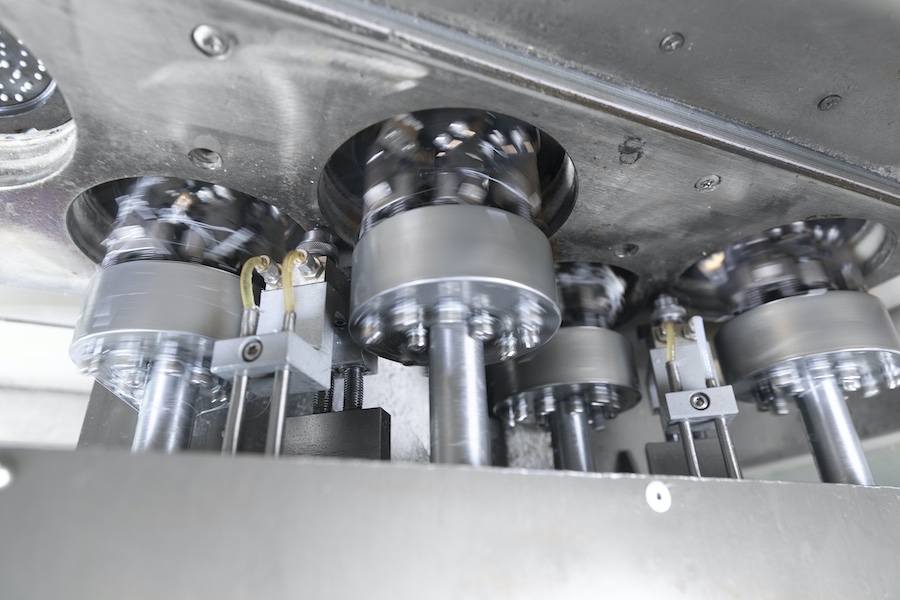
    Maintenance and service processes in chemical fiber spinning plants have a significant impact on product quality, equipment availability, and workplace safety. With three new retrofittable solutions, Barmag helps Producers make manual work processes more efficient, safer, and more reproducible.

    #Man-Made Fibers

    Selenis acquires Polisan Hellas assets and expands specialty copolyester production to more than 200,000 tonnes by 2028

    Continuous polymerisation joins Selenis’ existing lines in Portugal, Italy, Tunisia and the United States. Customers get the same grades from more than one site, supply from within their region and the cost base of continuous production for high-volume grades. Priority markets: shrink sleeves, film and sheet, healthcare, 3D printing filaments and textile to textile recycling.

    #Man-Made Fibers

    Textile Exchange: reporting companies advance on preferred materials as global fiber production reaches new high

    Companies participating in Textile Exchange’s Materials Benchmark increased their use of materials from preferred production systems in 2025, while global fiber production continued to grow and reached a record 139 million tonnes. The contrasting trends highlight both the potential for change at company level and the scale of the challenge facing the wider textile industry.

    #Man-Made Fibers

    Dutch court orders Shanghai Port Star to stop sales of HMPE link chains in EU

    The District Court of The Hague has ordered Chinese supplier Shanghai Port Star to stop selling and distributing certain synthetic fiber link chains in the European Union after finding that the products infringe EU design rights held by Avient Corporation. The ruling concerns link chains made from high-modulus polyethylene (HMPE) fibers for marine and industrial applications.

    Latest News

    #Knitting & Hosiery

    KARL MAYER invites the Global Textile Industry to celebrate its 90th anniversary at its German Headquarters in 2027

    KARL MAYER is turning its anniversary year 2027 into a milestone for the textile sector. To mark its 90th anniversary, the industry leader is inviting customers, partners, and experts from around the world to a unique event series in September aimed at pushing boundaries, unlocking new opportunities, and jointly setting the course for a new era in textiles – just as KARL MAYER has done throughout its history. The company’s headquarters in Obertshausen, near Frankfurt, is the place to be.

    #Associations

    ITMF names three winners of the Sustainability & Innovation Award 2026

    Three projects from the UK, Korea and China have been selected as winners of the ITMF Sustainability & Innovation Award 2026. The projects address textile-to-textile recycling, chemical recycling for automotive textiles and a regenerative approach combining silk production with ecological restoration.

    #Yarns

    Durak Maxibalance thread supports users’ movement and balance comfort

    Durak Tekstil, a leading brand in its industry, has developed Durak Maxibalance, a new product engineered with bio-ceramic and FAR IR technology. Ushering in a new era for sportswear, activewear, and medical textiles, this technology offers features designed to support balance and movement comfort by reflecting the energy absorbed from the body back into it.

    #Europe

    Textile ETP launches bioeconomy strategy for Europe’s textile industry

    On 22 September 2026, Textile ETP's Circular & Biobased Textiles Innovation Hub published its strategy for the biobased and circular transformation of Europe's textile and apparel industry.

    TOP