[pageLogInLogOut]

#Recycling / Circular Economy

Europe needs tipping point to scale textile-to-textile recycling, BCG and ReHubs say
© 2026 ReHubs
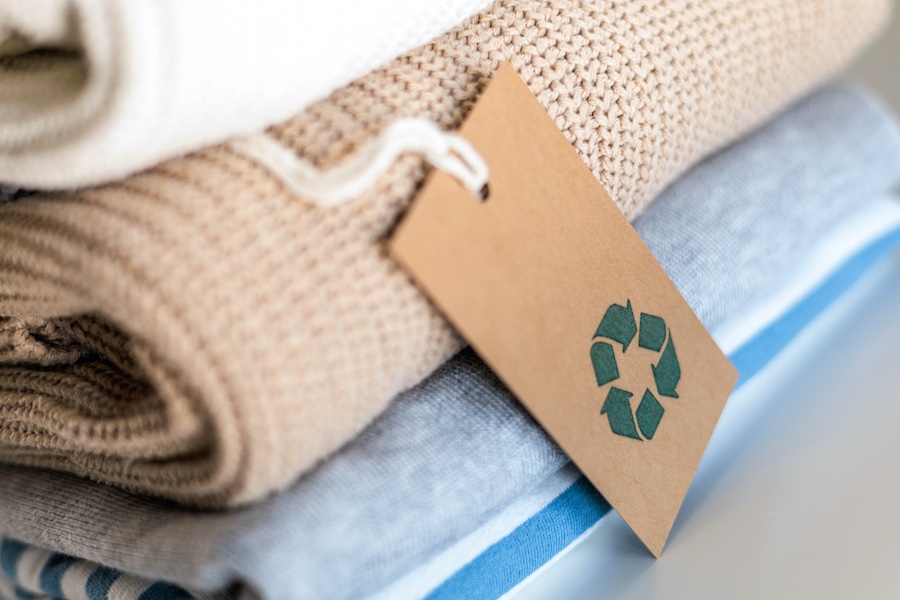
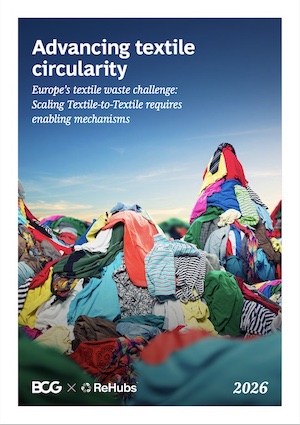
A new report from Boston Consulting Group (BCG) and ReHubs, titled “Advancing Textile Circularity – Europe’s textile waste challenge: Scaling Textile-to-Textile requires enabling mechanisms”, highlights the urgent need for systemic action to tackle Europe’s growing textile waste and scale a circular textile economy.


The report establishes the first harmonized fact base on textile waste in Europe. It finds that Europe generates around 15.2 million tonnes of textile waste every year, including 13.3 million tonnes of post-consumer waste. However, only a small share of this waste is collected and sorted for recycling, leaving most textile waste outside recycling systems.

As a result, textile-to-textile recycling currently represents less than 1% of post-consumer textile waste in Europe. At the same time, waste volumes continue to rise rapidly. Without decisive action, Europe’s textile waste could reach the equivalent of around 80 football stadiums filled with discarded textiles every year by 2035.

The report shows that scaling textile-to-textile recycling is technically possible but requires reaching a critical tipping point of c. 2.7 million tonnes of recycling annually by 2035 to unlock economies of scale and make the ecosystem viable.

Reaching this milestone will require €8-11 billion in capital investment and €5-6.5 billion in recurring annual operating costs, as well as coordinated supply- and demand-side measures across the value chain.

The analysis also underlines that textile-to-textile recycled fibers represent a new product category with structurally higher processing costs. Under current market conditions, they cannot compete directly with incumbent recycled materials or virgin fibers without targeted enabling mechanisms and coordinated policy support.

Scaling textile circularity will therefore require coordinated collaboration across the entire value chain, from improved collection and sorting infrastructure to demand signals from brands and clear policy frameworks that support investment and innovation.

Robert van de Kerkhof, CEO at ReHubs commented: “Europe has the opportunity to build a truly circular textile ecosystem, but it will require systemic change across the entire value chain. Textile-to-textile recycling is technically possible today, but scaling it requires coordinated action from industry, policymakers, and investors. Through collaboration across the value chain, ReHubs is helping to drive the transformation needed to build a circular textile economy in Europe.”

Nicolas Manuelli, Managing Director & Partner at BCG commented:“This report shows that scaling textile-to-textile recycling in Europe is achievable, but it requires the right economic conditions. Textile-to-textile recycled fibers are a new product category with higher processing costs, meaning they will not scale without enabling mechanisms. Supply-side and demand-side measures, combined with appropriate financing tools and supportive trade and industrial policies, will be essential to unlock investment and accelerate the transition to a circular textile system.”

© 2026 BCG / ReHubs
© 2026 BCG / ReHubs


Get the report:

https://www.bcg.com/publications/2026/france-advancing-textile-circularity-in-europe-the-case-for-system-level-scale-up
More News from REHUBS

#Recycling / Circular Economy

A circular European value chain turns post-consumer textile waste into new garments for Dutch retailer Zeeman

A closed-loop recycling project has successfully transformed 24 tons of post-consumer textiles into nearly 50,000 garments for Dutch retailer Zeeman, with each product containing a high-rate of 70% recycled content. This achievement represents a major milestone in accelerating textile-to-textile recycling in Europe.

#Recycling / Circular Economy

REHUBS to unveil strategy and tactical action plan to industrialise textile circularity by 2032

Europe’s circular economy in textiles and apparel is facing a daunting challenge. Increasing volumes of discarded textiles, fragile collection systems, and the flood of ultra-fast fashion are intensifying a crisis of overproduction, waste, and lost value. Despite advances in recycling technology, very few textiles today are recycled back into new textiles, with most waste still downcycled, incinerated, or exported.

#Recycling / Circular Economy

REHUBS to build industry-wide circularity roadmap and action plan in response to increasing textile waste challenges in Europe

ReHubs is leading systemic change across the textile and apparel industry, bringing together key stakeholders to achieve ambitious circularity goals through aligned efforts in infrastructure, policy, and finance. Since its inception, ReHubs has been the catalyst and engine for transforming Europe’s textile and apparel recycling landscape.

#Recycling / Circular Economy

Robert van de Kerkhof is new ReHubs CEO

ReHubs, the European textile recycling alliance, is announcing today a change in its daily leadership: Robert van de Kerkhof is taking over as interim CEO from Chris Deloof, who returns to Ghent University after 2 years of successful engagement with the organisation.

More News on Recycling / Circular Economy

#Recycling / Circular Economy

Reju secures €135 Million in Dutch NIKI Funding for industrial-scale textile-to-textile regeneration hub at Chemelot Industrial Park, the Netherlands

Reju™, the progressive textile-to-textile regeneration company, has been awarded €135 million in funding under the Netherlands’ Nationale Investeringsregeling Klimaatprojecten Industrie (NIKI) program. The funding will support Reju’s planned industrial-scale Regeneration Hub at Chemelot Industrial Park in Sittard-Geleen, covering both the investment phase and ongoing operations, and represents a critical milestone on the path toward final investment decision.

#Recycling / Circular Economy

eeden is now a Canopy partner

eeden is committed to enable circular textiles by developing recycling technologies that turn textile waste into valuable raw materials. But the commitment goes further – eeden advocates for supply chain solutions that uphold responsible environmental and ethical standards, protecting global ecosystems including Ancient and Endangered Forests.

#Recycling / Circular Economy

Infinited Fiber Company’s environmental permit for Kemi advances to statutory appeal phase

Infinited Fiber has reached an important regulatory milestone in Finland, as the environmental permit process for a potential facility in Kemi has progressed to the statutory appeal phase.

#Recycling / Circular Economy

Carbios confirms Longlaville plant in France following financing progress

Carbios has reaffirmed its plans to build its Longlaville plant in France within a project financing framework, targeting the start of production in the first half of 2028. The company also reports a solid cash position of around €60 million at the end of 2025 and has appointed Benoît Grenot as Deputy Chief Executive Officer to support the execution of its strategic projects.

Latest News

#Raw Materials

New study shows low environmental impact by Cotton made in Africa Organic Cotton from Tanzania

Today, the Aid by Trade Foundation (AbTF) is announcing the results of a comprehensive life-cycle analysis (LCA) for cotton produced in Tanzania under the Cotton made in Africa Organic (CmiA Organic) standard. The study emphasises the small ecological footprint of CmiA Organic verified cotton. This can largely be traced back to the absence of synthetic pesticides, artificial fertilisers, and artificial irrigation. Consequently, CmiA Organic cotton can help the textile industry meet regulatory requirements as well as science-based targets. The results also show that the consequences of climate change threaten the livelihoods of these cotton farmers, even though the type of agriculture they practise barely contributes to climate change.

#Raw Materials

Better Cotton Initiative strengthens regenerative focus in standard update

The Better Cotton Initiative (BCI) has strengthened the regenerative focus of its field-level standard with the launch of a new version of its Principles & Criteria (P&C), which marks the next step in the organisation’s journey to becoming a regenerative standards system.

#Man-Made Fibers

Selenis and Kintra Fibers partner to scale 100% bio-based synthetic fiber technology

Selenis, a leading global specialty polyester manufacturer, today announced a strategic manufacturing partnership with materials science company Kintra Fibers to scale Kintra’s patented fiber-grade PBS resin - a 100% bio-based and biodegradable material designed for textile applications.

#Functional Fabrics

PERFORMANCE DAYS proves its relevance as the industry’s key meeting point

Held on March 18–19, 2026, PERFORMANCE DAYS once again confirmed its position as a leading international platform for functional textiles. A total of 3.366 trade visitors and around 560 exhibitors gathered in Munich, with the event already kicking off successfully on DAY 0, which received highly positive feedback for its interactive format. Despite challenging conditions caused by the public transport strike in Munich, the event saw strong attendance and a consistently high level of activity across both exhibition days.

TOP