[pageLogInLogOut]

#Research & Development

Textilfabrik 7.0 launched: Mönchengladbach becomes a real-world lab for sustainable textile production
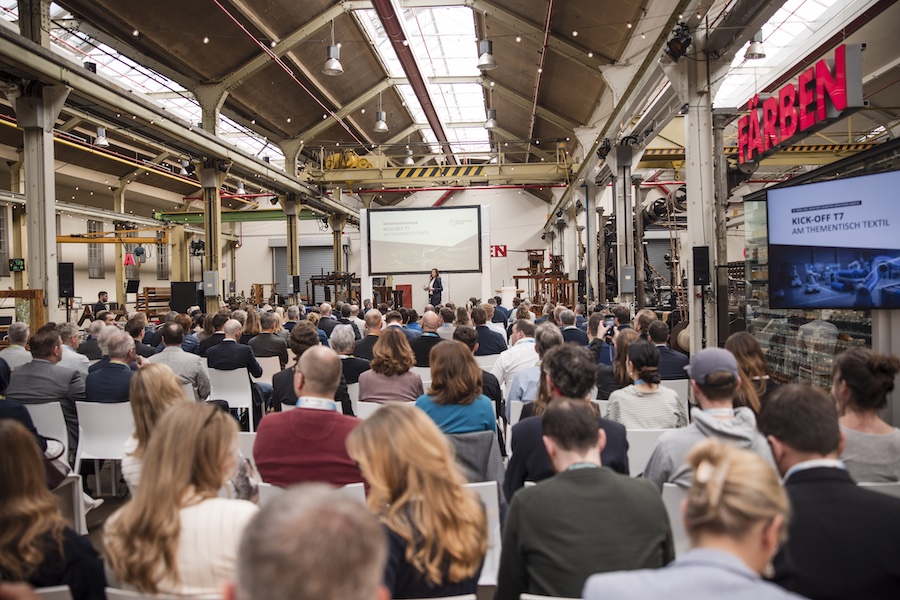
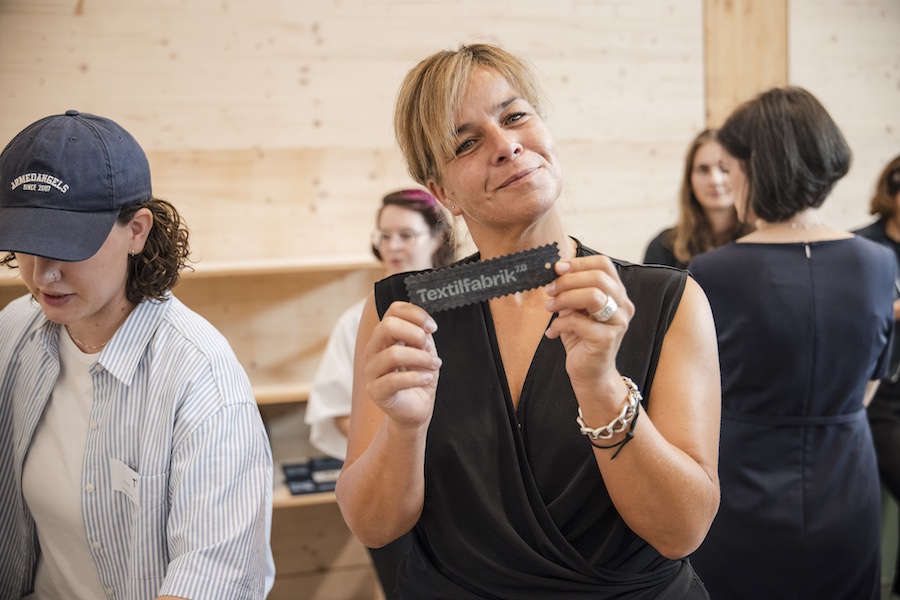
Kick-off event for Textilfabrik 7.0 © Copyright: Zukunftsagentur/Tomas Rodriguez
With the official kick-off event of the Textilfabrik 7.0 (T7), a major transformation project for the German textile and apparel industry has been launched in the Monforts Quarter in Mönchengladbach. At the “Textile Roundtable,” an event format organized by the Zukunftsagentur Rheinisches Revier, representatives from industry, research, politics, and the regional economy came together to jointly lay the foundation for CO₂-neutral, circular, and economically viable textile production in Germany.

The textile and fashion industry worldwide faces major challenges: around ten percent of global CO₂ emissions are attributed to it. At the same time, companies in Germany are under considerable competitive pressure. Textilfabrik 7.0 addresses precisely this intersection by bringing together research institutions, industry, and regional stakeholders to accelerate the transfer of innovative technologies and production processes into industrial application.

Silke Krebs, State Secretary at the Ministry of Economic Affairs, Industry, Climate Protection and Energy of the State of North Rhine-Westphalia emphasizes that the T7 project actively drives the transformation of the Rhenish mining region into a modern industrial hub. It combines innovative, sustainable textile production with research, development, and the use of AI and robotics. At the same time, it strengthens the region’s competitiveness and creates new jobs across all qualification levels. T7 demonstrates that structural change offers concrete opportunities for a future-proof industry.

For Felix Heinrichs, Mayor of the City of Mönchengladbach, it is evident that when thinking of textiles, you cannot overlook Mönchengladbach. Textile production is deeply embedded in the industrial DNA of Mönchengladbach. But it also has the potential to play a key role in the future of the city as a business location. Textilfabrik 7.0 brings industry and academia together for innovation and research. In doing so, it lays the foundation for sustainable and economically viable textile production - and thus for future-proof jobs in Mönchengladbach. Today’s launch of the T7 project marks a major milestone in the city’s structural transformation.

The kick-off event was aimed in particular at companies along the entire textile value chain. In several keynote presentations, participants gained insights into current developments and potential applications of future production models. Brother Internationale Industriemaschinen GmbH and Hch. Kettelhack GmbH & Co. KG demonstrated how on-demand production can be integrated into microfactory concepts, enabling flexible, demand-driven manufacturing processes.

In addition, 3E Smart Solutions presented how intelligent production for smart textiles could look in the future. The industry cluster Cluster Industrial Biotechnology (CLIB) showcased approaches for using biotechnological processes, such as microorganisms, in textile production to improve resource efficiency and close material loops.

At the heart of Textilfabrik 7.0 are four core modules: On-Demand Manufacturing, MicroFactory Engineering, Digital Textiles, and Biosphere. These topics also formed the basis for four workshops in which participants discussed with module leaders what requirements industry has for future production solutions. The goal was to identify concrete needs and incorporate them directly into further project planning.

Through its real-world lab approach, T7 aims to test and optimize new technologies along the entire textile value chain. These include robotics, digital process chains, and biotechnological methods that can help establish a functioning circular economy in practice.

Professor Dr. Susanne Meyer, President of Niederrhein University of Applied Sciences states that the Textilfabrik 7.0 exemplifies what applied research must achieve today: bringing together science, industry, and society to develop concrete solutions to the major challenges of our time. Niederrhein University of Applied Sciences contributes their textile expertise specifically to this future-oriented project, from digital production processes and sustainable materials to circular value creation models. In doing so, there is a contribution not only to the transformation of the textile industry but also to the innovative capacity and future viability of the entire region.

At the same time, the project makes an important contribution to structural change in the Rhenish mining region. Under the guiding principle “From Coal to AI,” new perspectives for industrial value creation and skilled employment are emerging in the region. Textilfabrik 7.0 is one of 19 anchor projects in the Rhenish mining region and is considered by the state to be central to the successful, rapid, and visible implementation of structural transformation.

Textilfabrik 7.0 is a joint project of the Research Institute for Textile and Clothing (FTB) at Niederrhein University of Applied Sciences (HSNR), the Institute for Textile Technology (ITA) at RWTH Aachen University, the Association of the North-West German Textile and Clothing Industry, the Association of the Rhenish Textile and Clothing Industry, the Textile Academy NRW, and WFMG – Mönchengladbach Economic Development Corporation.

In a second development phase, a future industrial park is planned to be created beyond Textilfabrik 7.0. Here, the textile and apparel industry will develop and produce under zero-emission conditions and with CO₂-neutral processes. The industrial park will provide space for innovative production facilities, company branches in the textile sector, and sustainable textile start-ups. This will create a modern industrial hub that combines research, development, and industrial production.

The project Textilfabrik 7.0 is funded by the Federal Ministry for Economic Affairs and Energy (BMWE) under the “STARK” funding guideline to strengthen transformation dynamics and promote new beginnings in coal regions and coal-fired power plant locations, by the State of North Rhine-Westphalia through the Ministry of Economic Affairs, Industry, Climate Protection and Energy (MWIKE) in accordance with the framework guideline for implementing the Investment Act for Coal Regions (InvKG) NRW, and by the Federal Ministry for Research, Technology and Space (BMFTR).
More News from Institut für Textiltechnik of RWTH Aachen University (ITA)

#Composites

More affordable, environmentally friendly hydrogen pressure tanks at ITA-JEC booth

As a highlight of the JEC, the Institut für Textiltechnik (ITA) of RWTH Aachen University will be presenting hydrogen pressure tanks manufactured using multifilament winding processes at the NRW joint booth in Hall 5, Stand G65.

#Research & Development

Pellet press enables thermomechanical textile recycling on a pilot scale at ITA

Since the end of 2025, the technical centre of the Institut für Textiltechnik (ITA) of RWTH Aachen University has been equipped with a pellet press from the manufacturer Amandus Kahl GmbH & Co. KG, Reinbek, Germany. This press can efficiently compact shredded synthetic textiles at a throughput of up to 25 kg/h and process them into pellets with a diameter of 4 mm.

#Research & Development

Solid Air Dynamics wins second place at RWTH Innovation Award

On 30 January, RWTH spin-off Solid Air Dynamics was awarded second place in the RWTH Innovation Awards for its research in the field of aerogel fibres. Manufactured from renewable raw materials, aerogel fibres offer outstanding thermal insulation, are extremely lightweight and completely biodegradable, and can consist of over 90 per cent air.

#Research & Development

Award-winning research for sustainable carbon fibre cycles

Sustainable recycling of carbon fibres is possible through targeted electrochemical surface modification, which makes the sizing of carbon fibres resistant to solvolysis. ITA PhD student Sabina Dann was awarded the MSW Award from RWTH Aachen University for her master's thesis on this development. The award ceremony took place on 12 November 2025 in Aachen.

More News on Research & Development

#Research & Development

Textile cascade filter for removing microplastics from wastewater

Microplastics are now found almost everywhere, even in remote regions of Antarctica. They enter the human body through the food chain. Studies indicate that microplastics may have negative effects on the human health.

#Research & Development

Fraunhofer IAP paves the way for "Green" carbon fibers

A new pilot plant in Guben is set to enable the production of bio-based carbon fibers. The plant is part of the Carbon Lab Factory Lausitz and will make an important contribution to the transformation of the Lausitz region—from a traditionally raw material- and basic industry-oriented region to a hub for innovative high-performance materials. The German federal government and the state of Brandenburg are providing the Fraunhofer Institute for Applied Polymer Research IAP with 53.3 million euros for this purpose.

#Research & Development

Hof University develops sustainable textile coating for the fashion of tomorrow from mushrooms

Clothing is often treated as disposable: T-shirts for events, general merchandise, or short-term campaigns frequently end up in the trash after only a few uses. This is particularly problematic given that their production still largely relies on fossil-based materials. This is precisely where a new research project at Hof University of Applied Sciences comes in.

#Techtextil 2026

STFI presents concepts for the textile circular economy and solutions for a healthy and safe life at Techtextil

Sächsisches Textilforschungsinstitut e.V. (STFI) has been supporting companies in developing marketable innovations for over 30 years. With a clear focus on sustainability, the environment, health and protection, the STFI offers future-oriented research, textile testing for tailor-made solutions and certification of per- sonal protective equipment. At Techtextil 2026, the institute will present ideas for the textile circular econ- omy and showcase solutions for healthy and safe living.

Latest News

#Raw Materials

New study shows low environmental impact by Cotton made in Africa Organic Cotton from Tanzania

Today, the Aid by Trade Foundation (AbTF) is announcing the results of a comprehensive life-cycle analysis (LCA) for cotton produced in Tanzania under the Cotton made in Africa Organic (CmiA Organic) standard. The study emphasises the small ecological footprint of CmiA Organic verified cotton. This can largely be traced back to the absence of synthetic pesticides, artificial fertilisers, and artificial irrigation. Consequently, CmiA Organic cotton can help the textile industry meet regulatory requirements as well as science-based targets. The results also show that the consequences of climate change threaten the livelihoods of these cotton farmers, even though the type of agriculture they practise barely contributes to climate change.

#Raw Materials

Better Cotton Initiative strengthens regenerative focus in standard update

The Better Cotton Initiative (BCI) has strengthened the regenerative focus of its field-level standard with the launch of a new version of its Principles & Criteria (P&C), which marks the next step in the organisation’s journey to becoming a regenerative standards system.

#Man-Made Fibers

Selenis and Kintra Fibers partner to scale 100% bio-based synthetic fiber technology

Selenis, a leading global specialty polyester manufacturer, today announced a strategic manufacturing partnership with materials science company Kintra Fibers to scale Kintra’s patented fiber-grade PBS resin - a 100% bio-based and biodegradable material designed for textile applications.

#Functional Fabrics

PERFORMANCE DAYS proves its relevance as the industry’s key meeting point

Held on March 18–19, 2026, PERFORMANCE DAYS once again confirmed its position as a leading international platform for functional textiles. A total of 3.366 trade visitors and around 560 exhibitors gathered in Munich, with the event already kicking off successfully on DAY 0, which received highly positive feedback for its interactive format. Despite challenging conditions caused by the public transport strike in Munich, the event saw strong attendance and a consistently high level of activity across both exhibition days.

TOP