[pageLogInLogOut]

#Research & Development

New approaches to carbon fibre recycling, energy-efficient texturing and the use of microwaves in false-twist texturing

Walter Reiners Foundation Prize awarded to three ITA graduates
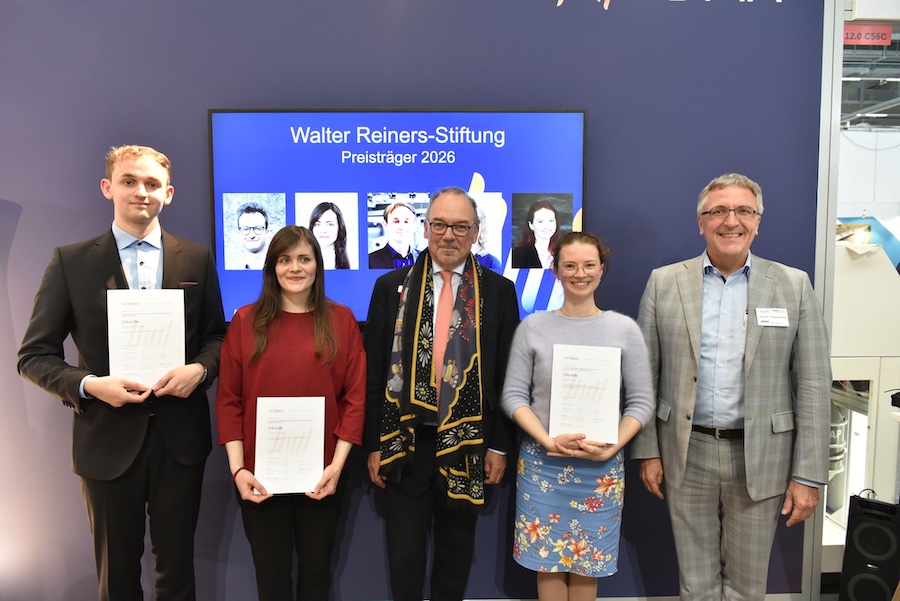
The proud award winners, from left to right: Lukas Balon, Annegret Storm, Peter D. Dornier, Sabina Dann, Professor Dr Thomas Gries. © 2026 Patrick Schibat, German Institutes for Textile and Fibre Research (DITF)
Sabina Dann, Lukas Balon and Annegret Storm from the Institut für Textiltechnik (ITA) of RWTH Aachen University were awarded the Walter Reiners Foundation Prize by the German Engineering Federation (VDMA) for their master’s and bachelor’s theses. Peter Dornier, Chairman of the Walter Reiners Foundation, presented the awards during Techtextil at the VDMA stand in Frankfurt am Main, Germany.

New Approaches in Carbon Fibre Recycling: VDMA Sustainability Award for Innovative Surface Treatment

ITA PhD-student Sabina Dann has been awarded the Master Sustainability Prize of the VDMA Walter Reiners Foundation 2026. The prize, endowed with EUR 3,500, recognises outstanding master’s theses that contribute to sustainable technologies in mechanical engineering.

At the centre of the award-winning thesis titled “Towards Sustainable Waste Management: Electrochemical Surface Treatment of Carbon Fibres for Improved Reclamation and Solvolysis Resistance” is a novel approach for the sustainable recovery of carbon fibres from composite materials. Carbon fibres are a key material in modern lightweight applications, particularly in aerospace, automotive engineering, and mechanical engineering. At the same time, their recycling poses a significant technological challenge due to the sensitive fibre surfaces and complex composite structures.

In the awarded master’s thesis an electrochemical surface treatment of carbon fibres is investigated that is specifically aimed at increasing their resistance to solvolytic recovery processes. Through the formation of stable covalent bonds on the fibre surface, it is ensured that the functional and mechanical properties of the fibres are not lost during the recycling process.

This creates a crucial basis for the reusability of high-performance carbon fibres: instead of a degradation of material properties, the method enables the preservation of performance throughout the entire recovery process.

The benefit of the work lies particularly in its contribution to a genuine circular economy for high-performance composite materials. The results show that carbon fibres can in future not only be recycled, but also specifically stabilised in quality and made available again for industrial applications. This opens up new possibilities for resource-efficient production chains in lightweight construction and mechanical engineering.

Energy-efficient texturing

Lukas Balon was awarded the ‘Master’s Scholarship’ for his Master’s thesis, ‘Development of a CFD model for simulating flow in die-texturing’, along with prize money of EUR 3,500. During texturing, smooth, melt-spun man-made fibre yarns are given a crimped structure to achieve a softer feel, greater elasticity and high heat retention. Textured yarns are therefore used in clothing, upholstery fabrics and carpets. In the compression chamber texturing process, yarns are crimped aerodynamically by a hot air stream. Although the compression chamber is highly productive compared to other processes, it has so far only been suitable for the production of coarse carpet yarns. An expansion into other markets, such as home textiles, has not yet taken place. The reason for this is the complex flow within the compression chamber, which has only been addressed in a rudimentary manner in previous developments. As part of this work, the flow field was therefore first investigated using simulation and subsequently the influence of key process parameters was systematically analysed.

The results provide the first detailed insight into which flow phenomena influence the texturing of the draw chamber and how these can be controlled by adjusting the process parameters. The findings open up a wide range of possibilities for the development of new draw chambers, for example in terms of energy efficiency or novel yarn structures.

Microwaves in false-twist texturing

False-twist texturing is a key component in the production chain for man-made fibres. However, production speed is limited by a phenomenon known as ‘surging’. This causes significant fluctuations in yarn tension, leading to the yarn breaking more readily. The shorter the heater length, the higher the production speeds that can be achieved. Innovative concepts for shorter heaters are therefore necessary for more efficient production.

To this end, in her bachelor’s thesis ‘Analytical Design and Evaluation of a Microwave Heating Technology in the False Twist Texturing Process’, Annegret Storm presented a creative concept for a novel heater that heats the yarn using microwaves rather than convection. To this end, she analytically designed a resonator in which the yarn is to be heated. Using the finite element method, the temperature profiles within the heater were determined numerically. Annegret Storm then compared the microwave heater with a high-temperature heater, which, at approximately 800 mm, is the shortest heater to date. It emerged that the microwave heater enabled a reduction in heater length of approximately 60%.

These results are promising and, if further implemented, could lead to increased production in false-twist texturing. For her bachelor’s thesis, Annegret Storm was awarded the Walter Reiners Foundation’s sponsorship prize and prize money of EUR 3,000.
More News from Institut für Textiltechnik of RWTH Aachen University (ITA)

#Research & Development

Elastic yarns to become more recyclable and environmentally friendly in future

On 29 April 2026, ITA student Tobias Dickmeiß was awarded a sponsorship prize by the Wilhelm Lorch-Stiftung for his innovative approach, to replacing conventional elastane with elastic yarns made from thermoplastic copolyester elastomers (TPC). Thanks to their thermoplastic nature and compatibility with typical polyesters used in the textile industry, elastic TPC yarns offer improved recyclability. Furthermore, the use of the melt-spinning process in yarn production eliminates the need for solvents that are harmful to the environment and human health.

#Research & Development

ITA spin-off Solid Air (SA) Dynamics reaches the semi-finals of the Rice Business Plan Competition

The ITA spin-off SA Dynamics has been nominated for the semi-finals of this year’s Rice Business Plan Competition (RBPC), one of the world’s most prestigious start-up competitions, held at Rice University in Houston, Texas.

#Techtextil 2026

Smart textiles can also be sustainable, eco-friendly and AI-powered – ITA at Techtextil 2026

Sports shoes made from algae, leggings made from mushrooms, filtering (diesel) oil from water, 4D textiles, recyclable, sustainable and featuring AI – this is what the ITA Group is presenting at three individual stands run by ITA Aachen, ITA Augsburg gGmbH and ITA Technologietransfer GmbH on the joint stand of Elmatex in hall 12.0 D05.

#Research & Development

Textilfabrik 7.0 launched: Mönchengladbach becomes a real-world lab for sustainable textile production

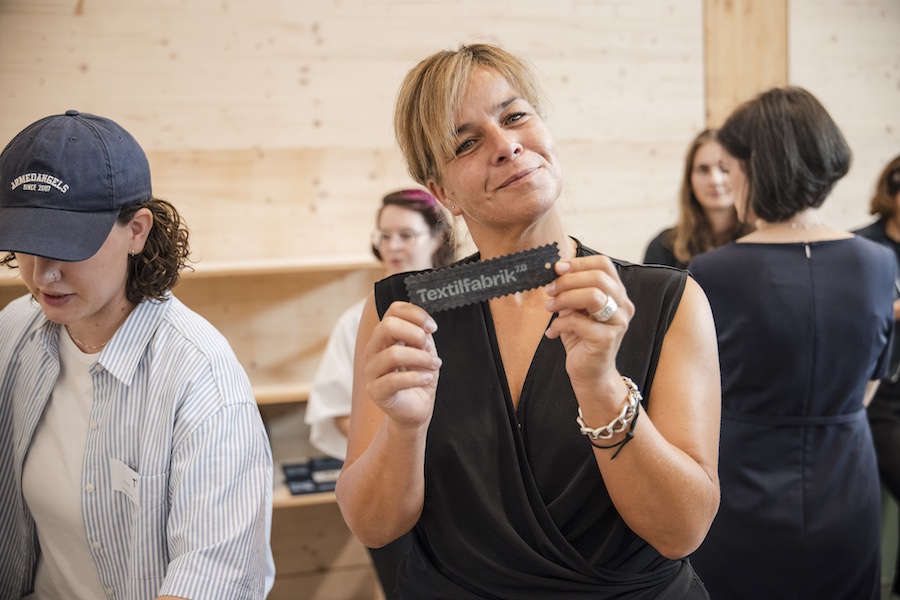
With the official kick-off event of the Textilfabrik 7.0 (T7), a major transformation project for the German textile and apparel industry has been launched in the Monforts Quarter in Mönchengladbach. At the “Textile Roundtable,” an event format organized by the Zukunftsagentur Rheinisches Revier, representatives from industry, research, politics, and the regional economy came together to jointly lay the foundation for CO₂-neutral, circular, and economically viable textile production in Germany.

More News on Research & Development

#Research & Development

Textile climate control system in workwear – exhibition at the 2026 SME Innovation Day!

Conventional protective workwear often reaches its limits during strenuous physical activity. In particular, the transport of sweat and excess body heat poses a problem. The German Institutes of Textile and Fiber Research (DITF) conducted research on flow-optimized, air-conducting textile structures that enable targeted climate control directly on the body. These structures can be integrated straight into protective work garments. The textile climate control system supports the body’s natural thermoregulation. This contributes to improved workplace safety and comfort.

#Techtextil 2026

Young talents honoured – 60 years Walter Reiners Foundation

At the Techtextil trade fair in Frankfurt at the end of April, Peter D. Dornier, chairman of the VDMA’s Walter Reiners Foundation, presented awards to five successful young engineers. Promotion and sustainability awards were presented in the categories of bachelor’s/project theses and diploma/master’s theses. Academic theses are eligible for the sustainability awards if, for example, they develop solutions for resource-efficient products and technologies.

#Research & Development

Regional hemp bast for lightweight construction profiles

The cultivation of fibre hemp for the production of ropes and clothing has a long tradition in Saxony. Due to its excellent fibre properties, it is also suitable as a renewable raw material for reinforcement in fibre composites. At the STFI and IWU in Chemnitz, the CannaPul project is cur- rently investigating how a regional value chain for hemp-based lightweight construction profiles can be established. To this end, the technical processing of hemp fibres into continuous fibre strands and their embedding in a suitable bio-based matrix are being investigated.

#ITMA 2027

ITMA 2027 opens Start-Up Valley applications following success stories from 2023

Following several high-profile success stories emerging from the Start-Up Valley at ITMA 2023, applications are now open for young companies wishing to participate in the initiative at ITMA 2027.

Latest News

#INDEX 2026

INDEX 2026: Reicofil introduces RF 5.10 upgrade boosting output by 10 percent

At INDEX 2026, Reifenhäuser Reicofil will present its latest developments for the nonwovens industry under the guiding themes “Grow Together”, “Expand Together” and “Transform Together”. On this occasion, the leading manufacturer of nonwoven machinery will be unveiling two brand-new technology advancements – RF 5.10 upgrade and RF Core – at the show.

#Recycled Fibers

Lindex and BASF partner to bring textile-­to­-textile recycled polyamide to lingerie sector

Lindex has partnered with BASF’s loopamid® to accelerate textile-­to-­textile recycling and advance the shift towards more circular material solutions in the fashion industry. Together they introduce loopamid to the lingerie sector.

#Dyeing, Drying, Finishing

Tradition and Innovation – Phoenox Textiles Ltd. relies on state-of-the-art carpet back-coating line from Brückner

For more than 70 years, Phoenox Textiles Ltd. has been synonymous with quality, reliability, and inno-vation in the textile industry. Founded in 1954 in Huddersfield (Yorkshire, UK), a region with a long tradition in textiles, this family-owned business has continued to evolve without losing sight of its roots. Today, in its fourth generation under the leadership of the Mosley family, Phoenox successfully combines decades of experience with a clear, forward-looking corporate strategy.

#ITM 2026

Uster FiberQ excels for recycled raw materials too

Uster FiberQ is a complete solution for raw material utilization, supporting spinners to achieve consistent quality and profitability every day, building further growth for the future. The Turkish company ORTA relies on FiberQ with recycled yarn for its denim production. Data-driven knowledge puts the producer in control of raw material utilization – ready to make the correct decisions for process efficiency, quality and productivity.

TOP