[pageLogInLogOut]

#Sustainability

Aid by Trade Foundation turns 20, invests half a million Euros in new biodiversity fund

To effectively promote nature conservation and biodiversity, the Aid by Trade Foundation (AbTF) announced at the second Hamburg Sustainability Conference (HSC) that it would be investing 500,000 euros in the ‘AbTF Biodiversity Fund’ to mark the foundation's 20th anniversary. Since it was established in 2005 by the entrepreneur Prof. Dr Michael Otto, AbTF has been committed to transforming the textile and fashion industries.
Prof. Dr Otto, Entrepreneur and Founder of the Aid by Trade Foundation © 2025 Aid by Trade Foundation


The foundation has made it its mission to conserve nature in areas where cotton and cashmere are produced. It pursues these goals through its internationally recognised sustainability standards as well as by supporting farming families in optimising their agricultural operations. Its support enables them to improve their living conditions and build up the resilience of their farming to climate change and market fluctuations.

Aid by Trade Foundation launches biodiversity fund

“In view of the global climate and environmental crises, we need to fundamentally rethink our actions and their impact on the environment,” explains Tina Stridde, the managing director of the Aid by Trade Foundation, adding, “Our ‘Aid by Trade’ approach is succeeding in activating trade to create positive effects for nature, people, and animals and to provide essential funding for an issue close to our hearts: the preservation of biodiversity.”

The first project funded by the AbTF Biodiversity Fund will be implemented in collaboration with African People and Wildlife (APW), a renowned organisation for community-oriented nature conservation based in Tanzania. APW has earned international recognition for its efforts in promoting peaceful coexistence between people and endangered wildlife.

The Aid by Trade Principle

The Aid by Trade Foundation has changed the textile and fashion industry worldwide over the past 20 years through its sustainability standards: Cotton made in Africa® (CmiA), Cotton made in Africa Organic, The Good Cashmere Standard® (GCS), and the Regenerative Cotton Standard® (RCS).

In 2005, against the backdrop of the WTO conference in Cancún in 2003, AbTF was founded by the entrepreneur Prof. Dr Michael Otto with three primary aims: making a decisive and measurable contribution to the sustainability of raw-material producers and their communities, improving their working and living conditions, and protecting nature. What began with Cotton made in Africa in three African countries is now a global foundation that maintains four recognised sustainability standards for cotton and cashmere. These standards are opening doors for retailers and brands, raw-material producers, and the textile supply chain, not to mention for consumers. AbTF has always remained true to the principle of activating market forces to provide aid—and this approach is only growing more successful.

“Who, in 2005, would have thought that a global alliance of fashion brands and textile companies would now be demanding raw materials verified according to the standards of the Aid by Trade Foundation?” asks Prof. Dr Michael Otto. “I am thrilled that this is the case today,” he continues, “and I am convinced that the foundation will keep making a significant contribution to sustainable fashion and will lead the way for people and the environment through its new biodiversity fund.”

Success in Trade and in the Field

The Aid by Trade Foundation has been continuously expanding its operations since 2005. Every year, millions of textiles bearing a label of the Hamburg-based Aid by Trade Foundation are sold. More than 3,000 partners in the market are implementing their sustainability goals with AbTF. By partnering with the foundation, they also make a significant contribution to nature conservation, animal welfare, and more dignified working and living conditions in cultivation regions.

AbTF launched its first initiative, CmiA, in 2006 with 100,000 small-scale farmers in three countries in Africa South of the Sahara. Now, in 2025, CmiA works with 22 cotton companies, 65 retailers and brands, and approximately 800,000 small-scale farmers in ten African countries. This means that the standard is verifying over one third of all cotton produced in Africa.

Eventually, two other cotton standards were added: Cotton made in Africa Organic and Regenerative Cotton Standard®. The launch of RCS with its holistic approach also represented AbTF’s first expansion of a cotton standard beyond Africa, to India. The Good Cashmere Standard®, established in 2019 as the first standard for sustainable cashmere from Inner Mongolia, has also proved its effectiveness. Having quickly risen to become a global leader in verifying sustainable cashmere production, GCS is now in demand by more than 50 fashion brands and textile companies, including H&M, J.Crew, Zadig&Voltaire, and The White Company. In China’s Inner Mongolia, GCS works with around 5,500 herders on whose farms 2.4 million goats live.

More News from Aid by Trade Foundation (AbTF)

#Natural Fibers

Cashmere producers stress the importance of The Good Cashmere Standard®

At the invitation of the Aid by Trade Foundation (AbTF), over 70 experts from the cashmere production and supply chain, as well as other specialists, met at the GCS Unit Meeting in Shanghai, China to discuss the progress and new objectives of The Good Cashmere Standard (GCS). The meeting focused on implementation and verification of the standard, important aspects of animal welfare and the importance of the standard in the global textile market.

#Natural Fibers

Aid by Trade Foundation publishes 2024 annual report: Growing impact for environment and people

The Aid by Trade Foundation (AbTF) is on a growth track. Despite a challenging global economy, AbTF increased its income by six percent from 2023 to 2024, reaching a total of EUR 8.6 million. This revenue has been invested in comprehensive measures for the sustainable production of cotton and cashmere as well as for expanded measures to ensure transparency in global value chains. In addition to gaining new partners in 2024—including big names like Mango, Nordstrom, and CWS Workwear—AbTF was able to expand its global stakeholder network active in the production of raw materials or textiles.

#Raw Materials

Aid by Trade Foundation receives Honorary Award of the German Africa Foundation 2025

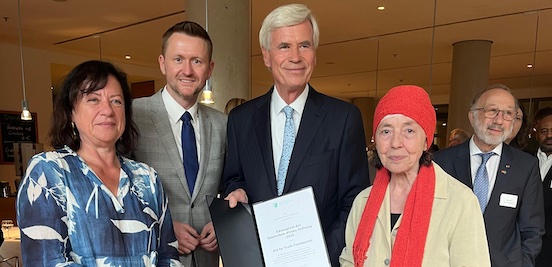
On the evening of 25 June, the Hamburg-based Aid by Trade Foundation (AbTF) received the Honorary Award of the German Africa Foundation 2025. Prof. Dr Michael Otto, the foundation’s founder and a prominent entrepreneur, accepted the award at a ceremony held at the German Bundestag. The Parliamentary State Secretary to the Federal Minister for Economic Cooperation and Development (BMZ), Dr Bärbel Kofler, presented the award in the presence of guests from politics, business and civil society as well as representatives of African embassies.

#Raw Materials

Laly Lichtenfeld joins AbTF Board of Trustees

The Aid by Trade Foundation is pleased to welcome Laly Lichtenfeld, an internationally renowned leader in community-driven nature conservation, to its board of trustees. After years of researching community-driven conservation, including as a Fulbright Scholar in 1996, she co-founded African People & Wildlife in 2005 with the aim of promoting peaceful coexistence between rural communities and wildlife such as lions and elephants.

More News on Sustainability

#Sustainability

Ying McGuire becomes new CEO of Cascale

Cascale today announced the appointment of Ying McGuire as Chief Executive Officer, effective June 1, 2026.

#Sustainability

VAUDE eliminates PFAS from all products

PFAS (per- and polyfluoroalkyl substances) are now detectable worldwide – in drinking water, soil and the human body. These so-called “forever chemicals” are considered hazardous to health and potentially carcinogenic, as they do not break down and remain in the environment permanently. Despite these risks, PFAS are still used in a wide range of products. More than 15 years ago, VAUDE made a strategic decision to gradually eliminate PFAS from all product categories.

#Sustainability

OEKO-TEX® chooses TextileGenesis to advance digital traceability for organic cotton

OEKO-TEX® today announced a full collaboration with TextileGenesis, a Lectra company, to digitally trace and authenticate organic cotton, strengthening fraud prevention across the supply chain. This announcement follows a successful pilot and brings together OEKO-TEX®’s certification expertise and closed testing system with TextileGenesis’ digital traceability platform to deliver a secure, end-to-end solution for managing certified organic cotton flows.

#Europe

ICAC to support European Commission on pending PEF legislation

The International Cotton Advisory Committee (ICAC) is proud to announce that it has been included as a member of the European Commission’s Technical Advisory Board (TAB) on the Product Environmental Footprint methodology. The Commission developed the Product Environmental Footprint (PEF) to assess and communicate the life cycle environmental performance of products and organizations.

Latest News

#Recycling / Circular Economy

Circulose restarts commercial-scale production at Ortviken plant in Sundsvall

Circulose today announced the restart of its commercial-scale production plant at Ortviken in Sundsvall, Sweden, marking a significant step in scaling next-generation materials for the global fashion industry. The company plans to resume production of CIRCULOSE®, a recycled pulp made entirely from discarded cotton textiles, in the fourth quarter of 2026.

#Textiles & Apparel / Garment

VIATT 2026 to debut German Pavilion, strengthening European participation alongside key Asian textile hubs

Vietnam’s textile and garment sector continues to be a major contributor to the country’s economic growth, with export revenues expected to reach USD 46 billion in 2025, a 5.6% increase from 2024 . From 26 – 28 February, the Vietnam International Trade Fair for Apparel, Textiles and Textile Technologies (VIATT) is set to contribute to economic growth opportunities by accelerating digital transformation and green transition across the entire textile value chain. The upcoming edition will respond to the rising demand for advanced technologies and sustainable materials with the introduction of the German Pavilion, alongside strong exhibitor participation from key Asian sectors, as well as several high-profile fringe events.

#Technical Textiles

Sustainable, lightweight, and sound absorbing: Polyester-based front trunk solution for BEVs

As car manufacturers look to further reduce their carbon footprint, Autoneum has developed an innovative front trunk solution for battery electric vehicles (BEVs), made entirely from polyester-based textile. The Ultra-Silent Frunk offers significant weight reduction, improved acoustic and thermal insulation, and uses up to 70 percent recycled material, supporting sustainable and efficient vehicle design. Autoneum, global technology leader in acoustic and thermal management for vehicles, has already received orders for the new frunk from three major OEMs in Asia and Europe to be built in three BEV models. Series production for two BEVs has been underway in China and Germany since last year.

#Raw Materials

Modern testing methods for raw cotton

The 38th International Cotton Conference Bremen will take place from 25 to 27 March 2026 at the Bremen Parliament. This conference has traditionally stood for in-depth expertise and international exchange. The program will focus on technical innovations, market trends, and regulatory frameworks across the entire value chain – from agriculture to the circular economy. With high-profile speakers, the conference is regarded as the key meeting point for the global cotton industry. Today’s focus: Cotton quality and testing methods.

TOP