[pageLogInLogOut]

#Europe

Consumption of clothing, footwear, other textiles in the EU reaches new record high

Europeans are buying and discarding more clothing, footwear and other textiles than ever before, which as a result, is putting more pressure on our climate and environment, according to a European Environment Agency (EEA) briefing released today. The updated consumption data highlights the need for policymakers, industry and consumers to play their role in helping Europe shift away from the fast-fashion trend, to produce better, longer lasting quality textiles which are designed to last long, and can be reused, repaired and recycled.

The average EU citizen bought 19 kilograms (kg) of clothing, footwear and household textiles in 2022 — up from 17 kg in 2019, which is enough to fill a large suitcase per person each year according to the EEA briefing 'Circularity of the EU textiles value chain in numbers'. The assessment analyses the latest data available on the circularity of the EU’s textile value chain. 

The impact of our current production and consumption of textiles system continues to cause high pressures on our environment and climate, including through material use, water and land use, greenhouse gas emissions, chemical and microplastics.

Circularity of the EU textiles value chain in numbers

Circularity of the EU textiles value chain in numbers

Out of the 19kg, 8kg consisted of clothing; 7kg was household textiles and 4kg was footwear.

Out of the 19kg, 8kg consisted of clothing, 7kg was household textiles and 4kg was footwear.

The EU’s textiles strategy is aimed at reducing these impacts and making textiles more circular and sustainable by design. For its success, a systemic shift in the textiles system is needed, moving to the production of more circular goods and higher quality goods that have longer use value, and can be more easily reused, repaired or recycled. The EEA’s Circularity Metrics Lab’s new module on textiles is monitoring this progress. 
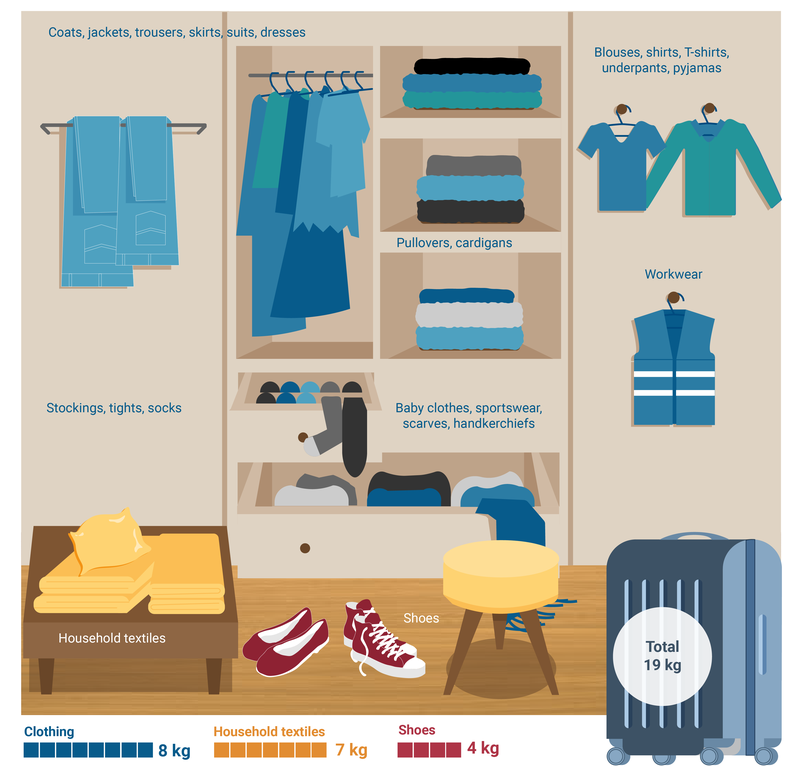
Out of the 19kg, 8kg consisted of clothing, 7kg was household textiles and 4kg was footwear © 2025 European Environment Agency


Fast fashion and online shopping 

The combination of increased online shopping, social media influencers and cheap production costs for synthetic textiles has been instrumental in the growth of fast fashion. This has allowed retailers to offer consumers new styles at low prices. The EEA briefing notes that digital technologies like 3D printing can reduce waste in production and can be used to reduce the environmental and climate pressures from textiles by improving efficiency. However, they also risk increasing consumption by enabling cheaper production costs and lower prices. 

Impact on the environment and climate

The environmental and climate pressures from EU textiles production and consumption remain high. Out of 12 categories of European household consumption — such as food, mobility, housing, health and education — textile consumption ranked, on average, the fifth largest in terms of environmental and climate pressures. The EEA measured these impacts across the metrics of raw material use, greenhouse gas (GHG) emissions and water and land use. 

Textile production and consumption also contribute to other environmental pressures, including air pollution, chemical use and pollution, microplastics pollution from production, the use and washing of textiles, as well as pressures from the handling of textiles that end up as waste. 

Textile waste and exports 

In 2022, EU Member States generated about 6.94 million tonnes of textile waste, which amounts to 16kg per person. The total amount of textile waste generation has remained relatively stable since 2016. 

The average collection of textile waste in the EU — an indicator of the effectiveness of separate collection systems — has been slowly increasing, rising by 4.3 percentage points since 2016 but overall, the collection of this waste has been low. In 2022, 85% of all textile waste from households was not collected separately and instead ended up as mixed household waste which ended up in landfills or incineration, from which it can’t be reused or recycled. 

The implementation of EU legislation on separate textile waste collection, starting in 2025, is expected to significantly increase the capture rates for textiles from households. 

The amount and share of textile waste sent to landfill in Europe has decreased, from 21% in 2010 to 12% in 2022. The amount sent for incineration (with and without energy recovery) in Europe has increased from 10% in 2010 to 14% in 2022.

Since 2000, the export of used textiles has nearly tripled, from a little over 550,000 tonnes in 2000, to 1.4 million tonnes in 2019. Since then, the volume has remained relatively constant, with 1.4 million tonnes having been exported in 2023.

While exports of used textiles from the EU are intended for reuse or recycling, studies show that EU textile exports enter a very complex pattern of trade, sorting, reuse, recycling and landfilling, and some is being burned or dumped in nature across mainly African and Asian countries. 

The EEA briefing will be presented at the following events:

26 March - Policy Breakfast: Re-Shaping Fashion Industry at the European Parliament

27 March: Threading up Europe’s textile circularity

1 April: Webinar - Presenting New Metrics and Data for Circularity & Sustainability in Textiles


More News from European Environment Agency

More News on Europe

#Europe

Antwerp Declaration community urges EU leaders to deliver emergency measures as Europe’s competitiveness crisis deepens

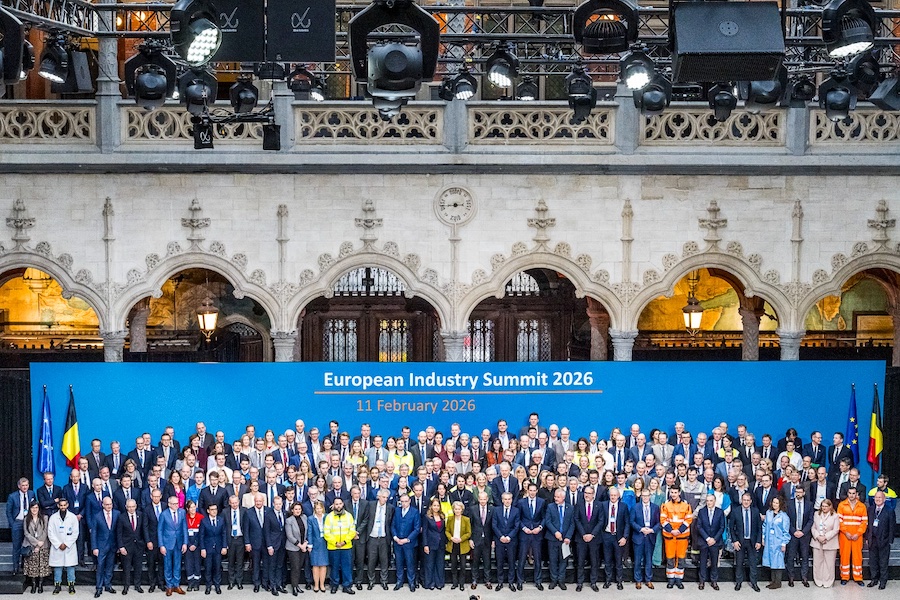
EURATEX, representing the European textile and fashion industry, joins the Antwerp Declaration Community’s call on EU Heads of State and Government to adopt emergency measures that restore industrial competitiveness and deliver tangible results for Europe’s manufacturing base in 2026.

#Europe

New EU rules to stop the destruction of unsold clothes and shoes

The European Commission today (Feb 9) adopted new measures under the Ecodesign for Sustainable Products Regulation (ESPR) to prevent the destruction of unsold apparel, clothing, accessories and footwear.

#Europe

FITA, ABIT and EURATEX underline strategic importance of Mercosur – EU Partnership Agreement for the textile and apparel industry

The Argentine Textile Industry Federation (FITA), the Brazilian Textile and Apparel Industry Association (ABIT), and the European Apparel and Textile Confederation (EURATEX) continue to monitor the process of internalizing the Mercosur-European Union Partnership Agreement. This agreement is essential for the competitiveness of our industries, on both sides of the Atlantic.

#Europe

Commission adopts a first-ever EU Visa Strategy

Today, the European Commission is adopting its first-ever EU Visa Strategy. It sets out a framework for a visa policy that is more strategic and that advances the EU's long-term interests, allowing it to be better equipped for growing mobility as well as the consequences of regional instability and geopolitical competition.

Latest News

#Recycling / Circular Economy

Circulose restarts commercial-scale production at Ortviken plant in Sundsvall

Circulose today announced the restart of its commercial-scale production plant at Ortviken in Sundsvall, Sweden, marking a significant step in scaling next-generation materials for the global fashion industry. The company plans to resume production of CIRCULOSE®, a recycled pulp made entirely from discarded cotton textiles, in the fourth quarter of 2026.

#Textiles & Apparel / Garment

VIATT 2026 to debut German Pavilion, strengthening European participation alongside key Asian textile hubs

Vietnam’s textile and garment sector continues to be a major contributor to the country’s economic growth, with export revenues expected to reach USD 46 billion in 2025, a 5.6% increase from 2024 . From 26 – 28 February, the Vietnam International Trade Fair for Apparel, Textiles and Textile Technologies (VIATT) is set to contribute to economic growth opportunities by accelerating digital transformation and green transition across the entire textile value chain. The upcoming edition will respond to the rising demand for advanced technologies and sustainable materials with the introduction of the German Pavilion, alongside strong exhibitor participation from key Asian sectors, as well as several high-profile fringe events.

#Sustainability

Ying McGuire becomes new CEO of Cascale

Cascale today announced the appointment of Ying McGuire as Chief Executive Officer, effective June 1, 2026.

#Technical Textiles

Sustainable, lightweight, and sound absorbing: Polyester-based front trunk solution for BEVs

As car manufacturers look to further reduce their carbon footprint, Autoneum has developed an innovative front trunk solution for battery electric vehicles (BEVs), made entirely from polyester-based textile. The Ultra-Silent Frunk offers significant weight reduction, improved acoustic and thermal insulation, and uses up to 70 percent recycled material, supporting sustainable and efficient vehicle design. Autoneum, global technology leader in acoustic and thermal management for vehicles, has already received orders for the new frunk from three major OEMs in Asia and Europe to be built in three BEV models. Series production for two BEVs has been underway in China and Germany since last year.

TOP