[pageLogInLogOut]

#Man-Made Fibers

Textile Exchange publishes comprehensive polyester LCA study
© 2026 Textile Exchange
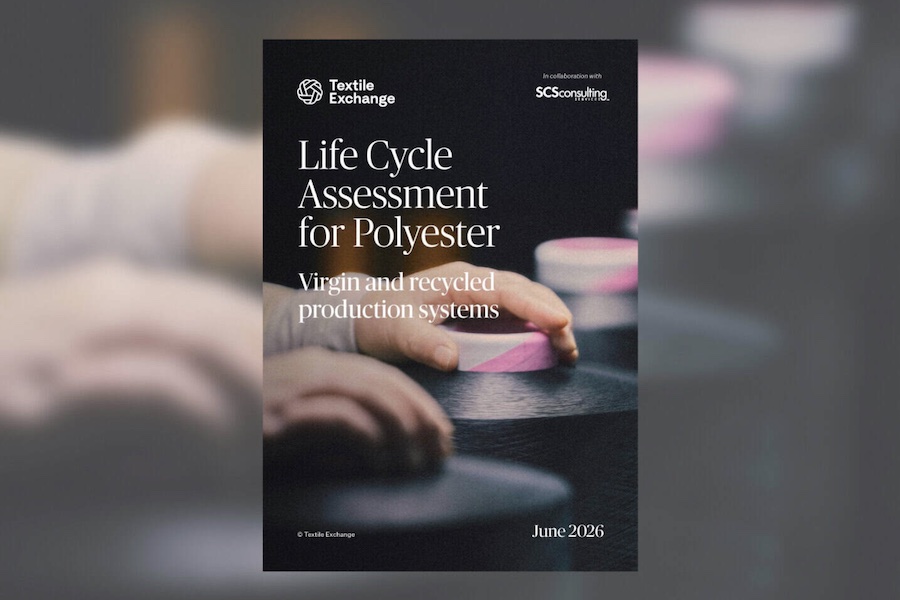
Textile Exchange has released a new Life Cycle Assessment (LCA) study on polyester, providing detailed data on the environmental impacts of both virgin and recycled polyester production. The study aims to strengthen understanding across the fashion, textile and apparel industries and support more informed decision-making regarding polyester sourcing and production.

According to Textile Exchange, the study identifies key environmental hotspots across different polyester production routes and includes new data on both thermomechanical and chemical recycling technologies. It also provides what is believed to be the first publicly available data on the environmental impacts of virgin polyethylene terephthalate (PET) production in Southeast Asia, a region that accounts for more than half of global virgin PET production.

The assessment focuses on virgin polyester production in Southeast Asia and recycled polyester production in China, Europe and the United States. Like all Textile Exchange LCA studies, it follows a cradle-to-gate approach, covering impacts from resource extraction through fiber formation. In addition, the study incorporates a broader “LCA+” methodology, including an assessment of human rights impacts associated with polyester production.

One of the central findings is that the environmental performance of polyester depends heavily on the production technology used. Key impact hotspots identified include the production of virgin fossil-based feedstocks, waste collection and sorting for recycled polyester, energy consumption and transportation.

To support industry-wide environmental modelling and progress tracking, the data from the study will be integrated into several major sustainability databases, including the Higg Materials Sustainability Index (MSI), Ecoinvent and the Quantis World Apparel and Footwear Life Cycle Assessment Database (WALDB). Textile Exchange notes that the data is primarily intended as proxy data for situations where source-specific LCA data is unavailable.

The polyester study is the second publication in Textile Exchange’s ongoing series of fiber-specific LCA studies. Earlier this year, the organization published its cotton LCA study, with additional assessments scheduled for release throughout 2026 and 2027.

To ensure scientific rigor and impartiality, the study was conducted in accordance with ISO standards, led by specialized LCA consultants, reviewed by independent expert panels and developed in consultation with a broad range of industry stakeholders.

Textile Exchange emphasizes that, as with all LCA data, results should be interpreted carefully and within their intended context. The organization advises against direct comparisons between different studies, regions or production systems, as methodological choices, assumptions and system boundaries can significantly influence outcomes.

Explore the full LCA study:

https://textileexchange.org/knowledge-center/reports/polyester-life-cycle-assessment/?utm_source=polyesterlca_email&utm_medium=email&utm_campaign=polyesterLCA&utm_term=null&utm_content=general

More News from Textile Exchange

#Man-Made Fibers

Textile Exchange: reporting companies advance on preferred materials as global fiber production reaches new high

Companies participating in Textile Exchange’s Materials Benchmark increased their use of materials from preferred production systems in 2025, while global fiber production continued to grow and reached a record 139 million tonnes. The contrasting trends highlight both the potential for change at company level and the scale of the challenge facing the wider textile industry.

#Sustainability

Action Cohort: Textile Exchange’s new initiative designed to help scale preferred production systems

Textile Exchange has published new guidance to help brands and retailers participating in its Action Cohort prepare for upcoming reporting and target-setting requirements. Earlier this year, the organization evolved its membership to create more action-oriented pathways, designed to accelerate progress toward scaling preferred production systems that create beneficial impacts and resilient supply chains and livelihoods.

#Sustainability

New guidance to help organizations deliver the Material Matter Standard’s human rights commitments

Textile Exchange has published new guidance and tools to help organizations better understand and implement the human rights and livelihoods requirements of the forthcoming Materials Matter Standard.

#Sustainability

Textile Exchange reports growth in certifications and industry engagement

Textile Exchange has published its 2025 Annual Report, highlighting continued growth in certified sites, industry participation and the development of its standards and membership structure. According to the report, more than 100,000 sites worldwide are now certified to Textile Exchange standards, more than three times the number recorded in 2020. Preliminary figures also indicate 12% year-on-year growth across the organization's current standards, including the Global Recycled Standard (GRS), Recycled Claim Standard (RCS) and the Responsible Animal Fiber standards.

More News on Man-Made Fibers

#Spinning

Barmag’s automated maintenance processes for quality, safety, and efficiency in spinning plants

Maintenance and service processes in chemical fiber spinning plants have a significant impact on product quality, equipment availability, and workplace safety. With three new retrofittable solutions, Barmag helps Producers make manual work processes more efficient, safer, and more reproducible.

#Man-Made Fibers

Selenis acquires Polisan Hellas assets and expands specialty copolyester production to more than 200,000 tonnes by 2028

Continuous polymerisation joins Selenis’ existing lines in Portugal, Italy, Tunisia and the United States. Customers get the same grades from more than one site, supply from within their region and the cost base of continuous production for high-volume grades. Priority markets: shrink sleeves, film and sheet, healthcare, 3D printing filaments and textile to textile recycling.

#Man-Made Fibers

Dutch court orders Shanghai Port Star to stop sales of HMPE link chains in EU

The District Court of The Hague has ordered Chinese supplier Shanghai Port Star to stop selling and distributing certain synthetic fiber link chains in the European Union after finding that the products infringe EU design rights held by Avient Corporation. The ruling concerns link chains made from high-modulus polyethylene (HMPE) fibers for marine and industrial applications.

#ITMA Asia + CITME 2026

ITMA Asia 2026: How Barmag is reshaping the future of man-made fiber production

The textile industry is entering a groundbreaking era. Manufacturers face rising energy prices, growing sustainability demands, increasing labor shortages, and an unprecedented need for flexibility. For a globally active textile industry, where competitiveness is closely linked to production efficiency and cost leadership, this means that technology is no longer merely a means of improving operational processes – it is increasingly becoming a strategic differentiator.

Latest News

#Knitting & Hosiery

KARL MAYER invites the Global Textile Industry to celebrate its 90th anniversary at its German Headquarters in 2027

KARL MAYER is turning its anniversary year 2027 into a milestone for the textile sector. To mark its 90th anniversary, the industry leader is inviting customers, partners, and experts from around the world to a unique event series in September aimed at pushing boundaries, unlocking new opportunities, and jointly setting the course for a new era in textiles – just as KARL MAYER has done throughout its history. The company’s headquarters in Obertshausen, near Frankfurt, is the place to be.

#Associations

ITMF names three winners of the Sustainability & Innovation Award 2026

Three projects from the UK, Korea and China have been selected as winners of the ITMF Sustainability & Innovation Award 2026. The projects address textile-to-textile recycling, chemical recycling for automotive textiles and a regenerative approach combining silk production with ecological restoration.

#Recycling / Circular Economy

nova-Institute launches groundbreaking Advanced Recycling Database for strategic market insight

The new Advanced Recycling Database reduces complexity by providing industry stakeholders with up-to-date expert-reviewed intelligence on companies, technologies, plants, capacities, locations, products and partnerships across the global advanced recycling landscape.

#Yarns

Durak Maxibalance thread supports users’ movement and balance comfort

Durak Tekstil, a leading brand in its industry, has developed Durak Maxibalance, a new product engineered with bio-ceramic and FAR IR technology. Ushering in a new era for sportswear, activewear, and medical textiles, this technology offers features designed to support balance and movement comfort by reflecting the energy absorbed from the body back into it.

TOP