[pageLogInLogOut]

#Sustainability

From Montréal to Morocco: Circle Economy Foundation’s impact was global in 2023

Circle Economy Foundation is excited to announce the launch of the Impact Report 2023. Following a year of firsts for the organisation, they turned their attention inward to take stock of their impact across the three levers of their Theory of Change: Analyse, Act and Scale. Read on to see some of the highlights from 2023.

To Analyse, the Circularity Gap Report Latin America and the Caribbean provided the first of its kind analysis in the region, finding that 40% of the region’s raw materials are exported—revealing the disparity between global material demand and local communities that bear the brunt of ecological breakdown. This year also saw the launch of the Circularity Gap Report for Cities, bringing the Circularity Gap Report to the local level: Munich was up first, demonstrating it can use 43% less materials than it uses now while cutting its consumption-based CO2 emissions by 23%. 
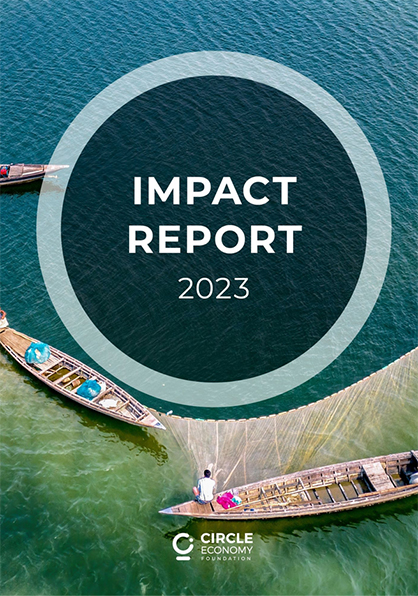
© 2023 Circle Economy Foundation


To Act, Circle Economy Foundation developed a training programme with Oxfam to build the capacity of small- and medium-sized enterprises towards a green and circular economy. The circular training model has so far been implemented across several countries: Nigeria, Egypt, Uganda, Somaliland, Kenya and Cambodia.

To Scale their work, they have finalised their spin-off, Circle Economy Consulting, and they are proud to announce that Deloitte will be its Scaling Partner. They have also been building capacity across key value chains via the UN-led SWITCH to Circular Economy Value Chains programme and the acquisition of Sustainability Games—an educational tool for teaching circular principles. Sustainability Games was implemented by plastics companies in Morocco and textiles companies in Bangladesh via SWITCH to educate and inform workers on the ground.

Zooming in on the practical outcomes of their work, they've seen their  research inform the creation of circular policies across Europe, the UK and Canada. For example, thanks to the Circle City Scan, Circular Montréal: Baseline Assessment, Montréal has released its public consultation document, ‘Towards a Montréal roadmap in the circular economy’, which will inform the creation of their future circular strategy. 


Meanwhile, in Austria, the Circularity Gap Report Austria was presented to the Ministry of Environment in 2019. Four years later, the report has contributed to the country’s recent policy changes. The Austrian Cabinet of Ministers has now adopted a National Circular Economy Strategy. Following their analysis, the comprehensive policy document aims to boost circularity from 9.7% to 18% by 2030.

Wrapping up this year, Circle Economy has empowered 30 businesses, three cities and four nations across three continents to become more circular. This contributes to the total of 150 businesses, 55 cities and 27 nations across six continents that they’ve aided over the past ten years. They’ve also trained more than 4,230 people in circular principles over the past decade.

These are just a few highlights from the Impact Report 2023. Download the full report to see how they’re making the circular economy a reality.


More News from Circle Economy

#Recycling / Circular Economy

Between 121 and 142 million people are employed in the circular economy globally, new study finds

Between 121 and 142 million people worldwide are employed in sectors that contribute to the circular economy, such as repair, recycling, second-hand trade and waste management. This represents roughly between 5 and 5.8 percent of total global employment (excluding agriculture), according to a new joint report by Circle Economy, the International Labour Organization (ILO) and the World Bank Group, in partnership with the UN Partnership for Action on Green Economy (UN-PAGE).

#Recycling / Circular Economy

Circulose welcomes Sara Diez Jauregui and Kalyan Madabhushi to its Board of Directors

Circulose is proud to announce the appointment of Sara Diez Jauregui and Kalyan Madabhushi to further strengthen its Board of Directors, following the recent appointment of Chair Helena Helmersson. These additions bring world-class expertise across the value chain: Sara offers extensive experience with leading fashion and apparel brands, while Kalyan brings a notable career at Aditya Birla Group, a global leader in cellulosic fiber production.

#Recycling / Circular Economy

Successful pilot: biodegradable plastic produced from textile waste

The 'Design for Transformation' (D4T) pilot project, led by Circle Economy and the Biomimicry Institute, has developed an innovative technology to produce bioplastics and gaseous products from textile waste. This set of technologies aims to enable companies to generate additional revenue streams from waste, whilst diverting it from landfills or incineration.

#Recycling / Circular Economy

Circle Economy and partners launch new textile 5R solutions project SOLSTICE

Launched on 28 May, 2024, the SOLSTICE project supports sustainable growth in the textile sector by raising customer awareness, enhancing recycling with new sorting methods, ensuring feedstock traceability using the Digital Product Passport, and providing data and guidelines to decision-makers. ?

More News on Sustainability

#Sustainability

Ying McGuire becomes new CEO of Cascale

Cascale today announced the appointment of Ying McGuire as Chief Executive Officer, effective June 1, 2026.

#Sustainability

VAUDE eliminates PFAS from all products

PFAS (per- and polyfluoroalkyl substances) are now detectable worldwide – in drinking water, soil and the human body. These so-called “forever chemicals” are considered hazardous to health and potentially carcinogenic, as they do not break down and remain in the environment permanently. Despite these risks, PFAS are still used in a wide range of products. More than 15 years ago, VAUDE made a strategic decision to gradually eliminate PFAS from all product categories.

#Sustainability

OEKO-TEX® chooses TextileGenesis to advance digital traceability for organic cotton

OEKO-TEX® today announced a full collaboration with TextileGenesis, a Lectra company, to digitally trace and authenticate organic cotton, strengthening fraud prevention across the supply chain. This announcement follows a successful pilot and brings together OEKO-TEX®’s certification expertise and closed testing system with TextileGenesis’ digital traceability platform to deliver a secure, end-to-end solution for managing certified organic cotton flows.

#Europe

ICAC to support European Commission on pending PEF legislation

The International Cotton Advisory Committee (ICAC) is proud to announce that it has been included as a member of the European Commission’s Technical Advisory Board (TAB) on the Product Environmental Footprint methodology. The Commission developed the Product Environmental Footprint (PEF) to assess and communicate the life cycle environmental performance of products and organizations.

Latest News

#Recycling / Circular Economy

Circulose restarts commercial-scale production at Ortviken plant in Sundsvall

Circulose today announced the restart of its commercial-scale production plant at Ortviken in Sundsvall, Sweden, marking a significant step in scaling next-generation materials for the global fashion industry. The company plans to resume production of CIRCULOSE®, a recycled pulp made entirely from discarded cotton textiles, in the fourth quarter of 2026.

#Textiles & Apparel / Garment

VIATT 2026 to debut German Pavilion, strengthening European participation alongside key Asian textile hubs

Vietnam’s textile and garment sector continues to be a major contributor to the country’s economic growth, with export revenues expected to reach USD 46 billion in 2025, a 5.6% increase from 2024 . From 26 – 28 February, the Vietnam International Trade Fair for Apparel, Textiles and Textile Technologies (VIATT) is set to contribute to economic growth opportunities by accelerating digital transformation and green transition across the entire textile value chain. The upcoming edition will respond to the rising demand for advanced technologies and sustainable materials with the introduction of the German Pavilion, alongside strong exhibitor participation from key Asian sectors, as well as several high-profile fringe events.

#Technical Textiles

Sustainable, lightweight, and sound absorbing: Polyester-based front trunk solution for BEVs

As car manufacturers look to further reduce their carbon footprint, Autoneum has developed an innovative front trunk solution for battery electric vehicles (BEVs), made entirely from polyester-based textile. The Ultra-Silent Frunk offers significant weight reduction, improved acoustic and thermal insulation, and uses up to 70 percent recycled material, supporting sustainable and efficient vehicle design. Autoneum, global technology leader in acoustic and thermal management for vehicles, has already received orders for the new frunk from three major OEMs in Asia and Europe to be built in three BEV models. Series production for two BEVs has been underway in China and Germany since last year.

#Raw Materials

Modern testing methods for raw cotton

The 38th International Cotton Conference Bremen will take place from 25 to 27 March 2026 at the Bremen Parliament. This conference has traditionally stood for in-depth expertise and international exchange. The program will focus on technical innovations, market trends, and regulatory frameworks across the entire value chain – from agriculture to the circular economy. With high-profile speakers, the conference is regarded as the key meeting point for the global cotton industry. Today’s focus: Cotton quality and testing methods.

TOP