[pageLogInLogOut]

#Sustainability

Groundbreaking architectural projects using natural fibres

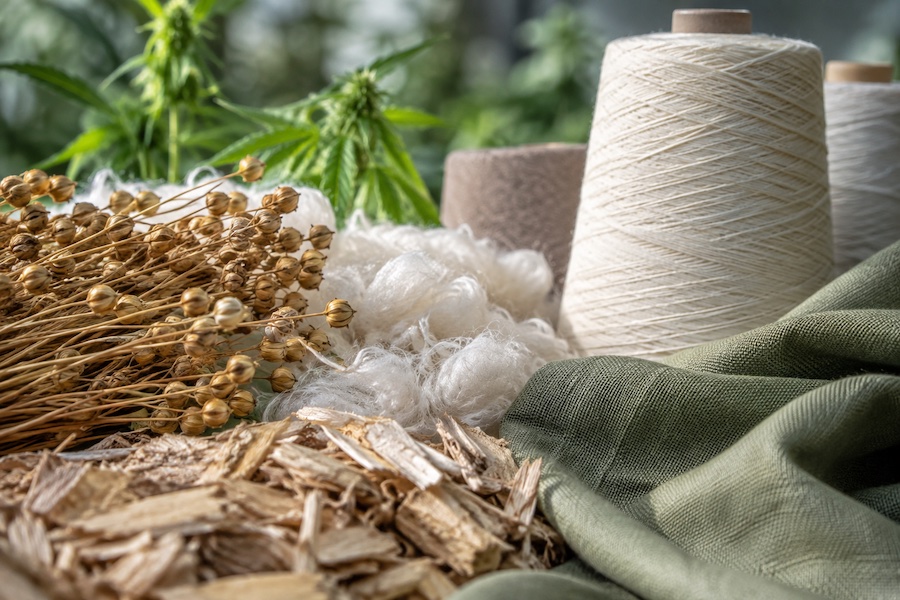
Paris, May 19 2025 : The Alliance for European Flax-Linen & Hemp is proud to spotlight a growing wave of innovative architectural and civil engineering applications featuring flax and hemp fibres. As the global construction industry turns toward sustainable solutions, flax and hemp are emerging as high-performance, low-impact alternatives for a new generation of bio-based architecture.

Pioneering Structural Applications

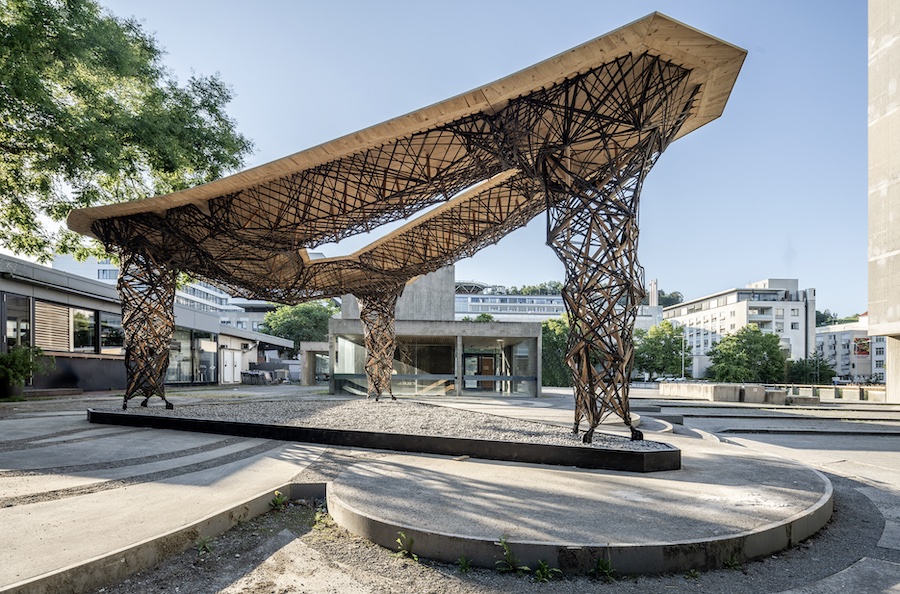
For the first time, flax is stepping beyond interior and insulation use to form key structural elements in buildings. At the forefront of this transformation is the University of Stuttgart’s ITECH Research Pavilion 2024 program in Germany. Two extraordinary lightweight structures have been created using filament-wound flax fibres, demonstrating the material’s strength and design flexibility. The main pavilion, a semi-permanent structure, features 20 flax fibre roof beams, crafted from Terre de Lin’s 100 Tex rovings and industrially processed by HA-CO Carbon GmbH. A second, smaller pavilion incorporates co-wound wood and Safilin’s 200 Tex flax fibres in its columns and roof structure. Both projects highlight coreless robotic winding technologies and deliver striking examples of sustainable construction methods.

Sustainable Façade Innovation

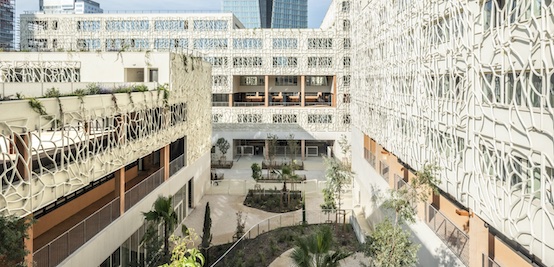
Flax is also proving its value in cladding and façade systems. French manufacturer Temca recently completed 880 lightweight shading panels using Bcomp’s ampliTex™ flax fibre material for the Cité Scolaire Internationale Jacques Chirac business school in Marseille. Designed by renowned architects Rudy Ricciotti and Roland Carta for Bouygues Bâtiment Sud-Est, the system uses RTM-moulded ampliTex™ combined with UV-resistant gelcoat and fire-rated resin, providing a nature-inspired, energy-efficient solution with drastically reduced weight and hardware requirements compared to traditional materials. Meanwhile, Dutch composite innovator NPSP continues its work integrating bio-based materials in public infrastructure. In collaboration with Alliance member Procotex and material partner Nabasco, NPSP has delivered striking façades across Europe, including the vibrant green cladding of Amsterdam’s NEMO Science Museum, designed by Renzo Piano. Nabasco® Natural panels offer both design freedom and top fire safety standards, paving the way for bio-based façades in modern urban design.

Civil Engineering and Urban Greening

DEMGY, a leader in recyclable moulded composites, has partnered with green roof experts PLANTIKA to introduce FLAXCOMP® sandwich base panels for rooftop garden modules. Replacing aluminum with perforated flax composites, the solution enhances water drainage and aeration while reducing environmental impact. If successful, the trial may lead to full flax composite construction in future urban greening projects, marking a critical advance toward circular building solutions.

“These projects reflect the growing ambition of our industry to deliver carbon-smart, beautiful, and high-performing structures using natural European fibres,” said Bruno Pech, Innovation Project Manager.

The Alliance for European Flax Linen and Hemp continues to support its members and partners in advancing bio-based innovation across architecture and civil engineering.
More News from Alliance of European Flax-Linen & Hemp

#Composites

Alliance for European Flax-Linen & Hemp expands bio-materials presence at JEC World 2026

The Alliance for European Flax-Linen & Hemp is pleased to announce its participation at JEC World 2026, featuring a significantly expanded presence and an enhanced offering for the global composites industry.

#Natural Fibers

Alliance for European Flax-Linen & Hemp expands technical capabilities with addition of CIRCULAR STRUCTURES

The Alliance for European Flax-Linen & Hemp is pleased to welcome CIRCULAR STRUCTURES, a Bremen-based platform for sustainable material development and product incubation, to its Technical Section. This addition further enhances the Alliance’s mission to accelerate the industrial adoption of European-grown flax and hemp fibres in high-performance composite applications.

#Composites

Alliance for European Flax-Linen & Hemp host Natural Fibre Composites Village at JEC World 2025

The Alliance for European Flax-Linen & Hemp will host a Natural Fibre Village at JEC World 2025 that will showcase the activities of the Alliance and nine of its members in a 250m2 area dedicated to natural fibre composites. Partnering with the JEC Group, the Alliance will lead the European flax and hemp industry exhibit where Bcomp, Demgy, Depestele, Eco-Technilin, Flipts en Dobbels, Libeco, Norafin, Safilin and Terre de Lin and, for the first time, Linificio e Canapificio Nazionale SRL, will all exhibit a wide range of flax and hemp raw materials and composite products.

#Natural Fibers

2025 is the year of acceleration for Alliance for European Flax-Linen & Hemp

The reference agro-industrial organisation for the sector, is accelerating its sustainable transformation trajectory.

More News on Sustainability

#Natural Fibers

Global Standard gGmbH launches second public consultation for GRTS Draft 2 for the textile industry (1–30 April 2026)

Global Standard gGmbH is pleased to announce the release of Draft 2 of the Global Responsible Textile Standard (GRTS) for its second public consultation. The consultation will be open from 1 April 2026 to 30 April 2026, inviting stakeholders across the textile and apparel value chain to provide input and contribute to the further development of this new Standard.

#Sustainability

Practical toolkit to drive coordinated climate action launched

An open-access workshop toolkit enables brands, suppliers, policymakers and investors across the textile industry to apply the System Map in their own work, identifying leverage points to halve emissions and enable a just transition.

#Raw Materials

Textile Exchange publishes cotton Life Cycle Assessment study to strengthen impact data

Textile Exchange has published the first in a series of seven Life Cycle Assessment (LCA) studies designed to improve the quality and robustness of environmental impact data for raw material production across the fashion, textile, and apparel industry. The first LCA study focuses on cotton and addresses critical data gaps and methodology variability through new high-quality data across key producing countries. The study includes organic, regenerative, recycled, and country averages for conventional cotton production systems, providing a clearer picture of the associated environmental impact.

#Sustainability

Experts publish APAC policy priorities

Cascale today announced the publication of its APAC Policy Priorities Paper, developed by the Asia-Pacific (APAC) Policy Member Expert Team (MET) to identify key regional sustainability challenges and provide practical, aligned recommendations for policymakers and industry stakeholders across Asia-Pacific.

Latest News

#Raw Materials

New study shows low environmental impact by Cotton made in Africa Organic Cotton from Tanzania

Today, the Aid by Trade Foundation (AbTF) is announcing the results of a comprehensive life-cycle analysis (LCA) for cotton produced in Tanzania under the Cotton made in Africa Organic (CmiA Organic) standard. The study emphasises the small ecological footprint of CmiA Organic verified cotton. This can largely be traced back to the absence of synthetic pesticides, artificial fertilisers, and artificial irrigation. Consequently, CmiA Organic cotton can help the textile industry meet regulatory requirements as well as science-based targets. The results also show that the consequences of climate change threaten the livelihoods of these cotton farmers, even though the type of agriculture they practise barely contributes to climate change.

#Raw Materials

Better Cotton Initiative strengthens regenerative focus in standard update

The Better Cotton Initiative (BCI) has strengthened the regenerative focus of its field-level standard with the launch of a new version of its Principles & Criteria (P&C), which marks the next step in the organisation’s journey to becoming a regenerative standards system.

#Man-Made Fibers

Selenis and Kintra Fibers partner to scale 100% bio-based synthetic fiber technology

Selenis, a leading global specialty polyester manufacturer, today announced a strategic manufacturing partnership with materials science company Kintra Fibers to scale Kintra’s patented fiber-grade PBS resin - a 100% bio-based and biodegradable material designed for textile applications.

#Functional Fabrics

PERFORMANCE DAYS proves its relevance as the industry’s key meeting point

Held on March 18–19, 2026, PERFORMANCE DAYS once again confirmed its position as a leading international platform for functional textiles. A total of 3.366 trade visitors and around 560 exhibitors gathered in Munich, with the event already kicking off successfully on DAY 0, which received highly positive feedback for its interactive format. Despite challenging conditions caused by the public transport strike in Munich, the event saw strong attendance and a consistently high level of activity across both exhibition days.

TOP