[pageLogInLogOut]

#Sustainability

Textile Exchange Conference 2025: Setting the course for systemic change

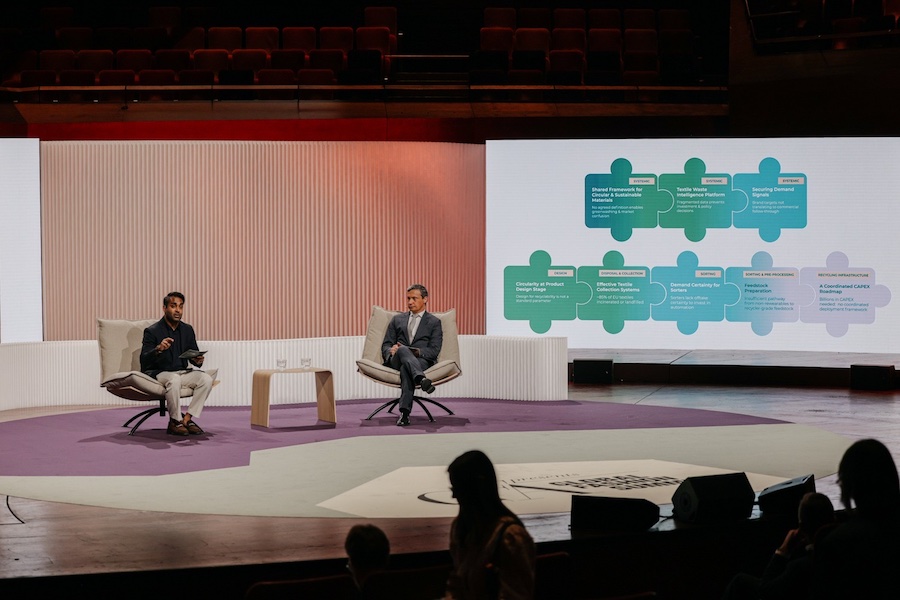
The 2025 Textile Exchange Conference brought together more than 1,600 participants on site in Lisbon and online, marking two days of intense dialogue on the future of sustainable and regenerative material systems. With a focus on collaboration, data-driven progress, and systemic transformation, the sessions highlighted both the challenges and the opportunities in building a truly resilient textile industry.


Day 1: From preferred materials to preferred systems

The opening day set the tone for the week, centering on how the industry can transition from isolated material improvements to holistic, regenerative production systems. In the morning plenary, Textile Exchange CEO Claire Bergkamp and Jonathan Hall, Managing Partner at Kantar’s Sustainable Transformation Practice, outlined the state of progress and the scale of transformation still required.

“When we dig beneath the noise, it’s clear consumers still care,” Hall said, citing Kantar data showing that 67% of people view environmentalism as extremely important in light of increasingly visible climate impacts.

Sessions throughout the day emphasized that systemic change requires measurable data, regional context, and shared accountability. Speakers called for more collaborative investment, outcome-based measurement, and tools that make impact data accessible from farm to brand level.

The afternoon plenary featured Deb Chachra, author of How Infrastructure Works, and Ashley Gill, Chief Standards and Strategy Officer at Textile Exchange, who presented the organization’s five-year strategy for accelerating impact through preferred production systems.

“Our goal is to build thriving landscapes, resilient communities, and a more sustainable future,” Gill said, introducing the new Materials Matter System. The initiative will integrate existing standards—including those for wool, mohair, alpaca, recycled materials, and organic cotton—into a unified framework, maintaining traceability while aligning the sector around shared sustainability outcomes.

Day 2: Overcoming barriers and enabling change

The second day explored the economic, policy, and social enablers needed to scale preferred production systems and strengthen resilience across the value chain.

In the morning plenary, Tariq Fancy, Lecturer at Stanford Graduate School of Business and former Chief Investment Officer for Sustainable Investing at BlackRock, challenged the audience to focus on long-term, practical solutions.

“Real progress comes from the boring but brilliant ideas—those that increase efficiency, reduce waste, and make business sense,” Fancy said.

The afternoon session, moderated by Robin Mellery-Pratt (Matter), brought together John Roberts, CEO of Australian Wool Innovation, and Vanessa Barboni Hellik, CEO of Another Tomorrow. Their discussion centered on building resilience through brand–producer collaboration and long-term supply partnerships to support farmers facing volatility.

Common threads: Data, finance, and verification

Across both days, five cross-cutting priorities emerged:

+++ Economic alignment – Shared investment models and long-term contracts are essential to make regenerative systems financially viable, especially for producers at Tier 4.

+++ Regulatory engagement – As EU textile policy evolves, proactive participation and alignment with circular standards will be crucial.

+++ Landscape-level action – Context-specific approaches are needed to link climate, nature, and social goals with material sourcing.

+++ Verification and transparency – Credible data and adaptable verification frameworks are vital to scaling impact and meeting new legislative demands.

+++ Internal enablers – True transformation requires engaging decision-makers across legal, finance, and marketing teams to embed sustainability into business strategy.

Looking ahead

As the Textile Exchange Conference 2025 continues, a clear message resonates: achieving a regenerative and equitable textile industry will demand collaboration across the entire value chain—supported by sound data, transparent standards, and shared responsibility.

More News from Textile Exchange

More News on Sustainability

#Nonwovens

EDANA wraps up its Sustainability & Policy Forum 2025: Uniting the industry and EU policymakers to navigate the future of nonwovens

Against a backdrop of rapidly evolving environmental legislation, the EDANA Sustainability & Policy Forum 2025 concluded the past week in Brussels, marking a step forward in the dialogue between the nonwovens industry and European policymakers. Held from 9-10 December at the historic Residence Palace, the two-day event successfully brought together business leaders, sustainability experts, and EU officials to address the dual challenges of circularity and industrial competitiveness.

#Sustainability

YKK recognized with Top ‘A’ rating by CDP for climate change leadership for third consecutive year

YKK Corporation announced its achievement of the highest “A List” rating in the 2025 Climate Change survey conducted by the global environmental disclosure nonprofit, CDP . This marks the third consecutive year YKK has received this prestigious recognition.

#Weaving

Itema announces strategic partnership with Ivy Decarb to accelerate decarbonization in weaving process

Itema is pleased to announce the strategic partnership with Ivy Decarb, the digital platform helping textile companies measure and reduce their carbon footprint.

#Man-Made Fibers

Teijin Carbon Europe receives EcoVadis Silver status – ranked among the top 15% of evaluated companies

Teijin Carbon Europe (TCE) has been recognized for its sustainability performance and has been awarded the EcoVadis Silver Medal in the latest assessment. In its first-ever EcoVadis evaluation, the company achieved a notable 72 out of 100 points, ranking among the top 15% of all companies evaluated worldwide, within the “Manufacture of Man-Made Fibres” category.

Latest News

#People

Happy Holidays!

Dear reader, the year 2025 is drawing to a close. We are entering what we hope will be a peaceful holiday season, spending time with our families and taking a moment to pause and reflect. We hope we have been able to support you once again this year with relevant news and articles, and we look forward to surprising you with many innovations in the coming year. Enjoy the festive season, stay healthy, and we wish you a happy and joyful holiday season.

#Weaving

Lindauer Dornier announces leadership transition in weaving machine business

After more than ten successful years at Lindauer DORNIER GmbH, Mr Wolfgang Schöffl will leave the family-owned company at the end of the year to enter well-deserved retirement.

#Heimtextil 2026

Texpertise Focus AI: Messe Frankfurt puts Artificial Intelligence centre stage at its international textile and apparel trade fairs

Under the banner 'Texpertise Focus AI, Messe Frankfurt will place a strong emphasis on Artificial Intelligence (AI) across its international textile and apparel trade fairs from 2026 onwards, setting a future-shaping signal for the industry. The initiative highlights the responsible use of AI along the entire textile value chain, from fibre production to the point of sale. The programme will launch at Heimtextil in Frankfurt in January 2026.

#Technical Textiles

Autoneum and Polestar set new benchmarks for passenger experience and sustainability

As the global market leader in sustainable acoustic and thermal management, Autoneum is a key supplier of interior and exterior components for the highly anticipated Polestar 5 model. The successful collaboration between Autoneum and Polestar marks a significant milestone in sustainable automotive engineering: the electric grand tourer sports car features several innovations in lightweight, fully recyclable polyester-based components that ensure a superior driving experience. Polestar 5 was revealed at the IAA Mobility 2025 in Munich and is available in 24 markets.

TOP