#Sustainability
Key takeaways from the 2025 Textile Exchange conference
This year, Textile Exchange brought together more than 1,600 attendees, across 30 sessions collectively led by over 70 speakers from across the fashion and apparel industries, as well as finance, academia and engineering. The conference featured a mix of plenaries, facilitated breakouts, and collective action workshops, providing participants with opportunities to learn, collaborate, and shape solutions together.
To ensure a diversity of perspectives, Textile Exchange was proud to support Tier 4 producer voices from every continent, with several receiving sponsorship to attend and contribute directly to the conversation shaping the future of our industry.
As part of the event, Textile Exchange celebrated outstanding leadership and innovation at the Climate and Nature Impact Awards, held at Estufa Fria. The winners included:
+++ Textile-to-Textile Partnership Award: Recover and Intradeco
+++ Regenerative Land Leadership Award: James Brodie
+++ Collaboration in Action Award: Victoria’s Secret and Alabama farm partners,
+++ Ryan Young Climate Leader Award: Pablo Borelli
The agenda
Under the theme of Shifting Landscapes, this year’s agenda aimed to drive home the urgency for our industry to rapidly adapt to changing climates, mitigate risk and unlock opportunities for systems transformation.
Day one set the tone for the week ahead, focusing on setting the direction of travel toward regenerative, and equitable material production systems. Through sessions discussing evolving science and on-the-ground insights, the day back-casted from our desired future to map out what transition looks like in practice.
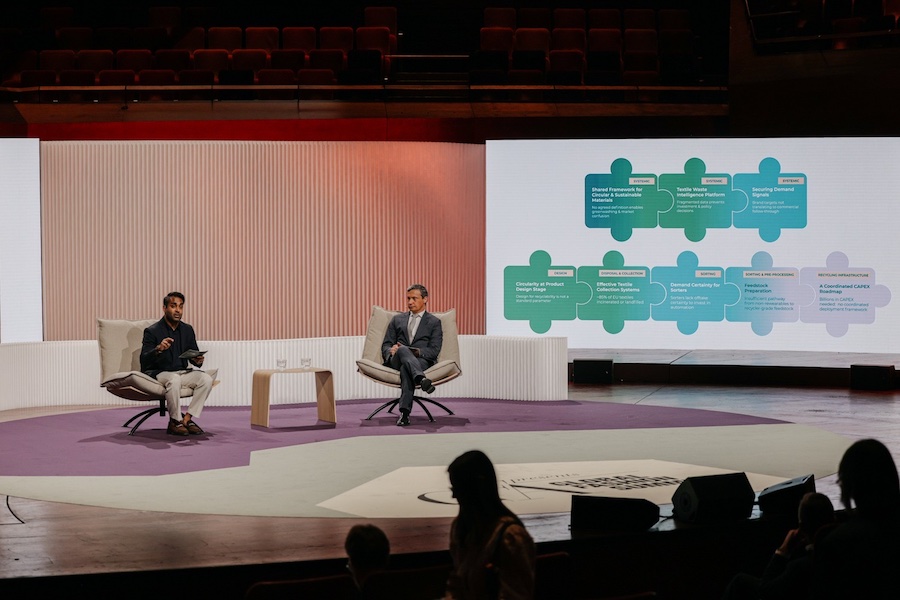
The opening plenary was led by Claire Bergkamp, CEO of Textile Exchange, and Jonathan Hall, Managing Partner at Kantar’s Sustainable Transformation Practices. Drawing on insights from Textile Exchange’s Materials Market Report and Materials Benchmark, impacts, volume, trend marketing analytics, and consumer dynamics, they set the stage with a clear-eyed view of where the sector stands today, acknowledging the progress made and the scale of transformation that is still needed.
The afternoon plenary explored what it will take to drive meaningful change over the next five years. Deb Chachra, author of How Infrastructure Works, and Ashley Gill, Chief Standards and Strategy Officer at Textile Exchange reflected on Textile Exchange’s theory of change and offered powerful insights into the structural levers needed to unlock large-scale transformation.
Key takeaways from the day included:
- From preferred materials to preferred systems: A panel representing farmers and material producers explored how shifting focus from preferred materials to preferred production systems can enable a more outcomes-driven, holistic approach. This will allow the industry to set a clear vision and pathways toward resilient, regenerative, and circular production practices, without relying on rigid material classifications.
- Impact data and the way it’s collected must be context specific and accessible: High-quality, transparent, and region-specific data is critical for setting realistic goals and enabling systemic change. Tools like Life Cycle Assessment (LCA) must be applied thoughtfully, with awareness of limitations. Making this data accessible to all stakeholders, from farmers through to brands, is critical to driving change we can measure. Read our Ensuring Integrity in the Use of Life Cycle Assessment Data report for more information.
- Progress demands collaboration and systems thinking: Achieving goals requires shared investment, cross-supply-chain collaboration, and aligned sourcing decisions. When the supply chain speaks a common language, alignment and co-development can create solutions that enable transformation at scale.
- Economic and environmental models must align: Reimagining growth doesn’t mean more volume—it means shifting how we grow. Companies can remain profitable while reducing virgin material use by focusing on higher-value products, reverse logistics, and circular business models. Find out more about reimagining growth in our Reimagining Growth Landscape Analysis report.
- Standards and outcome measurement drive accountability and progress: Standards are not just verification tools – they’re frameworks for strategy, collaboration, and shared learning. Measuring outcomes must be relevant, transparent, and integrated into continuous improvement cycles.
- Textile Exchange announced its new partnership approach as part of the Materials Matter System, and confirmed that it will be published on December 12, 2025, effective on December 31, 2026, and mandatory on December 31, 2027.
Day two was dedicated to exploring the interventions and enabling environments that can help the industry make progress. This included sessions on overcoming economic barriers to change, the impact of policy regulation, and why collaboration with local stakeholders is essential to design effective, landscape-level interventions.
In the morning plenary, Tariq Fancy, lecturer in management at Stanford University Graduate School of Business, and former Chief Investment Officer for Sustainable Investing at BlackRock reflected that to make real progress toward more sustainable systems, we much think long term and look for the “boring but brilliant” ideas that can increase efficiency.
The afternoon plenary tackled the growing uncertainty for brands in navigating the geopolitical and economic landscape. Robin Mellery-Pratt, Founding Partner of Matter, John Roberts, CEO of Australian Wool Innovation, and Vanessa Barboni Hellik, CEO of Another Tomorrow, shared practical insights for building resilience through collaboration, and the need to support farmers through volatility.
Insights from the day included:
- Addressing economic barriers is essential to scaling preferred production systems: Economic barriers like high upfront costs, uneven risk, and limited access to finance for producers are slowing the transition needed to close the supply-demand gap, meet climate and nature goals, and safeguard livelihoods. Collective financial responsibility, through long-term contracts, blended finance, and shared investment models, is vital to ease pressure on producers and ensure an equitable shift, particularly at Tier 4 of the supply chain.
- Regulation is rising and industry must engage, adapt, and lead: The textile sector is increasingly subject to tighter regulation, particularly within the EU. In this rapidly changing landscape, proactive policy engagement, close monitoring of legislative developments, and advocacy for standards that enable circular systems are becoming essential business strategies. Textile Exchange is actively involved in informing EU policy, particularly through the Policy Hub, on initiatives affecting fiber content targets, certification schemes, and Tier 4 supply chain dynamics. Read more about how new EU policy will affect the industry in this explainer.
- Landscape-level action requires context-specific insight and collaboration: Delivering impact for climate, nature, people, and animals starts with identifying which materials offer the most potential—and where. Collaboration with local stakeholders is essential to design effective, landscape-level interventions. Find out how Textile Exchange’s Regenerative Agriculture Outcome Framework can help the industry align on measurable outcomes for assessing the holistic impacts of regenerative practices, while allowing for flexibility depending on context.
- Best practices gain power when they’re verified: Verification is essential for scaling preferred production systems – it strengthens trust and transparency throughout the supply chain, supports credible sustainability claims, and helps stakeholders meet evolving legislative requirements. However, verification must be adaptable, with no one-size-fits-all approach.
To accelerate transition, we must reach the decision makers: Bridging the gap between sustainability goals and actual progress requires more effective engagement with decision-makers across businesses. A successful approach requires looking at both what’s inside a supply chain and the external factors that influence it. Cross-departmental collaboration and an understanding of the unique priorities of legal, finance and marketing teams are key.
The final day of sessions focused on advancing landscape-level transformation that accounts for complexity, responds to lived realities, and delivers impact across climate, nature, and livelihoods.
The day opened with a conversation between Chris Denson, founder of Visionology, Patrik Frisk, CEO of Reju, and Peter Majeranowski, CEO of Circ. Together, they explored how we’re at a watershed moment for innovation in textile-to-textile recycling. However, to fully unlock the potential of innovative technology it needs to be paired with upstream innovation and the right policies while creating an ecosystem that can efficiently collect and sort textiles.
The final plenary brought the week to a close by weaving together key insights and lessons from across the conference. Textile Exchange’s leadership team reflected on recurring themes, including the need for systemic change that makes economic sense—without losing sight of the science or the human element.
Key insights from the day included:
- Hotspot analysis is the entry point for landscape-level action: Identifying environmental and social “hotspots” within supply chains is a crucial first step toward implementing landscape-level solutions and enabling nature-positive outcomes on a larger scale. By integrating science into decision-making and pinpointing these areas early, businesses can align sustainability strategies with real-world conditions.
- Collaboration is essential for scalable, context-specific solutions: Effective landscape-level action depends on inclusive, participatory approaches. When it comes to recycling, this includes the collectors and sorters on the ground, who could offer fresh insights from their perspective of interacting with the materials on a daily basis. These methods move beyond one-size-fits-all models, ensuring interventions are both contextually relevant and impact-driven
- Equitable economic models at Tier 4 are vital for long-term supply chain resilience: Embedding equity at the raw material level helps build resilient landscapes and supply chains and ensures that those most connected to the realities on the ground are central to decision-making and benefit-sharing, simultaneously helping to foresee and prevent any unintended consequences that could come with changing the status quo.
- Data breakthroughs have been made—now it’s time to scale: While real progress has been made in the awareness of data’s importance and the collection of both reliable traceability and impact data, the industry continues to face traceability challenges such as fragmented systems, inconsistent data quality, and limited supplier capacity to meet new demands. We now need harmonized frameworks and clearly defined roles for tech providers, regulators, and standards bodies to scale effective data solutions across the supply chain.
Reflecting on where we stand and where we are headed, Claire Bergkamp, CEO of Textile Exchange said:
“We are dealing with a lot of uncertainty, but we are also seeing a lot of resilience in that uncertainty. We are seeing optimism that is truly grounded in the work that is happening on the ground, in the farms, in the facilities, in the communities that drive this change and deal with these realities day in and day out.”